


 Francais
 Deutsch
 Italiano
Refine Your Search
Foggia Italy 1944 stock footage and images
- Showing 2377 to 2382 of 8000 results more
more Hide
Hide
Kennedy and Johnson speak about peaceful aims of the United States in 1963 during the Cold War.
"To keep the peace" about need for peace, during Cold War. Expansive farm field of wheat waving in breeze under a sunny to partly cloudy sky in the United States. Wide shot of ocean waters and sun breaking through low clouds near dawn or dusk. President John F Kennedy delivering a speech on peace and nuclear testing, on July 2, 1963, in Naples Italy at NATO headquarters. Kennedy says, "The purpose of our military strength is peace. The purpose of our partnership is peace. So our negotiations for an end to nuclear tests and our opposition to nuclear dispersal are fully consistent with our attention to defense--these are all complementary parts of a single strategy for peace." Shortly after President Kennedy's death, President Lyndon B Johnson addresses a joint session of Congress on November 27, 1963. Shows segment of speech where President Johnson says, "We have proved that we are a good and reliable friend to those who seek peace and freedom. We have shown that we can also be a formidable foe to those who reject the path of peace and those who seek to impose upon us or our allies the yoke of tyranny."
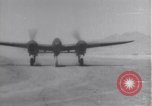
USAAF P-38 aircraft heading to Sicily on bombing mission, from North Africa, in World War II
P-38, of the U.S.Army Air Forces 14th Fighter Group, raises dust as it taxis close to the camera on Telergma airfield in Algeria, North Africa. Several 3-plane flights of P-38s take off, join up in formations, and fly overhead. A series of views, from inside a P-38, of others in formation as they fly over North African territory en route on bombing mission to Sicily, Italy, during World War 2.
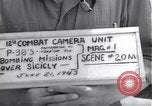
P-38 aircraft of the U.S. Army Air Forces 14th Fighter Group fly various formations over Telergma airfield in Algeria, during World War II
Cameraman slate notes that subject matter deals with bombing missions over Sicily, Italy, during World War 2. View from ground as two flights of four P-38 aircraft, from the USAAF 14th Fighter Group, fly overhead in formation at their base, Telergma airfield in Algeria. Then more are seen flying in vertical stacked formation over the field. Two land side-by-side on dusty runway. A "V" formation of P-38s flies overhead. The formation comes in over the field and individual P-38s peel off and circle to land. P-38s buzz the field in pairs, and then in flights of four.
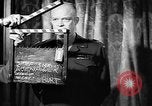
U.S. Army General Dwight Eisenhower delivers a speech on the V-E Day in Paris, France.
U.S. Army General Dwight Eisenhower speaks on the V-E day in Paris, France during World War II. General Eisenhower delivers a speech in Paris on the Victory in Europe Day. The General states that he has the proud privilege of speaking for the fighting men in his theater who conquered Western Europe and destroyed more men than they themselves possessed. The Allies selected Germany as their first object because it was the one place that all the Allies could bring their weight to bear. General Eisenhower pays his tribute to the Soviet Russian Army, the Allied Forces in Italy, the French, the British and the Americans on the Western Front and to GI Joe and his counterparts whom he says were the real heroes of the war.
Mob uprisings against Fascists in Europe, during the end of World War II. The Third Moscow Conference of the Allied occupying powers. The Belsen trials.
A mob, seeking revenge against Fascist leaders, fills a city square. They pound on steel gates of a government building. Soldiers and police attempt to protect various persons from the mobs. Others are unprotected and suffer beatings and death. Bodies of Benito Mussolini and his Mistress Clara Petacci are seen hung upside down by Italian Partisans in Milan, Italy, on 28 April 1945. Scene shifts to image of postwar occupying powers, United States, Soviet Union, and Great Britain, whose flags are displayed in the center of a conference table during the Third Moscow Conference. Principals signing agreements, in November, 1943, providing, among other things, for lawful and orderly trials of war criminals, following World War 2. Seen signing are: Soviet Foreign Minister Vyacheslav Mikhailovich Molotov; U.S. Secretary of State, Cordell Hull; and British foreign Secretary, Sir Anthony Eden. View of General Dwight D. Eisenhower, leading a contingent of American wartime Generals on a mission to document Nazi atrocities at liberated German concentration camps. Closeup of a man directing local German citizens who were forced to observe the horrors of the camp. Closeup of an oven used to dispose of bodies of victims. Dead bodies of concentration camp victims strewn in a heap. A room filled with documentary evidence to be analyzed and used in war crimes trials. the body of German General Admiral Hans-Georg von Friedeburg , and of Heinrich Himmler, both of whom committed suicide. A hand holding cyanide capsules. Body of Leipzig City Council deputy mayor Dr. Ernst Kurt Lisso slumped over his desk, following suicide. Body of his daughter, Regina Lisso also a suicide victim. Nazi war criminals being rounded up by Allied military.One being carried on a stretcher. Another, a German officer, is taken into custody. Next, Josef Kramer, the Commandant of Bergen-Belsen concentration camp is seen under guard by a British soldier. British soldiers guarding the court room of the second Belsen trial, convened by the Allied occupational forces, in the Gymnasium building of Luneburg. View of the courtroom with defendants wearing numbers. Closeup of numbers 1 and 2, Josef Kramer, and Fritz Klein, respectively. View of Allied military officers sitting in judgment. Closeups of women defendants, including Irma Grese (number 9) and Elisabeth Volkenrath (number 11). Camera pans around the courtroom.
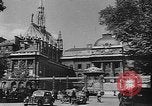
Politicians and numerous war crime trials in Europe after World War I and II.
Events and various war crime trials after World War I and II. Exterior view of Palais de Justice de Paris with some cars in front, in Paris, France. Courtroom views: Pietro Caruso, Fascist of Italy is seen in court. Next is Norwegian Army officer Vidkun Quisling in court. French General Henri-Philippe Petain in court in Paris. French politician Pierre Laval speaking in a court room. Views of lawyers and prosecutors speaking forcefully in courtrooms. Nazi Hermann Goering speaking in an outdoor setting. Nazi generals being arrested at end of World War II including Field Marshal von Rundstedt. Next scene shows Germany's Kaiser Wilhelm II and General Staff during World War I. Next is Briitsh Prime Minister Henry Lloyd George, after World War I. Kaiser Wilhelm II, residing in Doorn, Netherlands, after World War 1. With his good hand, the Kaiser throws wood into a pile. A post-war aerial view of Nuremberg, Germany with massive bomb damage and destruction in the city. The court house of Nuremberg. U.S. chief prosecutor Robert Jackson walking outside the Nuremberg courthouse with a military officer on his right and a woman on his left. Next scene is a dramatization of a British Court scene, with justices wearing powdered wigs. Elevated, wide view of Red Square in Moscow, Russia, Soviet Union. View of a Soviet court in session, and civilian viewers of the trial seen in upper gallery viewing seats.
CRITICALPAST.COM: About Us | Contact Us | FAQs - How to Order | License Agreement | My Account | My Lightboxes | Shopping Cart | Advanced Search | Featured Collections | Website Terms & Conditions | Privacy Policy ©2026 CriticalPast LLC.
License Agreement |
Terms & Conditions |
Privacy Policy
©2026 CriticalPast LLC.