


 Francais
 Deutsch
 Italiano
Refine Your Search
Fort Oglethorpe stock footage and images
- Showing 637 to 642 of 739 results more
more Hide
Hide
Peacetime activities and contributions by the U.S. Army in the United States.
Scenes from Army Day on April 6, 1934. Secretary of War George Henry Dern, in broadcast to the nation about importance of the Army, in peacetime. Brief glimpses of the Yellowstone River lower falls and Old Faithful and Beehive geysers erupting in Yellowstone Park, Wyoming. View amongst log buildings in Reproduction of Army Fort Dearborn, at the 1933 Century of Progress Exposition in Chicago, Illinois. A pioneer wagon; Native American Indians in ceremonial regalia; antique locomotives and trains at the Exposition. Army General Leonard Wood being sworn in as the Governor General of the Philippines. Closeup of General of the Armies, John J. Pershing, America's highest ranking Military officer. Headquarters of Walter Reed Army hospital, in Washington, DC, named for U.S. Army Major Walter Reed, who confirmed that yellow fever is transmitted by mosquito. Acting on this, the U.S. was able to complete the Panama Canal. View of French dredging equipment sitting idle in the water after Yellow Fever prevented them from completing the Panama Canal. Closeup of U.S. Army General William C. Gorgas, who, in 1904, headed the Sanitary Department that controlled mosquitoes and eradicated Yellow Fever, so the Panama Canal could be finished. View of alligator in swamp near the Panama Canal. Photograph of George Washington Goethals, Chief Engineer credited with making the canal happen. Explosives employed in Panama Canal construction. Earth and rocks being loaded into open rail cars. A steamship transiting the Panama Canal. The Washington Monument; U.S. Library of Congress; and the Lincoln Memorial, cited as examples of accomplishments by U.S. Army engineers. The Wilson Dam, under construction by Army engineers, in Muscle Shoals, Alabama and system of levees being built to control the Mississippi River. The raging Mississippi River during 1927 flood. Flood victims being assisted by U.S. Army soldiers, at a tent camp, receiving food and clothing. An Army airplane flying over a forest fire. Army personnel supervising men in the Civilian Conservation Corps or CCC. Mail being loaded aboard an Army airplane, as airmail service is being opened between Washington DC and New York City. President Woodrow Wilson talking with Army pilot Major Reuben H. Fleet. Mail being loaded into the nose of an airplane. U.S. Army Douglas World Cruiser airplanes in flight, returning from their trip around the world in 1924. A pilot sitting in front seat of a Douglas O-38 airplane, pulls a fabric hood over his cockpit to practice "blind flying". View of the aircraft in flight, with instructor pilot in the open rear cockpit. Army aviators taking a camera and a rifle aboard their airplane as they prepare to leave on an aerial mapping flight. Aerial view of skyscrapers of Manhattan Island, New York City. Army Signal Corps personnel working on communications devices. A cable laying ship operating at sea, in support of the U.S. Army's Alaskan cable and telegraph system. Men loading chemicals into hoppers on Army crop dusting airplane. Several views of Army airplanes crop dusting. Glimpse of boll weevil, the target of their efforts. Closeup of Karl Connell, who as a major in the AEF, in World War I, invented a superior gas mask known as the “Connell” or “Victory” mask. A group of miners wearing gas masks enter a smoky mine entrance. The Army invented tear gas, which is shown being used to thwart a bank robbery, in a staged demonstration. Brigadier General Hugh Johnson, appointed by President Franklin Roosevelt, as head of the Great Depression era National Recovery Administration, or NRA, is seen about to give a speech. Narrator cites him as an example of U.S. Army officers who also serve the country in civilian life. Scene shifts to cadets on parade at the United States Military Academy, West Point, New York.
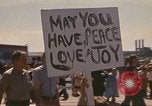
A large crowd of Americans arrive to greet Vietnamese refugees at the Harrisburg International Airport following Vietnam War.
Activities during Vietnamese refugee Operation New Life and Operation New Arrival in the United States at the end of the Vietnam War. American Airlines passenger airplane parked at the Harrisburg International Airport in Pennsylvania. '747 Luxury liner' and 'American' written on the airplane. People gather at the airport to greet the Vietnamese refugees. A child holds a board which reads: 'May you have peace, love, joy'. Another child holds a sign: 'Welcome to America'. Refugees debark from the airplane. Military personnel and civilian officials stand in the foreground. A baby in a stroller. Pennsylvania State Police stand at the airport. Refugees being interviewed at the airport. Refugees stand among the spectators. Vietnamese woman crying. Refugees board buses which will take them to Fort Indiantown Gap.
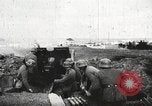
Germany attacks Poland, September 1, 1939, precipitating World War II
The German attack on Poland, at Danzig (Gdansk) triggering World War 2. Views of German artillery firing at fort and buildings across a stretch of water. German artilleryman looking through periscopic binoculars. Smoke rising from the shelling. German troops firing machine guns. German battleship Schleswig-Holstein is seen bombarding Polish army defenses at Westerplatte. (The battleship had entered the harbor and anchored off Westerplatte, in August, under the false pretense of a friendly visit.) Columns of smoke rising from fires started by the shelling. German troops advancing toward Gdynia in armored cars and trucks. A German officer on horseback. A German soldier on a motorcycle. Two German Panzer II tanks moving down a muddy slope as invasion begins. Army vehicles on wet roads and infantry making their way across a shallow streams. Infantry marching along a road. Closeups of the German soldiers as they pass the camera. Officers in a staff car. View from a height of smoke rising from fires on the ground in distance, mixing with cumulus clouds above. (Note: some English narrative begins late in the film, around TC: 00:58)
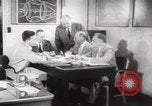
General Electric producing the first American jet airplane engine. Bell Aircraft building first U.S. jet powered airplane.
General Electric Company engineers work on designs for America's first jet aircraft engine during World War 2. In the company's plant, at Lynn, Massachusetts, machinists make parts for the engine and others assemble it. Company executives conversing about the enterprise. On April 18, 1942, the first engine produced is rolled into a test cell for operational testing. Engineers pull down the door to the test cell displaying the words: "Fort Knox." Engineers at control panel of the test cell. View into the test cell. GE Project manager, Donald F. Warner, actuates toggle switch to "on" position, and the engine ignites. Flame seen in rear of the engine. Complete change of location. View of Bell Aircraft company buildings. Bell engineers working on design of an airplane designated, XP-59A (Airacomet) to be powered by the new General Electric jet engine (later designated J-31 by the military). Views of the Bell engineering and production activities at secret facilities in Buffalo, New York. Two Bell workers expressing reservations about airplanes without propellers. A main intersection street scene in Schenectady, New York. Pedestrians walking and shopping. An F.W. Woolworth store on the corner. Copy of the Schenectady Gazette Newspaper, with headline about 500 planes raiding Berlin. A man buying a copy of the paper.
New Recreation facilities at Palisades Interstate Park in New York and new club house at Bethpage State Park
Works Progress Administration (WPA) building projects during the New Deal effort of the Great Depression: Palisades Interstate Park along the Hudson River in Fort Lee, New Jersey. A group of teenage boys hiking in the park. Groups gathered at a picnic area. Boys and girls playing outside of a new bath house building beside the park beach. View of the Perkins Memorial Tower built in honor of the former chairman of the Palisades Interstate Park Commission, and a wide view of the Palisades Interstate Park Administration Building still under construction. Scene changes to Bethpage State Park in Farmingdale New York, as 1930's cars drive in front of a newly built club house to discharge passengers. A uniformed door man stands by. Women golfers and men golfers play on the new 18 hole golf course in the park which requires no membership.
Members of the U.S. Army Air Corps 1934 Alaska Flight complete their photo-mapping mission and are ready to fly home
The U.S. Army Air Corps (USAAC) Alaska Flight of 1934. The YB-10 aircraft of the project after completing their photo-mapping of 21 thousand square miles of Alaska. The aircraft have each been named for leading Alaskan cities and are fueled and ready to fly home. View of the YB-10 flown by Expedition Commander, Lieutenant Colonel Henry Arnold, displaying painted name "City of Fairbanks" and flag containing stars of Big Dipper and Polaris (North Star). The symbol of the expedition is also painted on the fuselages of all the airplanes, consisting of a totem pole topped by an Eagle with two arrows, superimposed on a map of Alaska. Names: Anchorage, Fort Yukon, Tanana, and Kodiak, are seen painted on airplanes. Aviators of the USAAC Alaska Flight pose for a picture in front of a YB-10 aircraft. Lieutenant Colonel Henry Arnold, Commander of the expedition, is in the center of the first row of men. To his right, is a pipe-smoking officer in a campaign hat, holding a puppy Husky dog. Arnold pets the puppy