


 Francais
 Deutsch
 Italiano
Refine Your Search
Fort Oglethorpe stock footage and images
- Showing 685 to 690 of 739 results more
more Hide
Hide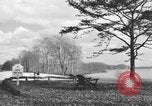
Mount Vernon Memorial Highway, and Rock Creek Park, near Washington, DC
Scenes along the Mount Vernon Memorial Highway, in Northern Virginia, near Washington,DC. Sign at section of the highway, reads: "South Fort Hunt." Automobile seen driving along the parkway that runs 15 miles from the Arlington Memorial Bridge to Mount Vernon. Views of the Potomac River which the highway parallels. Several cars in a parking area along the parkway, where sightseers enjoy the view. Sign warning drivers to slow as they approach George Washington's home at Mount Vernon. Visitors at the entrance to Mount Vernon. View of Mount Vernon mansion from the lawn on the Potomac River side. Scene shifts to Rock Creek Park in Maryland with views of the Rock Creek. Automobiles driving through the park. Views of Water falls,ducks, and an old mill with waterwheel turning. A car drives across the creek through several inches of water at a ford. An automobile approaching the Connecticut Avenue bridge over the parkway. Views of the Lincoln Memorial at Memorial Bridge.
Franklin Delano Roosevelt , Mrs. Eleanor Roosevelt, and Secretary of War, Harry H. Woodring,at the Watervliet Arsenal, New York
President Franklin Delano Roosevelt inspects an arsenal in Watervliet, New York. He arrives in a 1938 Packard open car with Mrs. Eleanor Roosevelt and Secretary of War, Harry H. Woodring. A car with Secret Service agents follows. The U.S. Army Colonel in charge greets them upon arrival. Arsenal employees lined up on either side to greet the Presidential party, which drives slowly between buildings at the arsenal as Secret Service agents run alongside the car. Secret Service agents move enthusiastic Arsenal employees back as the President's car emerges from an Arsenal building. The Presidential party remains in the car as they inspect railway guns, a navy broadside gun and 155 mm guns at the Watervliet Arsenal. An Army Captain describes details of the guns to them. The Presidential party also visits the Revolutionary War historic sites, including the Block House, on the site of Fort Neilson and the headquarters of General Benedict Arnold of American Continental Army.. View of signs identifying these sites, and a view of the the blockhouse.
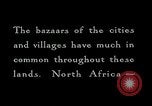
Markets, commerce, and architecture in the Muslim world of the Middle East
Opening scene shows families, including small children, walking through a bazaar in North Africa. Some riders on horseback pass them. A man in a fez and several merchants (some carrying goods on their heads) are seen. Customers converse with a seller of metal wares. The scene shifts to a bazaar in Arabia. Arabs and a few in more western dress, walk near the building. Inside, a man is seen sharpening and polishing curved knives. The next market shown is in Syria. A busy street is seen in front of the bazaar, with some people riding camels. A merchant walking with a donkey carrying a load of goods. A boy rides a small donkey. Pedestrians abound. Wooden objects are displayed in one of the stalls of the marketplace, where a carpenter is seen working on an item. Slate describes the next bazaar as located in North India (current-day Pakistan). A crowded market is seen with many textiles displayed and numerous persons walking through the area. Multistory buildings line the market. Views of Mosques in Moslem countries. The Blue Mosque (Binbirdirek, At Meydanı Cd No:10, 34122 Fatih/İstanbul, Türkiye) in Istanbul, Turkey. The Great Mosque of Muhammad Ali Pasha (Alabaster Mosque, Al Abageyah, El Khalifa, Cairo Governorate 4252360, Egypt) in the Citadel of Cairo, Egypt. A mosque with five low domes (minaret not seen) in Yemen. The Badshahi Mosque (Badshahi Mosque, Fort Rd, Walled City of Lahore, Lahore, Punjab 54000, Pakistan) in Lahore. Women carrying parcels on their heads, as they walk past massive clay structures. Closeup of a woman with several children, who run to play in yard near a clay house. A donkey stands in the yard. Examples of some large attractive clay buildings in southern Arabia.
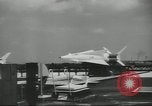
Missiles on launch pads at the Nike Hercules Missile site.Combat troops respond to practice alarm in Washington DC.
Combat troops of the Military District of Washington respond to practice alarm during Cold War period. Missiles on launch pads at the Nike Hercules Missile sites. During a practice exercise Army soldiers go underground and close a hatch as a siren blows. The missiles in Washington DC are raised to be ready for enemy attack. African American member of the Old Guard receives phone call and alerts fellow soldiers. Combat troops of the "Old Guard" at Fort Myer, get up from their beds and respond to an alarm to defend the city. The soldiers pick up their weapons and equipment. U.S. Army tanks take up positions with the Pentagon building in the background. Views of the U.S. Capitol at night.
Numerous scenes showing evolution of mechanized warfare emphasizing World War I. but including footage as late as 1934
Montage of scenes illustrating development of mechanized warfare beginning with American Expeditionary Forces (AEF) engaged in World War I. U.S. Army infantry soldiers moving out of trenches going "over the top" into "no man's land" and advancing on battlefield. U.S. troops firing Browning M1917 machine gun,1903 Springfield rifles, and Stokes mortar from trench positions. Soldiers firing mortar are wearing gas masks. AEF trucks and other vehicles ostensibly an improvement over horses, but seen having difficulty in mud. A truck pulling a large artillery gun. A German 80cm K (E) rail gun (developed in 1934) shown at the Rugenwalde Test Range in Germany. It moves along curving rails and is elevated to its maximum elevation (65 degrees). Two World War 1 rail guns firing. An American World War I Naval 14-inch rail gun firing. Allied heavy howitzers firing in World War 1 (one with gun crew in gas masks). American gunners with a French 75 field piece and caisson. French soldier advancing in no-mans-land. The Wright brothers brought warfare into the air with their Wright Flyer airplane, seen being maneuvered on the ground by U.S. Army personnel at Fort Myer, Virginia in July 1909. A De Havilland DH-4 airplane taking off in World War I. A German Fokker D.VIII aircraft in flight. Three U.S. Army Air Service Curtiss P-1B Hawk pursuit aircraft in flight, circa 1926. Aerial dogfight scene including view from behind a pilot in open cockpit biplane (from feature film, circa 1927). Brief view of Renault FT tank maneuvering in World War I. Narrative and clips shift to historical perspective of warfare, showing use of horse and chariot, starting in ancient Assyria and use of elephants in later years by Hannibal. Pictures of mounted soldiers, in the middle ages, waging war in armor, and being transported in a wagon. Shift to World War I showing British Mark IV tanks maneuvering in a field.
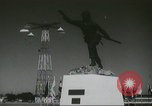
Sketches of U.S. Army Infantrymen fighting in every conflict from the Revolution to the Korean War.
Sketches of U.S. Army Infantry in the United States. 'Follow Me' statue at the U.S. Army Infantry School at Fort Benning, Georgia. The sketches depict infantrymen in various conflicts in American history, from Washington in the Revolution to combat in Korea. An infantryman holds the American flag. U.S. Army Infantry during the invasion of Africa. They fight in the Korea War.