


 Francais
 Deutsch
 Italiano
Refine Your Search
Fort Oglethorpe stock footage and images
- Showing 403 to 408 of 739 results more
more Hide
Hide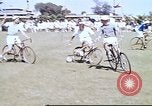
Bicycle polo matches on parade ground of Fort Stotsenburg in Philippines prior to World War II in Pacific.
Teams compete for fun in bicycle polo matches at Fort Stotsenburg in the Philippines before outbreak of World War 2 in the Pacific. Teams of men, distinguished by their costumes, play bicycle polo. Some teams wear distinctive hats. Others wear different colored hats or shirts. One teams even wears womens' dresses for its uniform. As the matches progress, bicycles are left strewn on the lawn, many with bent wheels and other damage. Spectators watch from lawn chairs and from a clubhouse on the edge of the parade grounds. A refreshment tent contains Liquor bottles on a table. A man holding a glass smiles and poses.
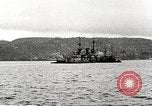
Turkish ships maneuver in the Dardanelles, Turkey. Views of shore, including fort at Hellespont. Cutters in U.S. waters
Warship in the Dardanelles, Turkey. The Turkish battle cruiser Yavuz. The Turkish fort at Hellespont. Several small working boats with dark sails. Several fast moving cutters underway in U.S. coastal waters.
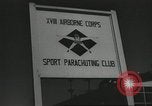
Sport Parachuting Club at Fort Bragg and the Army Parachute Team during a public demonstration
A sign identifies the "XVIII Airborne Corps Sport Parachuting Club" at Fort Bragg, North Carolina. Members of the club are seen standing at an operations counter inside the building. Each of them wears a patch with the club logo. A large open air stadium is seen where the Army Skydiving Team will perform. Paratroop members of the U.S. Army Parachute Team walking to an Army AT-19 aircraft. view of the aircraft in flight and of the pilot at the controls. Army Team members seated in the cabin of the airplane. View of large open area below with markings on the ground. Below, men sit near signal panels used to convey information to the jumpers.The first jumper signals to the copilot who signals back. The jumper goes out and free-falls. On the ground, signal panels call for various maneuvers which the trooper performs. Spectators look upwards to see the maneuvers. View from the plane, as the jumper opens his chute and steers toward a target marked on the field, which he hits perfectly. Another jumper leaves the airplane and repeats the process. View from the jumper of his altimeter. His chute opens and we see the ground target from his viewpoint. He lands.
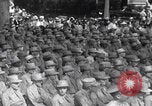
Director Oveta Culp Hobby speaks to first batch of graduating WAAC officers in Fort Des Moines (WW2)
United States Women’s Army Auxiliary Corps Director Oveta Culp Hobby speaking to first WAAC officers to graduate from Officers Candidate School in Fort Des Moines, Iowa during World War II. The Women’s Army Auxiliary Corps salute before taking their seats. Audience clapping before Director Hobby congratulates the graduates of the six-week WAAC program. “In the days and years to come, this saga will become of increasing strength to the nation. Shortly you will go on active duty, your graduation today is, in a real sense, a commencement of service” Hobby continued. “I can assure you, that you will be serving the purpose you had in mind when you volunteered as officer candidates for the Women’s Army Auxiliary Corps. I can assure you that it is a path of duty and devotion. You will serve as incorruptible witnesses for freedom. You have formed the soul of this corp. We will flourish and inspire and guide those who will follow you” Hobby concludes her speech before introducing Representative Congresswoman Edith Nourse Rogers to the graduates.
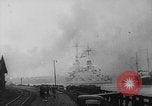
German battleship SMS Schleswig-Holstein bombards the Westerplatte fort in the port of the Polish town of Danzig (Gdansk)
Wide views of the German training ship SMS Schleswig-Holstein as it sails into the Polish port city of Danzig (Gdansk), beginning the German invasion of Poland in World War II. The Deutschland class battleship had been stationed close to the harbor since August 25th under the pretenses of a ceremonial visit, but 225 German soldiers were hiding belowdecks. In the morning of September 1st, the battleship fires on the fortified Polish munitions depot on the Westerplatte Peninsula, the first shots of World War II. Views onboard the Schleswig-Holstein of German sailors firing guns and Captain Gustav Kleikamp looking on through binoculars. After the bombardment, a white Polish surrender flag is visible flying from a building onshore. A "Westerplatte" peninsula sign and the ruined walls of the Westerplatte fort are shown from onboard a boat in the port of Danzig. German and Polish officers discuss surrender terms. German soldiers distribute cigarettes to battle-weary Polish Navy prisoners of war.
U.S. Army railroad train traveling in Fort Richardson, Alaska
A railroad train being pulled by a U.S. Army Alco S-2 locomotive, immediately followed by an Alaska Railroad ventilated refrigerator car and several other freight cars. The ground is snow-covered. A tall power pole is seen beside the track. Another take shows train stopped for a soldier, dressed in cold weather gear, who climbs aboard the locomotive. The train begins moving while he is on the steps. The freight cars in the train are seen to display Alaska Railroad labels. A flat car carries shipping containers.