


 Francais
 Deutsch
 Italiano
Refine Your Search
Fort Oglethorpe stock footage and images
- Showing 445 to 450 of 739 results more
more Hide
Hide
The Battle of Netherlands and the invasion of Belgium by the Germans during World War II.
The first phase of German assault on France and the Low Countries during World War II. An animated map depicts the German campaign to capture Liege (Luttich) and Fort Eben-Emael in Belgium. German troops invade Holland. Soldiers in trucks. Germans cross the Meuse (Maas) in boats. A collapsed bridge over the river. Armed German soldiers on bicycles cycle through a village. Soldiers drag a boat on the road. The Germans capture Fort Eben-Emael using flamethrowers. Soldiers fire guns during street fights. A soldier wades through shallow water while others cross a field amidst explosions. Bomb explosions and bomb damaged buildings. Soldiers take cover in a field. German troops cross the Albert Canal in Belgium. Troops in boats make their way across. They advance with tanks. Soldiers dig fox holes and eat. Soldiers man tanks and fire artillery. German aircraft bomb Allied positions. Massive explosion at Werk 4 fortification bunker of Fort Eben-Emael. Bomb damaged buildings and ruins. Black smoke arises due to explosions. German soldiers march Belgian and Dutch prisoners of war on a street.
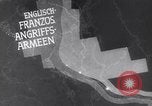
The Maginot Line and its inner workings. Allied forces marshaling to confront Nazi Germany early in World War II
Film opens with animated map showing the Maginot Line and attacks along it by Britiish and French and French Armies. Then it shows German Armies breaking through the line. Camera focuses along lines of steel post antitank barriers extending out of sight. Map illustrates fortifications in area labeled Maginot Line and shows vertical cross-section cutaway view of the Maginot Line fortifications. A French soldier is seen tending to an engine running deep inside the fortifications. French officers are seen near a large electric generator and large ducts for ventilation to the soldiers underground. French soldiers at a switch board in a communications center. French troops are seen double-time marching out from their quarters at the Maginot Line. Next they enter forts in the line. Closeup of soldiers' feet as they board narrow-gauge train to take them to their respective battle stations in the Maginot complex. View of the train carrying passengers through its tunnels. A French soldier moving large steel containers suspended on overhead trolleys. They appear to contain ammunition. A cook at work in a kitchen within the fort. French soldiers entertaining themselves, singing and clapping as one of them dances. A slate in the film reads:"Nous Vaincrons parce que nous sommes les plus forts" (We win because we are the strongest.) French troops marching to war. Animated map shows Areas under French control, including Colonial Africa, together with German-occupied areas. It shows other forces building up including those from British colonies and Canada and Australia. Closeup of French Colonial soldiers. French allied troops from various regions in the world marching. Massive parade of troops along the The Avenue des Champs-Élysées, in Paris, with the Arc de Triomphe behind them.
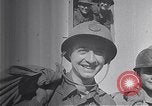
French officer inspecting machete of Senegalese trooper in North Africa.
French troops at attention in North Africa. French officer inspecting machete of Senegalese trooper. American forces camped outside bombed desert fort. Two American soldiers guarding fort. American flag atop desert fort. (World War II period).
Sevastopol falls to German and Romanian forces under command of General Erich von Manstein, in World War II
Camera pans over destruction in aftermath of German siege of Sevastopol, Crimea, in World War 2. German General Erich von Manstein, Commander of German and Romanian forces, visits with officers in the ruins of Fort Maxim Gorky. He shakes hands with several of his troops, standing in front of one of the Soviet 305mm coastal guns atop the fort. Scenes of wrecked Soviet defensive batteries. Romanian troops testing the area for buried land mines. A flag identifies location of one. Romanian soldiers removing a buried mine. Romanian officers overseeing the operation. Romanian troops moving downward from the slopes toward the city, where smoke rises from bombardment. German troops moving toward bunkers. One throws a hand grenade. German soldiers moving through the city in house-to-house operations. Soviet warships sunk in the harbor. The Nazi flag flying above damaged building overlooking the harbor. What appear to be twin towers of a Russian Church and a minaret are seen in the rubble. A German soldier lays out a Nazi flag to smooth it for raising, as smoke billows from fires behind him. Camera pans the bombed and shelled hillsides in the area. Some horses stand on the hillside. A damaged artillery field piece stands amidst rubble. A deep bomb crater is shown. Soviet prisoners walk down from the fortifications. A long line of Soviet prisoners is seen marching under guard. Narrator states they number some 90 thousand.

Story of Cuban missile crisis in the month of October.
Documentary "One Week in October." Aerial views of Russian missiles in Cuba. Columbus day parade with marching bands, Boy Scouts, troops. Brief excerpt from 1962 World Series Baseball game with New York Yankees pitcher Ralph Terry delivering to Willie Mays of the San Francisco Giants, who hits a ball to the deep left corner that is caught. March of Dimes annual poster girl. Jackie Kennedy with children of foreign diplomats. Fireworks in Uganda celebrating its independence. View of Vatican Palace and a candlelight vigil. President John Kennedy with Ahmed Ben Bella, Premier of Algeria. Ben Bella is then seen with Cuban leader Castro who receives him in Cuba. U.S. moon rocket launch. Scientists in America reviewing designs for fallout shelters during Cold War, and visiting banks, stores, and municipal buildings and garages to assess them for worthiness as bomb fallout shelters. Views of various types of fallout shelters. Food, water drums, medical and sanitation supplies bound for civic fallout shelters are seen rolling off of assembly lines and being boxed. Radiological monitoring equipment on an assembly line. A woman packages a geiger counter into a box. Then the fallout shelter supplies are seen transported by rail to defense department warehouses for distribution by local authorities to Community Fallout Shelters. View of moving train seen from above and from sideview. View of new fallout shelter signs being mounted at fallout shelters. Forklifts working at Naval Supply Center Oakland in California to arrange supplies for shelters. View of American Legion meeting where former President Harry Truman makes a speech. Former President Eisenhower gives a speech in Connecticut endorsing some candidates. Air Force helicopter flies overhead and then seen landing on White House lawn. Beaches of Cuba. Marches in Cuba. Historic view of soldiers marching beside monument to Battleship Maine in Havana. Crane atop monument as a wing is cut off; scenes of destruction of monument to Battleship Maine in Havana. Fidel Castro and Che Guevara marching into Havana in 1959 with cheering throngs after succeeding in revolt against Batista. Fidel Castro and Soviet leader Khrushchev greeting one another at United Nations in 1961. Soviet deputy premier Anastas Mikoyin greeted by Castro and crowd at Havana airport in 1960. Trade agreement between Cuba and Havana signed. Soviet Russian cargo ships on way to Havana. Cuban refugees in small boats being rescued by U.S. Coast Guard. Views of military specialists examining films of aerial views of suspected missile installations in Cuba. U.S. military mobilization for possible war. Strategic Air Command begins dispersing aircraft to possible needed locations. B-52 Stratofortress aircraft takes off. Badge on plane: "Anywhere. Anytime." Destroyer USS Strong, DD-758, making way in heavy seas. An American Aircraft Carrier underway in the distance. Polaris submarine on surface. Officers of STRAC or Strategic Army Corps seen meeting after being assigned to the new command of U.S. Forces Atlantic. Alerted U.S Army units on training exercise to maintain combat readiness. American Army troops load into rear of transport plane . C-124 Globemaster taking off. Then a C-119 shortly after takeoff flying overhead. Then a MATS C-124 again is seen overhead. 1st Armored division tanks being loaded onto rail for transport from Fort Hood Texas to Fort Stewart Georgia.
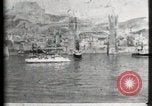
Bombardment of Taku, china, during Boxer rebellion, staged with models and filmed by Edison Manufacturing Company
An early experiment in motion picture film making. Film about Bombardment of Taku (aka Dagu) forts, on June 17, 1900, by Allied fleets,during the Boxer Rebellion in China. It is staged with models of battleships, and filmed in 1900, by the Edison Company. Model ships move across water contained within a model of that coastal area of China. Some are white and some black. At first they simply scurry back and forth. But they later assemble to begin firing at the Chinese land forts. A chinese Junk gets caught in the action and flees. Explosions on "land" raise much smoke and those from defenders cause white smoke and large splashes in water. Many explosions are set off with lots of smoke. The Russian ship "Gilyakwas" seen on fire and sinking.