


 Francais
 Deutsch
 Italiano
Refine Your Search
Fort Oglethorpe stock footage and images
- Showing 535 to 540 of 739 results more
more Hide
Hide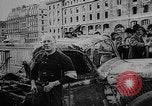
Parisians celebrate victory in the battle for Paris during World War II
The end of the Battle for Paris during World War 2. French woman on bicycle ducks under Large white banner reading (in German) "Armistice. Do not shoot." French Resistance taking German prisoners through the streets. Camera pans down burned out hotel building to street below filled with Parisians making their way around burned and shattered vehicles. The French tricolor flag flying above a building. View of Fort de Romainville, and bodies of French executed in its yard. Frenchmen tear down posters of Vichy officials. People ride in truck displaying American flags. Others pose atop a German tank on which they have painted the Free French Cross of Lorraine symbol. French General Leclerc leads elements of his armored division past Liberty statue. Spectators jam every available space along the way. Suddenly smoke appears as shooting breaks out and the parade stops. People in the streets and sidewalks seek cover, while French forces return fire on the German snipers. Soon the scene is partially obscured by the smoke of gunfire. People keep running for cover. Final scenes are entirely celebratory, filled with happy Parisians.
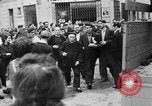
FFI leaders in Paris, France during World War II.
On the liberation of France from German troops during World War II. A group of FFI ( French Forces of Interior ) men round up male collaborators and one woman collaborationist, accused of assisting the Germans, and load them into a FFI truck. Leaders of FFI. Dead bodies of civilians lying on the grounds of the Fort de Romainville which served as a Nazi prison and transit camp. They had been massacred by German forces.
United States P-47 aircraft flies over a German city.
Allied aircraft in Germany during World War II. United States P-47 aircraft pull up for landing in a German city. A fort like structure on a hill. P-47 aircraft encircles the German city.
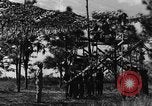
Camouflaged nets, shed and haystacks are used to conceal aircraft and equipment in the United States.
Camouflage tactics being used to conceal equipment in the United States. Army engineers make a camouflaged net at McGill Field in Florida. An aircraft on a field. The engineers cut a tree on the field. An aircraft taxis and moves under the camouflaged net. Soldiers at a camouflage school construct a camouflaged net to conceal an aircraft. Dispersal method being used to conceal an aircraft. A haystack and a shed are used to conceal pack mules and anti aircraft guns at Fort Bragg in Carolina. (World War II period).
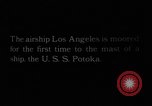
Airship USS Los Angeles is moored to USS Potoka underway at sea in the United States.
Development of air power. Mooring of U.S. Navy airship USS Los Angeles in the United States. The airship comes in and is moored to USS Potoka out on the water. The ship underway at sea. Interior of a helium producing plant at Fort Worth in Texas.
Beginnings of successful powered heavier-than-air flight. Wright Brothers flights in U.S. and Europe. General Hap Arnold
History of aviation. A balloon in flight. Historic glider such as that which interested U.S. War Department as early as 1898. In 1903, a crew of men moving a Wright Flyer into position. Two men turn over propellers on a Wright Flyer, and the engine starts. View of the Wright-designed water-cooled engine. View of Orville Wright. The famous first powered flight, at Kitty Hawk, North Carolina, with Orville Wright at controls. Animation shows that 120 foot flight juxtaposed against a B-36 wing. Wilbur Wright in Europe, in 1908, gesturing as he converses with interested parties. A gallery of spectators including the President of France, King of England, King of Spain, and King of Italy. Wilbur Wright places a wheel under the right wing of a Wright Flyer and lashes it to the strut. A team of horses pulls the plane across the field. Men maneuver the plane onto a monorail on the ground. Men pull on a heavy rope to raise a weight in a tower, for a catapult. Two men spin the propellers and the Wright Brothers airplane motor starts. Wilbur Wright and his passenger, a French journalist, board the plane. The catapult weight drops, launching the aircraft which flies low over the field. U.S. President Theodore Roosevelt speaking (He is seen on a podium campaigning for the Bull Moose Party nomination at the Kansas State Fair in Hutchinson, Kansas on September 22, 1912.) War department issues specifications for a heavier-than-air craft. Reenactment of a Wright brother signing a bid contract. A Wright Flyer airborne at Fort Myer, Virginia, as the Wrights meet the Army specifications and sell, U.S. Army airplane number 1, to the War Department, in 1908. Gold Aviator wings being pinned on the uniform of a U.S. Army pilot. Photograph of Army Air Forces Chief, General Henry (Hap) Arnold, wearing his original aviator wings on his service uniform. A Glenn Curtis training airplane starting up and taking off. View of a DH-4 airplane and a Wright Flyer taking off together.