


 Francais
 Deutsch
 Italiano
Refine Your Search
Fort Oglethorpe stock footage and images
- Showing 553 to 558 of 739 results more
more Hide
Hide
Allies enter Dardanelles and Constantinople after end of World War I
Allied war ship entering the Dardanelles immediately after end of World War 1. Views of the Fort of Sedul-Bahr which had been pounded by British long range guns. French General Louis Franchet D'Esperey landing at shore and reviewing formation of Turkish troops at Constantinople. The Turkish battleship, Yavuz Sultan Selim (formerly German SMS Goeben) tied up at a dock. She displays the Turkish flag.
Civilian Conservation Corps recruits are trained by the U.S. Army for a reforestation program at Camp Roosevelt in Washington DC
The United States Army imparts training to recruits for President Roosevelt's Reforestation Program at Camp Roosevelt in Washington DC. A vessel (“Potomac”) arrives in Fort Washington, Maryland. Civilian Conservation Corps (CCC) recruits exit the vessel and walk down a road. The young men are trained by the United States Army for the reforestation program in the Great Depression.
How the U.S. Army cares for its soldiers during the Vietnam War.
U.S. soldiers slogging through muddy fields, along dirt roads and through jungles. A soldier with vegetation on his helmet (comouflage) speaks into a radiophone. A few U.S. soldiers talk among themselves in camp. A tank firing artillery. A helicopter firing rockets. An air ambulance helicopter. Soldiers boarding a Pan American jetliner for transport to Hawaii, for Rest and Recuperation. Signs reading:" Aloha R&R Hawaii' and 'Aloha R&R Personnel' displayed at Fort Derussy, in Hawaii. A group of men and women in a long canoe, enjoying themselves during "R and R." An Army Chaplain conducts religious service for soldiers in the field. Sign on a building reads: Army Community Service Center." An officer speaks with a woman military dependent at the center. A sign lists myriad types of assistance available. Two soldiers talk. A soldier gets a hair cut. Little school children at a school in Vietnam. Vietnamese people following an American soldier across a bridge. American soldiers under fire and firing weapons from the air, from tanks, and from small arms. A soldier loads a grenade launcher. An Army doctor treats an injured Vietnamese girl. American flag flying in the breeze.
Filipino people going about their routine activities in the Philippines; Filipinos trained by American soldiers.
Part of a 1944 film showing scenes of Filipino people circa 1940, before World War 2. At opening, Filipino women are seen walking alongside a row of factory buildings. A factory room filled with Filipino women dressed in white caps and white uniforms engaged in production at individual individual work stations in a factory. A machine shop filled with Filipino men engaged in metal work. Several people at the window of an office, conducting business with a woman inside. A stock or commodities market office with quotes on tote boards. Women working alongside a moving production line. A woman operating a fabric processing machine. Filipino miners pushing hopper cars of mined ore across a bridge. Miners riding on an engine pulling a train of hopper cars filled with ore from a mine. Filipino longshoremen handling cargoes on a wharf. Scene shifts to an open field where a number of Filipino men are being trained to use firearms during World War 2. One is being coached by an American soldier as he works with a Browning M 1917 water cooled machine gun. Lines of Filipino men firing rifles under supervision of U.S Army trainers. A contingent of uniformed Filipino soldiers, led by an American soldier, marches past a sign, in an camp of tents, reading "A-T Company, 1st Filipino Infantry." Filipino soldiers at a tent camp, being instructed by an American soldier, using a large set of maps. Camera pans over a camp of many tents laid out in order. A formation of Filipino soldiers marches between tents. An American soldier opening his foot locker at his quarters. An illustrated portrait of General Douglas MacArthur. A formation in a field with a Filipino band playing and a Color Guard carrying the American and Filipino flags. A large group of Filipino children walking along a path. A Filipino boy lying on the floor in his home, reading a large book. Filipino school girls seated at benches next to tables. Women doing laundry at an outdoor pond. Next, an actor in khaki clothing sits in a tent and speaks as if addressing American soldiers regarding the Philippines. Among other things, he says,"These people aren't natives. They aren't beggars. They have cities and farms and industries.They have schools and courts and a Constitution. They also have pride and patriotism and self-respect. They love freedom They'll die for it." He cautions American soldiers about their behavior vis-a-vis Filipinos. He states that "Filipinos are American." He alludes to messages received from American and Filipino defenders in Fort Mills, at the fall of Corregidor on May 5, 1942. View of radio towers and worker in radio studio. Morse code messages heard as an American army radio operator with a headset transcribes the messages. Scene shifts to an amphibious invasion fleet attacking a Japanese held island in the Pacific.
Japanese soldiers advance and give victory banzai in Corregidor Island, Philippines (WWII)
Japanese victory at the Battle of Corregidor during Japanese occupation of Philippines in World War II. Japanese troops land on Corregidor Island (also known as Fort Mills during the American Colonial Period). Japanese troops disembark from boats during their landing at the island of Corregidor. Japanese soldiers climb their way up the island. Soldiers advance on Corregidor Island. Japanese troops march past destroyed buildings. Captured American and Filipino prisoners of war are taken away. Japanese soldiers stand near gun batteries and give victory banzai. View of the Mile Long Barracks of Corregidor. The soldiers advance and walk past a destroyed building. The Japanese flag is raised. Japanese soldiers take down the United States flag in Corregidor.
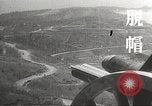
Japanese officials examine wrecked and captured U.S. Army equipment and ammunition on the Philippine Islands.
The invasion of the Philippine Islands by Japanese troops during World War II. Aerial view of vehicles passing on a road. Occupying Japanese officers and Princes Morihiro Higashi-Kuni and Takamatsu inspect wreckage. They inspect wrecked U.S. guns and equipment in Corregidor and at Fort Mills. Mountains in the foreground. Men carrying wooden boxes walk on a street. U.S. prisoners of war in a prison camp. Men bathing at sea. A sign board reads: 'Restricted Road'. Barricades outside the prison camp.