


 Francais
 Deutsch
 Italiano
Refine Your Search
Goodenough Island New Guinea 1943 stock footage and images
- Showing 673 to 678 of 13636 results more
more Hide
Hide
Shows the importance and application of camouflage techniques during combat in World War 2.
A film 'Camouflage in Combat' underlines the importance of tactical exploitation and counteraction of shadows and use of nets, underbrush and other camouflage during World War II. The film shows U.S. soldiers going into a theater in the United States and watching a movie 'Camouflage'. The movie shows a soldier in a forest. He is shot down. A soldier approaches him. He looks skywards. He applies mud on his face to camouflage himself. Soldiers paint each other's faces with GI paint. On 5th June 1944, fully camouflaged Airborne and pathfinder U.S. paratroopers preparing for D-Day invasion jump over Normandy, France. Soldiers with camouflaged helmets. A soldier camouflages his helmet with grass and twigs. A soldier on an island with his helmet camouflaged with grass and twigs found in the area which gives him a perfect blend. U.S. soldiers with camouflaged helmets in France. A camouflaged tank rolls. An officer inspects soldiers standing in a line. Their helmets are camouflaged. A U.S. soldier hiding in shadows in Casino, Italy fires his gun. His ring sparkles. A soldier in a prone position fires. A New Zealand soldier fires while in shadows.
U.S. aviators are welcomed at different places during their journey around the world.
A flight around the world. A globe rotates. U.S. President Calvin Coolidge bids goodbye to army airmen. The President and Major General Mason Patrick and the fliers on a lawn of the White House, Washington DC. The journey starts from Seattle, Washington. Douglas World Cruisers ( DWC ) in flight. The DWCs parked in a bay. A forest in the background. They arrive at Chignik Bay, Alaska. The aircraft in flight. An iceberg. Lieutenant Lowell Smith stands on one of the pontoons and works with propellers on his DWC. The DWCs in flight from America to Asia. The aviators are welcomed by Japanese officials in Yetorufu, Japan. Japanese children playing in a school yard. A child has a Japanese and a U.S. flag, one in each hand. They reach Hong Kong, China. A fleet of native junks to welcome them. In Calcutta, India , a DWC taxis on water. A large number of people gather around a DWC. A crane lifts a DWC out of water. The aviators land in Constantinople. People around the aircraft. They reach Paris, France.. Aerial views of the city. Mrs. Maclaren congratulates the airmen in London, England. The crew of USS Richmond cheers the aviators. The aviators board their aircraft from a small boat. People watch as the aircraft land in Labrador, Canada. The DWCs are anchored in a bay and the aviators are brought to the shore in a boat. Naval officers greet them. The aircraft in flight over the Boston skyline. A motor launch in Boston Harbor. The DWCs land on water. The aviators arrive at the dock in the motor launch and are greeted by officials. They fly over New York. A large crowd greets the aviators at Mitchel Field, Long Island. They arrive at Bolling Field in Washington and are congratulated by President Coolidge and U.S. Secretary of War John Wingate Weeks. The three DWCs are followed by an XNBL-1 Barling bomber in flight in Dayton. Lt. Jack Harding is welcomed home. The world flight ends in Seattle, Washington. Photographers click pictures as a DWC lands. Major Martin greets aviators standing beside a DWC.
U.S. Army Air Service aircraft are utilized for map making and for aerial photography in the United States.
Aircraft are used for different purposes in the United States. Men and a pilot and an observer load a three-lensed camera into the back cockpit of a two-winged bi-plane for map making. A view from an aircraft into the two cockpits of another aircraft directly below. Two U.S. Army Air Service officers assemble a mosaic map on a wall. A mosaic aerial map. An aerial photograph of New York City, the Island of Manhattan with the East River on the right and the Hudson River on the left.
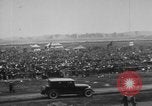
Lieutenant Cyrus Bettis and Lieutenant Jimmy Doolittle win air races in 1925.
In October 1925, crowd gathered to watch the Pulitzer Trophy air races at Mitchel Field, Long Island, New York. VIPs arrive in various automobiles. Army Air Service Curtiss R3C-1 airplane is pushed onto the field. Air Service Chief, General Patrick , speaks with Lieutenant Cyrus Bettis as Lieutenant James Doolittle listens. A Navy crew works on their entry in the race, similar to the Army Air Service airplane. Navy Lieutenant Al Williams seen with a pipe upside down in his mouth. Lieutenant Bettis taxis out for takeoff in his airplane number 43. Then Navy Lt. Williams proceeds to take off in his aircraft, number 40. Lt. Bettis breaks ground and begins to fly the closed course, coming very close to the ground at times. He lands and climbs out of the cockpit, surrounded by spectators and officials who are convinced he has won, registering a speed of 249 miles per hour. Navy Lt. Williams lands shortly thereafter having averaged 242 miles per hour. He is greeted by several spectators, including a young woman. Two weeks later, the U.S. Army was represented by Lieutenant Jimmy Doolittle, who flew the Curtis R3C-1, again, but this time fitted with floats, at the Schneider Cup Seaplane Race in Baltimore, Maryland. He shakes hands with a young woman, just before the race. The Navy also entered with a similar seaplane, shown being pushed into the water. The British entry, a Glouster-Mapier IIIA is seen (replacing the Supermarine-Napier S.4, that was damaged). The Italian Macci M.33 is seen on a dock with engine running. The float planes taxi out over the Chesapeake bay waters to takeoff position. Doolittle is the first to take off and to return, logging an average speed of 232 miles per hour. He is seen smiling after the race.

Fokker F-10A trimotor and Sikorsky S-40 flying boat carry tourists. Buildings, harbor, and streets of San Juan in Puerto Rico.
Map highlights New York in United States and San Juan in Puerto Rico. Connection established between the two places. Baltimore and Miami also connected with San Juan. Map of Island of Puerto Rico. Boats at San Juan harbor. Buildings in background. A Pan American Airways Fokker F-10A trimotor passenger plane lands on airfield. Tourists deplane. A Sikorsky S-40 flying boat being tied up to a dock. Automobiles parked in streets of port city. Buildings in city. Traffic moves on street. Man looks down from balcony of building. Traffic in narrow streets. Cloudy sky as seen from seacoast.
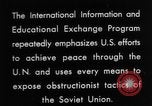
Events of World War 2, and creation of United Nations Organization following the surrender of Germany and Japan
Summary of World War II events and formation of the United Nations Organization. Soviet troops on Eastern Front of Europe fire artillery on German positions in 1944. Russian troops advance. German soldiers come out of buildings and surrender. Allied Forces land in France on D-Day. Allied troops and tanks fight Germans on streets in towns and villages of France. U.S. Army tanks fire at German positions. Various groups of German prisoners of war march along roads and are herded into prison camps operated by American and British forces. In 1945, the Allied leaders meet at Yalta on the Crimean Peninsula to discuss Allied military strategy in the final months of WWII. Leaders included British PM Winston Churchill, U.S. President Franklin D Roosevelt and Soviet Premier Joseph Stalin. The meeting of U.S. and Soviet Russian troops at the Elbe River. German Nazi Swastika symbol blown up in explosion atop Zeppelinfeld Nazi party rally grounds in Nuremberg. Aerial view of Berlin in ruins, as seen from low-flying aircraft flying directly over the Unter den Linden boulevard and the Brandenburg Gate. Wrecked and bombed German buildings seen everywhere. German officials signing surrender instrument at Rheims. U.S. President Harry S Truman, Winston Churchill and Joseph Stalin at Potsdam Conference. U.S. Marines battling on beaches of Pacific Islands. Iconic shot of U.S. Marines raising the American flag on Mount Suribachi at Iwo Jima. Aerial view of bombed and ruined city of Tokyo, Japan. The Japanese surrender to MacArthur aboard the battleship USS Missouri. General MacArthur speaks aboard Missouri. Victory celebrations all across the world, with some scenes from earlier V-E Day (Victory in Europe) day in May 1945, including crowds celebrating in Paris, France, and some scenes on V-J Day (Victory over Japan day) in August 1945. Crowds on streets celebrate. Happy crowds jam streets. Delegates of Nations, among them Andrei Gromyko and Vyascheslav Molotov meet in San Francisco and create a United Nations organization. Truman arrives at signing of UN charter. Various delegates sign charter. U.S. troops disembark troop carrier ships at U.S. ports and are discharged after completing military service in World War 2. Group of U.S. Army soldiers exits a church (the Chapel at Fort Dix, New Jersey), waving their discharge papers in hand.
CRITICALPAST.COM: About Us | Contact Us | FAQs - How to Order | License Agreement | My Account | My Lightboxes | Shopping Cart | Advanced Search | Featured Collections | Website Terms & Conditions | Privacy Policy ©2026 CriticalPast LLC.
License Agreement |
Terms & Conditions |
Privacy Policy
©2026 CriticalPast LLC.