


 Francais
 Deutsch
 Italiano
Refine Your Search
Goodenough Island New Guinea 1943 stock footage and images
- Showing 721 to 726 of 13636 results more
more Hide
Hide
Display of animals at YMCA show by girls and boys.
Display of animals at YMCA show. View of boys and girls posing with animals like dogs, cats, guinea pigs, rabbits, etc. Some animals are caged whereas some are not.
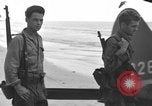
United States pilots board Stinson L-5 plane parked along shore in Palawan, Philippines, during World War II.
U.S. pilots board Stinson L-5 Sentinel airplane of the 25th Liaison Squadron "Guinea Short Lines" (serial 42-99261) parked on shore at Palawan, Philippines, during World War 2. The L-5 taxis along shoreline and takes off. L-5 in flight over sea.
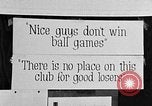
Shriver shows articles collected from various nations and tells the objectives of the USPC to an interviewer in Washington DC.
Director of Peace Corps Robert Sargent Shriver in Washington DC. Robert Sargent Shriver, Jr. is interviewed as he prepares to leave his office. Robert Sargent Shriver Jr. shows slogans on a board. The slogans are 'Nice guys don't win ball games' and 'There is no place on the club for good losers'. He talks about the beginning of the United States Peace Corps (USPC) and its objectives. He talks about a musical instrument. He shows another musical instrument with an autograph of the President of Guinea, Africa. He shows a glass replica of a Buddhist temple (WAT) from the University of Bangkok and a honorary degree, Doctor of Political Science. Excerpt from a speech by the Foreign Minister of Thailand in his tribute to the USPC. He talks about his experiences as the Director of Peace Corps and works of the USPC.

Plague causing bacteria being examined by U.S. Navy in a laboratory in North Africa.
A U.S. Navy training film about the prevention and cure of plague in North Africa. Animation shows the nature of rat population that leads to spread of plague. It depicts the tactics to be adopted by the plague control team. A man uses kerosene to kill fleas and catches a rat. Rats caught, are brought to plague control laboratory. Captured rats are chloroformed. Fleas being removed from rats. Fleas being counted and identified. They are placed on slides and a technician looks at the fleas through microscope. Rats being mounted on a table and dissected and being searched for pasteurella pestis. Man looks into a microscope at pasteurella pestis. A guinea pig being inoculated with it and observed for next few days for symptoms of plague. A dead pig being dissected and it shows signs of plague.
Bombing of Kahili Airdrome on Bougainville Island by U.S. AAF B-24 Liberators
Aerial views of the bombing of Kahili Airdrome on Bougainville Island. U.S. B-24 Liberator bombers in flight at a high altitude over the airdrome, dropping bombs. (World War II period).
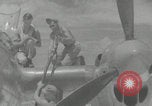
U.S forces intercept and shoot down Admiral Isoroku Yamamoto of the Imperial Japanese Navy in Bougainville Island (WW2)
United States airmen on wing and fueling a P-38 Lightning aircraft to prepare for a mission in World War II. A military jeep carrying some airmen drives by. An airman gets off the jeep and runs to a P-38. The United States airman climbs the P-38 and takes his seat, his comrade closes the aircraft canopy. An airman closes his aircraft canopy. A P-38 with engines running. A fighter-bomber (Lockheed P-38 Lightning) begins to taxi in the airfield. An airman in the control tower signals using a light. The Lockheed P-38 Lightning takes off from the airfield. A group of Lockheed P-38 Lightning aircraft zoom in the sky. Aerial shot of Bougainville Island coast. Japanese Zeroes flying in the sky, seen via gun camera footage. Two Japanese bombers are flying, one of the bombers catches fire after it was attacked by American aircraft. A Lockheed P-38 Lightning slightly angles in a maneuver. A Lockheed P-38 Lightning fires at the Japanese in front. A Lockheed P-38 Lightning chases and fires at the Japanese aircraft, a Mitsubishi Betty. Cockpit aims at Japanese aircraft. A Lockheed P-38 Lightning fires, the Japanese bomber is hit and explodes into a ball of fire. Three Lockheed P-38 Lightning aircraft fly in the sky. Three airmen, Lieutenant Besby Holmes, Captain Tom Lanphier and Lieutenant Rex T. Barber, laugh facing the camera. Ending slate.
CRITICALPAST.COM: About Us | Contact Us | FAQs - How to Order | License Agreement | My Account | My Lightboxes | Shopping Cart | Advanced Search | Featured Collections | Website Terms & Conditions | Privacy Policy ©2026 CriticalPast LLC.
License Agreement |
Terms & Conditions |
Privacy Policy
©2026 CriticalPast LLC.