


 Francais
 Deutsch
 Italiano

Refine Your Search
Goodenough Island New Guinea 1943 stock footage and images
- Showing 7495 to 7500 of 13663 results more
 Hide
Color Sound

Illustrations and photos of United State President Franklin Delano Roosevelt from his childhood with mother, Sara Delano Roosevelt, at Hyde Park New York USA
Artist illustration of Sara Delano Roosevelt, mother of future United State President Franklin Delano Roosevelt, reading from a book. A page from a Roosevelt heirloom Dutch Bible turns to show an illustration of Sara Roosevelt holding Franklin Roosevelt as a baby circa 1882. The page turns to show a photograph of Franklin Delano Roosevelt as a young child. Another page turns to show a picture of Franklin Delano Roosevelt as a boy wearing a sailor collar shirt. Image of Franklin Delano Roosevelt wearing a miniature sailor suit, fashionable children’s wear during the 19th century.
Preparation of the Holloman High Speed Test Track (HHSTT) for fluid-submerged chimpanzee testing at Holloman Air Force base in New Mexico, United States
Shot of the Aero Med Fluid Tank sled, a rocket sled with a chamber designed to submerge a live animal test subject in water during acceleration and deceleration testing. Men work on and inspect the sled, long runway visible in the background. First Lieutenant A. V. Zaborowski prepares the subject's (chimpanzee) face mask. Men in hard hats prepare the sled. Panoramic shot of the rear of the sled. Close up of the chimpanzee's face mask used for submersion. A team of men work on the sled. Man uses pliers to adjust the face mask. The frame of a stretcher is inserted into the chamber of the sled.
Doctors prepare a chimpanzee for high speed fluid-submerged rocket sled testing at Holloman Air Force Base in New Mexico, United States
A stretcher carrying a chimpanzee is lifted from the back of a vehicle. The stretcher is placed on the ground, and doctors from the veterinary services branch of the Aero-Med Field Laboratory inject the chimpanzee's arm with a syringe. Close up of the chimpanzee, tied down to the stretcher. The doctors wait, monitoring their watch, and use a stethoscope on the sedated chimpanzee. A sticky glue paste is used to adhere a physiological monitoring array to the chimpanzee; an electrode is connected to each breast and one leg. The chimpanzee is placed into a harness by a team of men. A man tests the breathing mask which will be put on the chimpanzee. The chimp is brought to the fluid chamber of the Aero Med Fluid Tank sled and attached to the frame inside. A man in a shirt and tie speaks with the team of men. The breathing mask is test-fitted on the chimpanzee, then removed, and a glue is applied around the face. Shot of the team of men standing at the sled before test with live animal is conducted.
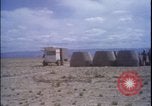
Chimpanzee submerged in rocket sled chamber for testing at Holloman Air Force Base in New Mexico, United States
Shot of a man in a mobile fire control station. A large team of men stand around the Aero Med Fluid Tank sled, which holds a live chimpanzee. Shot of the chimpanzee in full testing gear including intricate harness and breathing mask. The door is closed and the fluid chamber is filled with water, submerging the chimpanzee during the animal test operation. Close ups of the chimp through the overhead glass viewing port. A hatch on the top of the chamber is closed. Excess water spills out a small drainage spout. The hatch on top is opened and a man sticks his arm inside the chamber. Plastic wrapping is removed from the sled. Shot shows the sled and runway extending into the distance. A truck arrives carrying solid rocket motors, also called "rocket bottles." A canister is lifted by crane.
Rocket sled carrying water-submerged chimpanzee is launched at Holloman Air Force Base, New Mexico, United States
Sweeping shot captures the fiery launch and run of the Aero Med Fluid Tank sled, which carries a chimpanzee submerged in water during live animal testing. The rocket sled accelerates along the Holloman High Speed Test Track (HHSTT) at great speed, a fiery blaze behind. Second, closer view of the launch. Scene changes to post-launch. The door of the fluid chamber is opened and water is drained. Men inspect the chimpanzee inside. Close ups of the harnessed chimp, chest rises and falls. The chimpanzee, strapped to a stretcher, is removed from the sled chamber. Harness is removed and the chimpanzee is transferred to the back of a vehicle. Close up of the now-empty stretcher and harness rig.
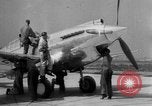
Pilots perform acceptance test flights on new P-40 aircraft at Curtiss Aircraft facility in Buffalo, NY during World War II
Pilots test fly a P-40 airplane at a Curtiss Company facility at Buffalo, NY (the Buffalo municipal airport) during World War II. Curtiss company employees giving a final cleanup and polish to a shiny P-40 airplane. parked on the ramp. Two pilots are suited up to fly: H. Lloyd Child, Curtiss’ chief test pilot (at left), and a U.S. Army Air Force major (at right), are dressed in flight suits, helmets, goggles, and wearing seat-pack parachutes. They stand beside a well-worn P-40 airplane that has a pilot/technician in its cockpit, checking controls. H. Lloyd Child (at left), points to a clipboard on his leg with information on it and discusses it with another pilot (the USAAF major). Next, a pilot is seen taxiing the shiny P-40 at fairly high speed, with the canopy open. He taxis past parked aircraft in front of a hangar, including a Curtiss SBC Helldiver; a Stinson Gullwing; and a Spartan Executive airplane. The P-40 taxis out to the runway where the pilot makes a long takeoff roll before breaking ground. Then he pulls the P-40 into a fairly steep climb, leveling off at about traffic pattern altitude, without retracting his landing gear.
CRITICALPAST.COM: About Us | Contact Us | FAQs - How to Order | License Agreement | My Account | My Lightboxes | Shopping Cart | Advanced Search | Featured Collections | Website Terms & Conditions | Privacy Policy ©2026 CriticalPast LLC.
License Agreement |
Terms & Conditions |
Privacy Policy
©2026 CriticalPast LLC.