


 Francais
 Deutsch
 Italiano
Refine Your Search
Goodenough Island New Guinea 1943 stock footage and images
- Showing 7531 to 7536 of 13634 results more
more Hide
Hide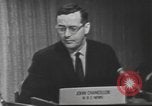
Vice President Nixon and Senator Kennedy debate in the United States over nuclear tests resumed by the Soviet Union.
The fourth presidential election debate held between Democratic nominee Senator John F. Kennedy and Republican nominee U.S. Vice President Richard Nixon in in New York, United States on 21st October 1960. NBC News correspondent John Chancellor asks a question to Senator Kennedy in relation with U.S. relations with the Soviet Union. Correspondent Chancellor asks if Russians have resumed testing of nuclear devices as per news from Atomic Energy Commission of Washington and if the U.S. would resume its own nuclear weapon testing in 1961. Senator Kennedy replies to the question and says that the next President of the United States should make one last effort to secure an agreement on the cessation of nuclear bomb tests. He mentions the Conference for the Reduction and Limitation of Armaments from 1932-1934 held in Geneva, Switzerland. Kennedy says that he believes the effort should be made once more by who so ever is elected the President of the United States. Senator Kennedy says that if they fail in making the effort, the responsibility will be clearly on the Russians and then they'll have to meet their responsibilities for the security of the United States, and they may have to test underground. He says that there may be testing in outer space. Senator Kennedy says that he is most concerned about the whole problem of the spread of atomic weapons. ABC News correspondent Quincy Howe asks the Vice President to comment. Vice President Nixon says that the Soviet Union is filibustering. He says further that the elected president should immediately make a time table to break Soviet filibustering.
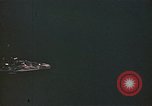
Warships of the U.S. Navy fleet in the Hudson River on Navy Day in 1945
View of the Hudson River from an aircraft flying North, over the New Jersey shoreline. United States Navy warships are seen in the Hudson River, on the occasion of President Truman's first official visit to New York City, on Navy Day, October 27, 1945. Approximately 50 ships were anchored in the Hudson. The first clearly identified is the Battleship, USS Missouri(BB-63) with the Destroyer USS Renshaw (DD-499) tied alongside (bringing President Truman aboard during his review of the fleet). Others seen include the USS Midway (CVB-41); the USS Enterprise (CV-6); The USS Augusta (CA-31); and the USS Boise (CL-47). Several more surface ships are seen followed by six submarines on the surface, as the aircraft approaches the George Washington Bridge. More warships seen North of the bridge. Scene shifts to the USS Missouri and USS Renshaw, again. Next, the aircraft flies past a Navy blimp hovering below, over the river. The Aircraft Carriers, Enterprise and Midway are seen again. Glimpses of the New York City shore and buildings are seen at times in the film, as well as the palisades on the New Jersey shore, near the George Washington Bridge.
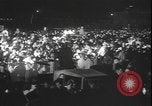
Flight achievements of 1933 - Wiley Post completing solo journey around the world and Roscoe Turner speed record coast-to-coast
American aviator Wiley Post returns to Floyd Bennett Field in New York after completing his solo flight around the world in a just under 8 days. People gather in a large number to welcome him. They gather around his aircraft. Scene shifts to streets of New York City where Wiley Post is honored with a ticker tape parade for his Around The World achievement. The aviator seated aboard a jeep passing by. People celebrate and greet him. He is bestowed with the Medal of Valor by New York City Mayor John P. O'Brien. Next segment shows plane of American aviator Roscoe Turner landing, after his record-setting flight from New York to Los Angeles in 10 hours and 5 minutes flying his Wedell-Williams Model 44 (WW-44) aircraft. This won him the 1933 Bendix Trophy. Close view of Roscoe Turner smiling from the cockpit of his aircraft. From a November 10, 1958 newsreel recounting events 25 years earlier.
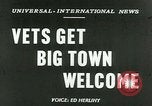
Veterans receive heroes welcome on their return from Korea.
2200 veterans return from Korea. The troops get a heroes reception. Veterans aboard a ship. Ship crosses the Statue of Liberty and enters the New York harbor. New York City fireboats for their welcome in the harbor. A large crowd awaits their return in the harbor. People hold boards and banners with soldiers' names. A soldier takes photographs of the crowd from the ship. Soldiers get off the ship for a family reunion. Soldiers meet their wives, mothers, children and family. The veterans in military trucks during the ticker parade through Broadway. People lined up on either side of the road to welcome them. A ceremony at the City Hall. Military officers and New York officials welcome the soldiers. A large crowd at the gathering. Soldiers sit with their family members.
Bob Feller and Jackie Robinson inducted into baseball Hall of Fame; scenes from careers of Feller and Robinson
People gather at baseball's Hall of Fame in Cooperstown New York. Announcer notes Cleveland Indians pitcher Bob Feller and Brooklyn Dodgers second baseman Jackie Robinson have been inducted into the Hall of Fame. Scenes from the careers of both players. Bob Feller greeting kids on field, holding a child. Bob Feller pitching at Polo Grounds in New York, date unknown. Jackie Robinson seen removing baseball bat from rack. Announcer notes he is the first African American man admitted to the Hall of Fame. Robinson seen hitting ball to outfield wall and sliding into second base for a double. Robinson successfully steals home against New York Yankees pitcher Whitey Ford in the opening game of the 1955 World Series -- although catcher Yogi Berra disagrees vehemently with the umpire's call.
Dignitaries including Mrs Harmon at Spanish African American art painting exhibition by Pastor Argudin y Pedroso in United States.
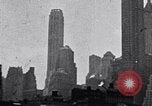
Various buildings of New York City seen as camera pans from left to right and also shows a sailing boat at port in New York City United States. Palmer Hayden paints at New York waterfront. Dignitaries and arts supporters including Mrs Harmon at Spanish African American art painting exhibition by Pastor Argudin y Pedroso. James L Allen in his photography studio. A woman prepares a sculpture.
CRITICALPAST.COM: About Us | Contact Us | FAQs - How to Order | License Agreement | My Account | My Lightboxes | Shopping Cart | Advanced Search | Featured Collections | Website Terms & Conditions | Privacy Policy ©2026 CriticalPast LLC.
License Agreement |
Terms & Conditions |
Privacy Policy
©2026 CriticalPast LLC.