


 Francais
 Deutsch
 Italiano
Refine Your Search
Goodenough Island New Guinea 1943 stock footage and images
- Showing 7711 to 7716 of 13637 results more
more Hide
Hide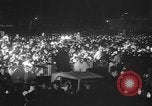
Wiley Hardeman Post receives welcome after flying solo around world and Colonel Roscoe Turner earns Bendix Trophy for speed
Wiley Post on arrival at Floyd Bennett field in New York, after flying around the world in 8 days. People take dinner at dining table to celebrate the setting of a new record in aviation. Crowd stands around the aircraft after arrival. Motorcade of Wiley Post in New York City. People welcome him with ticker tape parade in New York. Mayor of New York city, John Patrick O'Brien presents him with Medal of Valor. Next segment covers pilot Colonel Roscoe Turner who sets a new record of 10 hours and 5 minutes flying coast to coast from New York to Los Angeles. His Wedell-Williams Model 44 (WW-44) aircraft is seen landing and Roscoe Turner smiles broadly for the camera. He won the Bendix Trophy. From a November 10, 1958 newsreel recounting events 25 years earlier.
Early Bell Laboratory technology in computer art and computer animation for communication, advertising, motion pictures.
Computer screen showing animation of a silhouette of a man running. Narrator states that the first such image was generated at Bell Telephone Laboratories in New Jersey in the early 1960s. More views of the so called "Olympic Runner" graphic design generated by the Bell Laboratories newest digital computer. Colors like pink, blue and red are used in the early, historic computer art and animation technology. Men seated in a control room, interacting with the digital computer and other animation and recording hardware. Views of computer monitor screens and discussion by narrator about various visual forms created by computers. Various computer generated images are shown on the screen. Engineer stands in front of video tape machine where the images are being recorded. More computer and animation hardware is shown including an Animation Aid. Narrator describes process of photographing analog computer art work onto motion picture film and then enhancing it with color choices. Engineer is seen operating camera, and then a close up view of motion picture film running on machines and on reels. Animation and color consultant in discussion as they stand over some frames of the film that they have isolated. Sample work of early computer artists is shown, with moving animated art seen on screen, combining color and motion in new ways that were not possible before the digital computer. Another view of the video tape machine operating. Narrator discusses use of the computer also in development of computer generated music that accompanies the visual images. Animated clock is seen. Different kinds of animations are seen.
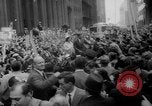
Kennedy elected President. Kennedy seen in pre-election parade procession and greeting Eisenhower following election win.
John Fitzgerald Kennedy and his wife are cheered at a New York ticker tape parade on October 19, 1960, during the 1960 Presidential campaign. A large crowd gathered in New York City during a ticker tape parade for Senator John F Kennedy on October 19, 1960 near the end of the campaign. John F. Kennedy and his wife Jacqueline Kennedy in an open roof car wave and smile at the crowd. Views of Republican candidate Richard Nixon and his wife Pat Nixon campaigning. The scrolling text marquee on the New York Times building at One Times Square in New York flashes news of Kennedy taking lead in New Jersey on election night. Next scene shows United States President elect John F. Kennedy as he shakes hands with President Dwight Eisenhower on the steps of the White House.
Contributions of African Americans in various fields in the United States.
(See also clip 65675078146 from different film transfer). Famous African American men and women citizens in the United States. Clip opens with of Booker T. Washington at Tuskegee University. Scene in a laboratory with African American scientist and inventor George Washington Carver, as an elderly man, working with another scientist in the laboratory. African American judge of New York city court. African American explorer Matthew Henson is seen looking at a globe (he was with Admiral Peary planting the American flag at the North Pole in 1909), and an unnamed African American surgeon at work in an operating room in New York. Next scene shows famous "father of the blues" musician and composer W.C. Handy (William Christoper Handy) smiling. Next is seen the financier and publisher of the Amsterdam News, Dr. C.B. Powell (Clilan Powell) greeting three uniformed African American women during a World War 2 war bond drive, and handing them a check (close up is shown) for 25,000 dollars, dated January 4, 1942, for the war bond drive. It is from the account of the Victory Mutual Life Insurance Company which Dr. Powell also owned. The check is signed by C.B Powell and Philip M.H. Savory (Dr. Savory was co-owner of the New York Amsterdam News). The next scene shows Elise Johnson McDougald, better known as Gertrude Elise Ayer, who was the first black full-time public school principal after the consolidation of New York City schools in 1898. She was also a noted woman writer during the Harlem Renaissance. She is seated in her office at her desk, likely in P.S. 119 in Harlem, since this is approximately year 1945 and she was at P.S 119 at that time. Her name plaque is visible on the front center of the desk. Principal Ayer smiles as a woman delivers a document to her. Next is seen the African American historian, author, and professor, Lawrence D. Reddick, serving in his role as the curator of the Schomburg Collection of African American Literature. In an art studio is seen the famous African American sculptor and painter Charles Alston, at work on a sculpture. Next scene shows the famous African American contralto singer, Marian Anderson, receiving a bouquet of flowers and smiling after a performance. This transitions to a view of African American orchestra conductor Dean Dixon leading an orchestra in a performance of Beethoven's 9th Symphony. Several views of different sections of the orchestra performing under Dixon's direction. Clip closes with brief shots of campuses of several historically black colleges and universities in the United States like Howard University, Hampton, Tuskegee, Fisk, Prairie View. An American college football game underway at the stadium of one of the colleges.
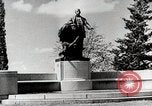
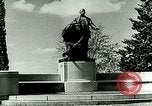
Achievements of African Americans in art, literature, music science, and medicine in the United States, in the late 1930s and 1940s.
A film about achievements of various African American men and women citizens in the United States. A statue of Booker T. Washington, founder of Tuskegee University in Alabama. View of African American scientist and inventor George Washington Carver, as an elderly man, working with another scientist in a laboratory. African American judge of New York city court. African American explorer Matthew Henson is seen looking at a globe (he was with Admiral Peary planting the American flag at the North Pole in 1909), and an unnamed African American surgeon at work in an operating room in New York. Next scene shows famous "father of the blues" musician and composer W.C. Handy (William Christoper Handy) smiling. Next is seen the financier and publisher of the Amsterdam News, Dr. C.B. Powell (Clilan Powell) greeting three uniformed African American women during a World War 2 war bond drive, and handing them a check (close up is shown) for 25,000 dollars, dated January 4, 1942, for the war bond drive. It is from the account of the Victory Mutual Life Insurance Company which Dr. Powell also owned. The check is signed by C.B Powell and Philip M.H. Savory (Dr. Savory was co-owner of the New York Amsterdam News). The next scene shows Elise Johnson McDougald, better known as Gertrude Elise Ayer, who was the first black full-time public school principal after the consolidation of New York City schools in 1898. She was also a noted woman writer during the Harlem Renaissance. She is seated in her office at her desk, likely in P.S. 119 in Harlem, since this is approximately year 1945 and she was at P.S 119 at that time. Her name plaque is visible on the front center of the desk. Principal Ayer smiles as a woman delivers a document to her. Next is seen the African American historian, author, and professor, Lawrence D. Reddick, serving in his role as the curator of the Schomburg Collection of African American Literature. In an art studio is seen the famous "Harlem Renaissance" African American sculptor and painter Charles Alston, at work on a sculpture. Next scene shows the famous African American contralto singer, Marian Anderson, receiving a bouquet of flowers and smiling after a performance. This transitions to a view of African American orchestra conductor Dean Dixon leading an orchestra in a performance of Beethoven's 9th Symphony. Several views of different sections of the orchestra performing under Dixon's direction. Clip closes with brief shots of campuses of several historically black colleges and universities in the United States like Howard University, Hampton, Tuskegee, Fisk, Prairie View. A football game underway in one of the colleges, and view on the field as quarterback throws a pass.
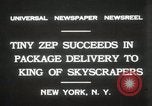
Good Year blimp drops a package by rope to employee in the top of the Empire State Building, for delivery to Governor Al Smith.
The Empire State Building in New York. View of the Empire State Building dominating the Manhattan skyline. Good Year blimp with lettering "Columbia" on it approaches and passes directly over the Empire State Building. Trailing from it is a long rope with a bundle tied on the end. The bundle swings into the side of the Empire State Building near its top. An employee grabs the bundle. Huge crowd gathered at the base of the Empire State Building. Next scene shows a Good Year employee (Good Year lettering on his shirt) delivering the bundle of what appears to be newspapers to New York State Governor Al Smith in the crowd on the street outside the Empire State Building. A very special delivery.
CRITICALPAST.COM: About Us | Contact Us | FAQs - How to Order | License Agreement | My Account | My Lightboxes | Shopping Cart | Advanced Search | Featured Collections | Website Terms & Conditions | Privacy Policy ©2026 CriticalPast LLC.
License Agreement |
Terms & Conditions |
Privacy Policy
©2026 CriticalPast LLC.