


 Francais
 Deutsch
 Italiano
Refine Your Search
Goodenough Island New Guinea 1943 stock footage and images
- Showing 769 to 774 of 13636 results more
more Hide
Hide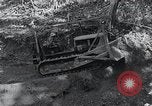
Bulldozer clears path for road construction in Burma.
Bulldozer clears path for road construction in Burma.It pushes land,bushes and trees over embankment. Shows a 6x6 truck loaded with supplies stuck in a ditch.Soldiers unload the supplies from the 6x6. The bulldozer pulls the 6x6 out of the ditch.25 january 1943. (World War II period).
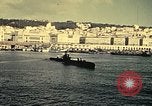
Italian submarine enters harbor at Tunis, Tunisia, and docks.
Setting is Port of Tunis, Tunisia, following Occupation by Allies in 1943. The entire film depicts an Italian submarine transiting the harbor and eventually berthing at a dock.

Views of Tunis harbor filmed from a ship whose crew also demonstrates firing of ship's guns.
Montage of brief scenes in World War 2, around Port of Tunis, Tunisia, following Occupation by Allies in 1943. The first is view from a ship rising and falling with waves or swells in water, with sun setting in background. Next a high speed boat (perhaps a PT boat) is seen churning up large white wake as it speeds about in waters near Tunis. Closeup of a sailor (aboard the camera boat) manning a deck gun. He maneuvers the gun in various elevations and directions and then fires a round from it. Another crew member fires a tripod mounted Browning M 1919 air cooled 30 caliber machine gun. A third sailor fires a twin 20mm antiaircraft gun from a station atop the ship. A soldier fires his rifle from the ship's deck at sunset. Camera pans across widely spaced group of warships in the distance, and continues panning to show city of Tunis on the horizon. Now in Tunis harbor, the camera ship moves past a sunken ship with masts and funnel showing above water surface. Anchored transport ships silhouetted against light sky in the harbor. Stern view of a landing craft infantry. Huge explosion occurs in the water. An American soldier is seen on a sandy hill plunging the handle on a detonator. Views of waters turning rough in the area. Change of scene and time (water is extremely calm). A beached ship is seen in the harbor and several boats.

Dayton, Ohio plans to increase the number of persons employed in its war plants (WW2)
Film opens showing large factory building with all its lights on at night. Smoke stacks at industrial plant emitting white smoke against dark sky. Sparks flying outdoors from a steel plant at night. War production workers inside a fabricating plant drawing a ribbon of hot steel from a roller and dragging a newly made sheet of metal across the floor. Two men with shovels stoking a furnace. Men shaping parts on forging machines. A group of men using sledge hammers to drive down pipe supports under a large piece of sheet metal. Women employees at work inspecting U.S. Army helmets on an assembly line. Workers in a crowded machine shop. A sign reading: "500 workers needed NOW Training on the job." A display of job recruitment announcements in newspapers. A room full of idle manufacturing machinery (ostensibly due to labor shortages). Sign on iron fence outside a building, reads: "Essential WAR WORK Day or Night Men and Women" and "We have a war job for you. Apply here." Some more similar signs. Animated chart of Labor Needs with Labor supply lagging behind, superimposed on a drawing of a defense plant. Map of the USA highlighting areas of industrial might where labor shortages exist. Camera zooms in on Dayton, Ohio on the map. Aerial views all over the city of Dayton, Ohio. View from a tall building overlooking a major Dayton commercial street. The Gem City Savings building, with clock tower on top, at the corner of Third and Main streets. On April 7, 1943, two hundred leading citizens of Dayton are seen attending a meeting at which Stanley C. Allyn, President of the National Cash Register Company, is speaking. He speaks about the danger of Dayton falling behind its war production goals because of manpower difficulties. View of the audience, which includes several military officers in uniform. Allyn speaks of the potential for war work being moved elsewhere because of this, and challenges Dayton's leaders to solve the problem without requiring action from Washington. Next, an emergency committee of community leaders is seen around a table. Camera pans over attendees, including labor leaders from AF of L and CIO; Government officials present, including Area Director and Deputy Regional Director of the War Manpower Commission, and Chief of Program Requirements for the Region; leading industrialists and retailers are shown. Local officials seen include the Mayor of Dayton and Secretary of the Chamber of Commerce as well as the Commanding Army Air Forces Generals of Wright Field and Patterson field. In final scene, Stanley Allyn is seen at the head of the table, speaking to the group. He outlines three ways to obtain more war workers from the Dayton population during World War II.
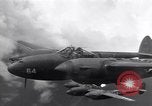
P-38 aircraft of the U.S. Army 13th Air Force demonstrate their speed and maneuverability
November 25, 1943 in the South Pacific during World War 2. Two P-38s of the 13th Army Air Force photographed in formation from a third airplane. Cumulus clouds in the background.The two P-38s peel off and dive. In another sequence, the P-38s join in close formation, peel off and maneuver at high speed in the distance, over water. Includes closeup views of individual P-38 aircraft and of multiple P-38 aircraft in formation.

P-38s of U.S. Army 13th Air Force demonstrate ability to drop auxiliary tanks during World War II in Pacific Theater
November 25, 1943 13th Air Force, South Pacific,during World War 2. A flight of three P-38s in formation with cumulus clouds behind them. Two are being photographed from the third airplane. The lead P-38 demonstrates ability to improve performance for aerial combat, by jettisoning its long range 250 gallon drop tanks and accelerating ahead of the other aircraft.
CRITICALPAST.COM: About Us | Contact Us | FAQs - How to Order | License Agreement | My Account | My Lightboxes | Shopping Cart | Advanced Search | Featured Collections | Website Terms & Conditions | Privacy Policy ©2026 CriticalPast LLC.
License Agreement |
Terms & Conditions |
Privacy Policy
©2026 CriticalPast LLC.