


 Francais
 Deutsch
 Italiano
Refine Your Search
Goodenough Island New Guinea 1943 stock footage and images
- Showing 7795 to 7800 of 13637 results more
more Hide
Hide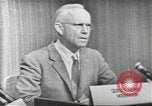
U.S. Senator John Kennedy talks about the foreign policy of America prior to presidential elections in the United States.
The fourth presidential election debate held between Democratic nominee Senator John F. Kennedy and Republican nominee U.S. Vice President Richard Nixon in New York, United States on 21st October 1960. ABC news correspondent Quincy Howe speaks prior to the fourth Kennedy-Nixon presidential debate. Senator Kennedy says he agrees with the policy of Eisenhower's administration regarding the Formosa Strait (Taiwan). He speaks about Communist influence of Cuban Prime Minister Fidel Castro on Latin Americans which is becoming a threat for the United States. Kennedy also mentions Communist Russians broadcasting ten times as many programs in Spanish to Latin America as the United States does. He talks about technical assistance given to Africa by the United States. He speaks about future of increasing communist influence in world. Kennedy mentions Liberia and the Union of South Africa who voted with America on the question of admission of Red China in the United Nations. Senator Kennedy speaks about Communist influence increasing in the world and relates to it by saying that there are six counties in Africa that are members of the United Nations and there is not a single American diplomatic representative in any of these six. He further speaks about military progress of Communist nations.
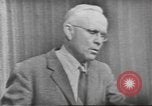
Vice President Nixon and Senator Kennedy debate over a fight against communism prior to presidential elections in the U.S.
The fourth presidential election debate held between Democratic nominee Senator John F. Kennedy and Republican nominee U.S. Vice President Richard Nixon in New York, United States on 21st October 1960. ABC News correspondent Quincy Howe speaks during the debate and allows correspondent Walter Cronkite to ask Senator Kennedy a question. Mr. Cronkite asks Senator Kennedy that in what areas the United States might take offensive against communism rather than being defensive to the Soviet Union. Senator Kennedy replies to the question and says that the eastern Europe is very vulnerable area according to him. He says there should be policies which make it possible to establish closer relation with a country like Poland and he also mentions the Hungarian Revolution. Senator Kennedy speaks about the relations between the Soviet Union and China. He says that India represents a great area for affirmative action by the free world. India started from about the same place that China did. India under a free society has been making some progress. But if India does not succeed, Communism can take over. He says that in Africa, Asia, Latin America, eastern Europe, the great force on their side is the desire of people to be free. Correspondent Howe asks Vice President Nixon to comment on the topic. Nixon speaks about Poland and says that Poland in not in a position to take any independent position under Soviet control. He talks about aids being sent to Poland from the U.S. and says that the U.S. can have more exchange with Poland or with any other Iron Curtain countries.
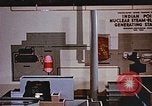
Various power plants and different uses of isotopes in United States,1957.
Men discussing design of Model of 275000KW Indian Point Nuclear power plant to be built in New York. Nuclear power plants in Detroit,Chicago and New England planned in next 10 years. Animation of a map of U.S. shows new nuclear power plants to be built. Narrator indicates that by 1975 atomic plants (nuclear power) may provide a substantial portion of the U.S. electricity. Views of electric power supply lines and towers. Cans of isotopes in a factory. A reaction studied by scientist. Exterior of White Plains Hospital building; inside doctors at a radio lab. Iodine isotopes are mixed in water and a patient drinks it. Doctor analyzes the isotopes by a tracer placed near the Thyroid gland of the patient. The doctor looks at the scale. Doctor examines another patient. The patient is given radiation therapy to control malignant tumors of cancer, via a cobalt therapy machine, at New York Memorial Center.
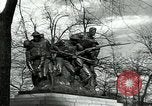
History and contributions of the U.S. Army infantryman to development of the United States of America
Memorial statue in Central Park, New York, to the 7th U.S. Army Regiment of World War I (World War 1, WWI, First World War). American infantrymen run with rifles from C-47 transport planes. U.S. soldiers in battlefield in Europe, and parading in tanks and marching,along the Champs Elysee,in Paris, France, with the Arc de Triomphe behind them. Soldiers march with flags. People watch. Korean War era U.S. soldiers march with rifles. West Point cadets march in New York City. Houses and buildings along the sides of the street. U.S. Army soldiers in various modes of operation: riflemen, artillerymen, paratroopers,ski troops, and Army engineers building bridges. One scene shows a woman soldier working as a mechanic. Soldiers training on an obstacle course, traversing a polar region with dog sleds. A gun emplacement in Hawaii and U.S.troops parading in the Philippines. A ship traversing the Panama Canal. View of U.S. Army tent Camp in Puerto Rico. A U.S. soldier sentry standing guard beside the ocean, in summer, in Iceland. An American soldier poses on a hill in New Jersey, silhouetted against backdrop of the Manhattan skyline with tall skyscrapers of New York City seen behind him. Sergeant James Mansfield talks about Colonel William Wilson Quinn. Colonel William Wilson Quinn on the show discusses the blue badge of the combat infantryman. The badge framed on a wall. He says that the badge has a blue background which is the color of the infantry. Copy of a rifle on the badge is surrounded by a circle with a star.
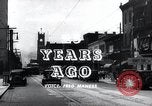
Historical events of 1935 including Stresa Front, U.S. anti-war demonstrations, FDR in Jacksonville, Easter Parade, Female flyers
Scenes showing various historical events that took place in April 1935, during the Great Depression. In Stresa, Italy, on the banks of Lake Maggiore, leaders of Britain, France and Italy confer on German rearmament, in violation and defiance of the Versailles Treaty. (There they sign the "Stresa Front"). Images show the French and British delegations arriving by boat and walking near the port at Stresa, including British Prime Minister Ramsay MacDonald, French Prime Minister Pierre Etienne Flandin, and French Foreign Minister (President of the Council of Ministers) Pierre Laval. U.S. College students across the country join in anti-war, pacifist demonstrations a few years before World War 2. They are seen marching with banners and anti-war signs and cartoons. One banner reads, "It is the task of the 20th century to make this world a brotherhood." Also "War is Hell....Who want to go to hell?" and "War is Stupid". President Franklin Roosevelt returns from a two week cruise. He arrives in Jacksonville Florida. Local officials and crowds in Jacksonville greet him and cheer. Boy Scouts in a line greet the President. Views of Franklin Roosevelt in an open car and on ships and docks. Al Smith and Herbert Hoover share the speaker's stage in New York lending their support in fundraising for the Salvation Army during the Depression. Scenes from the Easter Parade in New York City. Crowds gather, filling double-decker open air buses. Al Smith seen with his wife. Postmaster General James Farley and Irish tenor singer John McCormack are seen on Fifth Avenue in New York. Amelia Earhart completes a 1700-mile flight from Burbank, California to Mexico City. Scenes of her in Mexico City in a car laden down with celebrating Mexican officials. Aviatrix Bernadine King sets a new record for upside down endurance flying. She is seen getting into her plane, and her plane is seen upside down in the air.

Electromagnetic Hazards Group staff talk about ball lightning tests to determine structural integrity of composite materials.
Electromagnetic Hazards Group conducts ball lightning tests under Project Tesla, inside a hangar at Wendover Air Force Base in Utah. An interviewer gets information from the scientists. A team member talks about modern aircraft, new material and avionics system susceptible to lightning. He states that the composite materials used in new aircraft are stronger and don't conduct electricity like conventional metals. The team's research work involves protective measures and verification of the same. He discusses the effect of lightning on aircraft electronics, and the use of Wendover as the research facility due to its reproduction of long arcs. The aim is to study the effects of atmospheric electricity on new materials and electronics systems in modern aircraft. Robert Golka talks about a new company to study and create ball lightning, and apply it to nuclear fusion research.
CRITICALPAST.COM: About Us | Contact Us | FAQs - How to Order | License Agreement | My Account | My Lightboxes | Shopping Cart | Advanced Search | Featured Collections | Website Terms & Conditions | Privacy Policy ©2026 CriticalPast LLC.
License Agreement |
Terms & Conditions |
Privacy Policy
©2026 CriticalPast LLC.