


 Francais
 Deutsch
 Italiano
Refine Your Search
Goodenough Island New Guinea 1943 stock footage and images
- Showing 8029 to 8034 of 13637 results more
more Hide
Hide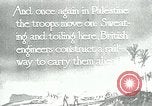
British engineers lay railroad tracks in Palestine. Troops Bivouacked in palm grove.
British military engineers (they appear to be Australian and or New Zealand, ANZAC, troops) constructing a railroad line in Palestine during World War I. Some drive spikes to secure the new rails, as others position them with long steel poles. Teams of local laborers carry materials forward from the track-laying supply train that moves forward as track is installed. Another scene shows a holt tractor pulling British artillery and men across the sand. Final scene is of British troops bivouacked in a grove of palm trees. The Suez Canal is visible in far background. (World War I; World War 1; WWI; WW1)
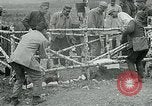
U.S. and French soldiers repair the grave of Lieutenant Quentin Roosevelt in World War I
French and American soldiers remove a makeshift fence from around the grave of Lieutenant Quentin Roosevelt (son of former President Theodore Roosevelt) who was killed during aerial combat in skies over Chamery, France, on June 14, 1918. He was buried with honors, in a battlefield grave, marked with a simple wooden cross, by German fliers. Now American and French soldiers are seen placing a new fence around the grave, along with a new cross and headstone, engraved in French. They also place floral pieces on the grave.
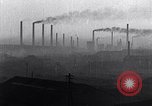
People work at cotton, paper and automotive factory in Japan.
Industry and production activities of Japanese people working in Japan. Smoke rise from chimneys at industrial factory area. Factory workers go towards plant. Woman works at a machine in cotton plant. Man paints on dish. Woman feeds flax into machine. Men cut down trees in forest. Wood logs are rolled to water. Machine chops wood to pulp. Filled vats ready for paper processing. Hot melted metal at steel plant. Worker takes out hot metal rod. Workers in a car factory. Workers assemble parts of truck at automotive factory. Ready vehicles come out of factory in line. Train pulls into elevated subway station. People get off train. An electric train arrives. Persons of management and labor representatives sit and discuss for common good. Workers at shipyard. Ready and decorated ship launched in sea. People wave. Ship heading for New York harbor. New York skyline in the background.
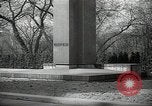
President Woodrow Wilson's statue in a park in Czechoslovakia.
The Woodrow Wilson Monument (New Town, 110 00 Prague 1, Czechia) in New Town, Prague, Czechoslovakia before World War II. President Woodrow Wilson's statue in a park. Written on a wall nearby: 'The World must be made safe for Democracy'. People pass through the park.
French soldiers firing various machine guns in World War I
French soldiers firing a Saint-Etienne model machine gun in a field in France. One soldier waits with a new strip holding 24 rounds of 8mm Lebel ammunition. As the previous clip is done firing, he inserts the new one, and the gunner continues firing. Behind them another gun crew is firing a Maxim machine gun. Next, French gunners are seen firing Hotchkiss Mle 1914 machine guns. Data appears on the screen comparing the machine gun output from the mobilization to 1917. (World War I. World War 1. WWI. WW1)

Devastation from atomic bomb dropped on Hiroshima Japan in World War II
U.S. War Department film showing devastation from atomic bomb dropped on Hiroshima, Japan, during World War 2. Opening scene is darkness of predawn in Alamogordo, New Mexico, on 16, July, 1945, at 5:29:45 AM. Suddenly, a huge explosion lights up the sky. A fireball and mushroom shaped cloud form. Closer view of the explosion from another camera. Following the initial explosion, the ensuing sound is a continuous roar. Another view is shown, from a third camera location. It highlights the boiling fire and smoke of the explosion. These scenes document the first successful test of a nuclear weapon, code named "Trinity". Change of scene shows glimpse of the Manhattan Project B Reactor site at Hanford, Washington, as viewed from a car driving past. Closeup of the facility, from right up against a boundary fence. Glimpses of other Manhattan Project facilities in New Mexico, Oak Ridge, Tennessee, and another view of the Hanford, Washington facility. Next, a rough topographical map of Japan is shown. Closeup of elevated railroad train traveling in Hiroshima, Japan. Imperial Japanese Army motorized vehicles are shown on parade, including fully tracked open personnel carriers with soldiers aboard and Type 94 Tankettes being driven by individual soldiers. Japanese infantry marching in full field gear including shouldered rifles with fixed bayonets. Closeup of a Japanese Army officer. Glimpse of Japanese support troops, such as quartermaster elements, in black uniforms. Japanese technicians in white lab coats at a wartime facility. Japanese Navy Warships being launched from Hiroshima ship yards. A lone B-29 bomber seen in flight over clouds. Its tail number, 42-63735 is clearly seen. It displays a large "05" on it upper tail. (This is not the "Enola Gay" whose tail number was 44-86292.) Closeup of one of the aircraft's engines with propeller turning. Glimpse upward from interior of the aircraft. Scene shifts to aerial photograph of Hiroshima with overlay depicting the bomb strike zone. Animated map showing explosion and precise point ot detonation above the junction of the Motoyasu and Ota Rivers. A view at the ground of destruction from the atomic explosion. An American soldier stands in the midst of the destruction. Slabs of heavy concrete are destroyed. View looking East from ground zero, past a burned tree trunk in the foreground, where the shells of several stronger buildings still stand amidst a sea of rubble. To the South, hardly anything is left standing. Looking West, everything is essentially leveled.
CRITICALPAST.COM: About Us | Contact Us | FAQs - How to Order | License Agreement | My Account | My Lightboxes | Shopping Cart | Advanced Search | Featured Collections | Website Terms & Conditions | Privacy Policy ©2026 CriticalPast LLC.
License Agreement |
Terms & Conditions |
Privacy Policy
©2026 CriticalPast LLC.