


 Francais
 Deutsch
 Italiano

Refine Your Search
Goodenough Island New Guinea 1943 stock footage and images
- Showing 8221 to 8226 of 13663 results more
 Hide
Color Sound
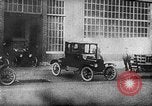
Scenes related to the Ford Motor company and the Ford Model T automobile in the United States.
Ford Model T cars being driven out the exit door of the Highland Park factory, Michigan,circa 1916. Numerous Model T cars driving on both sides of a divided highway. The Ford Highland Park Plant, circa 1920. Panoramic exterior views of the Ford River Rouge plant and factory buildings, circa 1930. A Ford Freighter ship, docked at the River Rouge plant. A view of the home of Henry and Clara Ford, at 66 Edison Road (now 140) Dearborn, Michigan, in 1914. Sketch of children coming home from school, singing song from McGuffey reader school book. View of schoolroom with McGuffey readers on desk. Narrator relates story of Henry Ford trying to buy a McGuffey reader and being unable to obtain one. Narrator states that Ford realizes from this incident "the changes that are reordering his culture. The modes of life which Henry so loved are passing, disappearing into history." Street scene outside Ford Plant, during shift change, and street filled with workers. A car driving on empty road in Sudbury, Massachusetts. The historic Wayside Inn (immortalized in Henry Wadsworth Longfellow's "Tales of the Wayside Inn") which Henry Ford purchased in 1923, to preserve for posterity. View of the original Pennsylvania Railroad Station in New York City, circa 1912. View of crowded sidewalks and street on 5th Avenue, and other street scenes in New York City, circa 1920. Model T Ford cars driving in U.S. National Parks. A visitor feeding a bear from his Ford car, as a U.S. National Park Ranger stands nearby. People in Ford Model T, stopped by side of road to pick wild flowers. Two men remove a seat back from their Model T car to make a camper. Both men lying down in the car. Man carrying picnic basket from Ford Model T, parked beside a beach, where he joins the rest of his party on the sand. Children run along the beach, and stop to play with seaweed.
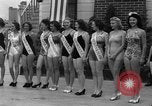
Miss Ohio Marilyn Meseke wins Miss America contest and poses wearing a sash in the United States.
Marilyn Meseke wins 1938 Miss America. The contestants wearing costumes lined up during the pageant at the Steel Pier (1000 Boardwalk, Atlantic City, New Jersey, U.S.) in Atlantic City, New Jersey. Miss Ohio Marilyn Meseke wins. Marilyn with Miss America crown. The winner poses with a sash.
Israeli delegates go to the United Nations and seek for a separate Jewish state -- formation of Israel.
Formation of Israel in May 1948 and events leading up to it. October 1947: Jewish refugees from Europe aboard two ships arriving in Palestine, only to be turned away by British authorities and sent to internment in Cyprus. They get off from the ship Cyprus. A Jewish woman with her child at the dock. A sign reads 'United Nations Palestine Commission'. Delegates seated in a hall debating about the partition of Palestine between the Jews and the Arabs. Destroyed houses and buildings in Haifa after fighting between Israeli and Arab forces. Jewish troops holding guns walk on the ruins of building. The dead Jewish people on street. The troops stand in a group. Captured Arab prisoners in the Negev desert area, being directed by Israeli Defense Forces soldiers (IDF). The prisoners with their hands up enter a vehicle. Cars and people on a street with a traffic circle in Tel Aviv. Prime Minister of Israel, David Ben Gurion, enters a building on May 14, 1948, to be installed as leader of the new government. The Jewish soldiers stand holding guns. A flag of Israel flutters in the air on a flag pole. United Nations soldiers stand holding a white flag and join Israeli troops in recovering bodies of Israeli soldiers killed in ongoing skirmishes with Arab forces. The troops stand on a border. President of Israel Chaim Weizmann, a Jewish patriot, walks with officials. Soldiers stand on the side. The Israel delegates go to the United Nations and seek for Israel to be admitted to the United Nations. Delegates seated in hall. Middle Eastern Arab country representatives of the UN walk out of the hall in protest after Israeli receives the vote admitting it to the UN. The empty seats of the Arab countries. The new state of Israel is born. Flags are raised at the UN including the flag of Israel. People cheer and celebrate. From a July 2, 1964 newsreel of "Yesterday's Big Story".
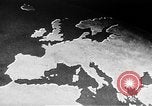
The Marshall Plan is implemented in different European nations so that they can recover from economic problems.
A documentary reviews the beginning of the Marshall Plan in response to the post war (World War II) needs of Europeans. It depicts its effect on the lives of people during the first year of its implementation. People on a street. A map of Europe. Animation depicts the production of textile, output of coal, requirement of manufacturing industries, and declined food production. U.S. Secretary of State George Catlett Marshall, Jr., tells the people of Europe that if they work together the U.S. will supply money for food and raw material. Wide and close views of newsstand in England, United Kingdom. British man buys a newspaper to read about Marshall's appeal in the newspapers. Traffic on the streets in Paris, France. Foreign Minsters of Great Britain, France and Soviet Foreign Minister Vyacheslav Mikhailovich Molotov arrive in Paris and ascend steps of building for a meeting to discuss the Marshall Plan. The delegates and representatives at the meeting. Molotov comes out from the meeting. Animated map depicts 16 European nations which get together to work for economic development. The delegates seated in a hall in Paris. The Organization for Economic Co-operation is formed. Delegates of European nations signing a document. Wide view of a port area in Norway. A book on a table reads 'First Annual Requirements Program Submitted to O.E.E.C.' Wide view of Piazza del Popolo in Rome, Italy with Flaminio Obelisk in the center and traffic on roads Traffic and people on roads of Ulus Square (Ulus Meydanı) in Ankara, Turkey, with the equestrian statue Monument of Victory, depicting Mustafa Kemal Atatürk on horseback. Busy street and pedestrian traffic along O’Connell Street in Dublin, Ireland, with Gresham Hotel visible. Traffic passing over the O’Connell Bridge spanning the River Liffey. The U.S. Capitol in Washington DC. A meeting of the Congress for the Marshall Plan. View of Paul G. Hoffman who was appointed the administrator of the Marshall Plan. Man smoking cigarette and tuning radio to listen to broadcast. Families and people in living rooms listen on radios to news about the European Recover Program (ERP). Men unload food supplies sent by the U.S. from ships at a dock. People listen to a dignitary. Men unload machines from the ship. Workers in the Netherlands ride bicycles. A man unloads cotton from a freight car. A sign for ERP on the freight car. Men at work in a textile mill in the Netherlands. A coal hoist is delivered in Britain and British miners dig out coal and use the hoist. The coal is loaded aboard a ship for trade. Fiat automobile assembly line seen in operation in Turin, Italy, with workers building new 1948 Fiat Topolino cars.
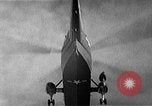
Events leading to Cuban Missile Crisis as United States military prepares for emergency in October 1962.
Events leading to the Cuban Missile Crisis of October 1962 when the United States and the Soviet Union confronted each other with nuclear destruction. A helicopter lands on the White House lawn in Washington DC. Scenes of Cuba and emergence of Castro in recent prior years. Beach views in Cuba. A military parade in an earlier time, with Cuban troops marching in front of the Monument to the Battleship Maine. Next scene shows desecration and destruction of the Battleship Maine Monument in Cuba.. A crowd of cheering Cuban people as Fidel Castro enters Havana, Cuba in 1959. Exterior view of United Nations building in New York City. Fidel Castro and Soviet Premier Nikita Khrushchev embrace during meeting in New York in September 1960. Deputy Premier of the Soviet Union Anastas Mikoyan deplanes and is greeted by Fidel Castro in Havana. A trade agreement between Russia and Cuba signed by Fidel Castro. Russian cargo ships en route to Havana. Cuban refugees in small boats. A map depicts proximity of Cuba to the U.S. U.S. surveillance aircraft heading for Cuba. A sign reads 'HQ. 4080 S W Intelligence Division'. Men examine reconnaissance photographs of Soviet nuclear missiles in Cuba. The photographs show transports and tents for fueling and maintenance. A sign reads 'Strategic Missile Facility GAM 77 Combined Systems'. U.S. missiles rolled out of hangar and readied for emergency. A U.S. Air Force B-52 bomber aircraft takes off from an airfield. U.S. Navy ships in the Atlantic Ocean. A U.S. submarine underway at sea.

Description of American demographics in 1970 emphasizing diversity of backgrounds and cultures
Animated map assembles sections of the United States of America reflecting various kinds of inhabitants. A woman of Native American Indian origins weaves a straw hat as a young boy plays nearby. Sign outside a building identifying the "Slovak Political Benefial Assn." Other signs on seen on different buildings include: "Polish Army Veterans Association of America;" "Ukrainian American Youth Association;" and "Germantown Hospital." A brass plate on a building reading: "English-Speaking Union." Asian-American school girls, and a Japanese-American man with a boy. View of a wood carving in ancient African style. A street scene showing many Hispanic Americans, and commercial signs in Spanish. A group of new American citizens reciting oath at a naturalization ceremony, each receiving a small American flag. Some appear to be of Asian or South Asian descent, including possibly Vietnamese. Animated map shown again, indicating the geographical distribution of Americans in the U.S. First it shows areas where citizens live near water, either the oceans, Gulf of Mexico, or the Great Lakes. Montage of urban scenes showing some of the cities where most Americans live. The Massachusetts State House in Boston. New York City street scene with the Empire State Building in background. City Hall in Philadelphia, Pennsylvania. The Capitol in Washington, DC
CRITICALPAST.COM: About Us | Contact Us | FAQs - How to Order | License Agreement | My Account | My Lightboxes | Shopping Cart | Advanced Search | Featured Collections | Website Terms & Conditions | Privacy Policy ©2026 CriticalPast LLC.
License Agreement |
Terms & Conditions |
Privacy Policy
©2026 CriticalPast LLC.