


 Francais
 Deutsch
 Italiano

Refine Your Search
Goodenough Island New Guinea 1943 stock footage and images
- Showing 8407 to 8412 of 13663 results more
 Hide
Color Sound

Loss of life during Battle of Tarawa, World War II.
High casualties occur in Battle of Tarawa. Dead bodies of soldiers lie amidst wreckage. U.S. Marine feeds a cat under damaged tank and advances towards Japanese pill box. Stripped Japanese is marched in by U.S. soldiers. U.S. soldiers view a damaged plane.
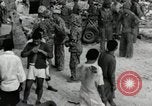
Korean workers during Battle of Tarawa, World War II.
Korean workers standing amongst U.S. Marines. Japanese twin mount gun is seen. Marines crawls and advances on dugout.

American Destroyer Escorts complete shakedown training in Bermuda, during World War II.Montage of naval engagements.
American Destroyer Escort USS Frament (DE-677) arriving, with other Destroyer Escorts, off the coast of Bermuda, during World War 2. (The Destroyer Escort USS Dionne, DE-261, appears in one scene.) Crewmen at bow of the Frament drop anchor into the water. Sailors jump in water for a swim. Sailors in uniforms being reviewed by officers aboard the deck, before taking boats to shore, on liberty. View of a busy street in Bermuda. Two sailors are asked for their IDs by a U.S. Shore Patrolman. Pedestrians on the street. Bermudian Policeman directing traffic. Sailors in uniforms travel on bicycles and in horse- drawn carriage. The Commander of the Shakedown Operation inspects crews of the Destroyer Escorts before they head out to sea from Bermuda. At this point, a montage of naval engagements is seen including sailors firing at attacking airplanes, aircraft attacking ships, depth charge being launched from a destroyer escort and exploding.

The wounded U.S. Marines are carried to a landing craft and the U.S. Army Units relieve the Marines during the battle of Tarawa.
U.S. captures Tarawa from Japan during World War II. Fighting in Tarawa. Explosions as the enemy positions are shelled. The U.S. Marines move forward. The wounded are placed on stretcher and the Marines waddle through the water and carry the wounded to the landing craft. A Marine takes off his battered helmet. The Marines move forward and on the way take prisoners. Dead Japanese soldiers. A Marine feeds a lone kitten which has survived. The U.S. Army Units relive the Marines. A colonel with his soldiers. U.S. soldiers salute as the American flag is hoisted. A soldier blows into a trumpet.
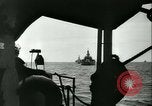
U.S. Signal Corps officers and soldiers use mine detectors, modern radars, and meteorological equipment during World War II.
The role and contribution of the U.S. Army Signal Corps in combat and war. U.S. shuttle ships loaded with signal communication supplies for U.S. and Allied troops in the European Theater make their way in the Atlantic ocean. The Squier Laboratory at Camp Alfred Vail in Fort Monmouth, New Jersey. A technician works on signal communication equipment in the laboratory. U.S. soldiers use mine detectors in the European Theater during World War II. The mine detectors detect metallic, non-metallic mines, wooden box mines, and mines in glass containers. Artillery soldiers bury large microphones into the ground in advance zones. The microphones relay back information on enemy artillery. Soldiers receive the information on radio sets. U.S. aircraft on a training flight simulating real combat situation: The aircraft lost in heavy rain and rough weather, looking for the location of Boston. The pilot switches on a modern advanced radar. The radar waves pierce thick clouds, are reflected by Earth's surface and display an image on the scope. The image shows the clear location of Boston harbor directly under the aircraft. U.S. bombers attack over the Channel coast on D-Day (6 June, 1944). U.S. soldiers employ meteorological equipment for long range weather forecast in the European Theater during World War II. Soldiers release a hydrogen balloon into the sky. Another soldier uses an apparatus to take readings of atmospheric conditions behind enemy lines. An aircraft drops an automatic weather station called SCM-18-TI by parachute into enemy territory. The timed mechanism sends out weather data in codes. The interior of the automatic weather station lying open in a field.
V-mail procedures including cutting, microfilming, transport, photographic enlargement, and processing during WWII.
The use of V-mail (Victory Mail) by the United States during World War II. V-mail procedures including cutting, microfilming, transport, photographic enlargement, and processing of V-mail letters and post. A poster promoting the use of V-mail. Women in a line at a post office. The post office staff at counter windows serves the customers. A woman collects a V-mail letter, writes her message and then addresses the letter. The preferred use of a softer pencil in V-mails. Cutting: Specially trained soldiers unpack the V-mails and use a cutting machine to open each mail. Processing: The experienced staff sorts mails into the respective destination groups at sorting tables. Soldiers open mails to photograph them. A soldier sorts mail that can't be photographed and are to be sent back. These mails include stamps, enclosures, snapshots and bad writing. The correct mails are then sorted into given numbers in bundles. Microfilming: Women use Airgraph machines to photograph each mail on 16mm films. 1600 mails on 100 feet of film. The complete reels are sent for developing. Women put in new reels of negatives into the cameras. Developers dry the film reels. Stacks of reels on a table containing images of thousands of letters. Soldiers packing and stacking many hundreds of sacks filled with V-mail letter microfilm images. A Boeing 314 Pan American Clipper flying boat sea plane (military designation C-98) is seen taking off to transport V-mail to major destination points. A bag of microfilm reels is delivered to an officer. He unpacks the reels and sends them to the printing room. Enlargement: Enlargement machines are used to enlarge the snapshots. Men and women operate the printing machines. Soldiers with the printed facsimiles on tables. Processing: Women slice the prints into separate letters. Machines used to insert facsimiles into V-mail envelopes and seal them. The mails are then sent to the exact destinations by ordinary post. Soldiers gather around as a comrade distributes mail at a U.S. military base in the combat area.
CRITICALPAST.COM: About Us | Contact Us | FAQs - How to Order | License Agreement | My Account | My Lightboxes | Shopping Cart | Advanced Search | Featured Collections | Website Terms & Conditions | Privacy Policy ©2026 CriticalPast LLC.
License Agreement |
Terms & Conditions |
Privacy Policy
©2026 CriticalPast LLC.