


 Francais
 Deutsch
 Italiano
Refine Your Search
Goodenough Island New Guinea 1943 stock footage and images
- Showing 871 to 876 of 13636 results more
more Hide
Hide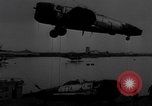
Montage of scenes from the air war between U.S. and German warplanes during World war 2
Montage of scenes from air war in Europe, covering period from about 1943 through 1945 during World War Two. U.S. P-47 and P-38 fighter aircraft being unloaded from a ship at a port in Europe during the Second World War. A line of P-47s on an airfield. German aircraft taking off and inflight, including: Me-109; He-111 bombers; Me-110 fighters; and Fw-190 fighters. U.S. P-51s firing at and destroying German aircraft. Multiple aerial dogfight scenes with gun camera footage showing dramatic mid air explosions of various enemy German aircraft. U.S. B-17s flying to Berlin and back again, with P-51 fighter escorts. P-38 aircraft flying in formation and returning from escort duty, seeking targets of opportunity, strafe German airfields, and fire on German aerodromes and parked aircraft, destroying many airplanes.

Allied forces prepare for D-Day, also known as 'Operation Overlord' (WW2)
'Eve of Battle' depicts the Allied invasion of Europe during World War II. Slave labor from Nazi Germany-invaded countries construct Atlantic Wall. German artillery and fortifications in the Atlantic Wall. Nazi German soldiers marching in groups. Nazi leader Adolf Hitler shake hands with Italian fascist leader Benito Mussolini. Allied leaders Franklin D. Roosevelt, Winston Churchill and Joseph Stalin sit together during the Tehran Conference in December 1943. Exiled Allied leaders such as General Charles de Gaulle of France, Queen Wilhelmina of the Netherlands and Dr. Edvard Beneš of Czechoslovakia inspect Allied troops. Various Allied troops from Poland, Norway, England, United States, and Czechoslovakia prepare to launch an invasion in France. Eisenhower along with other officers plans the European invasion. Allied ships and aircraft on their way to Europe. Allied bombers drop bombs over Nazi German U-boats. Naval battle begins and explosions occur, smoky docks. In England war supplies unloaded. Supplies include weapons, military equipment, and food. A tank and locomotive trains being loaded into a ship bound for Europe. Allied aircraft take off at night. A man directs an aircraft taking off. Allied bombers bombard German targets resulting into fiery flare in Europe. British children playing jump rope as a supply train pass by in the background. Tanks and fighter planes transported by train. Supply boxes unloaded and stacked for transport to the battle front.
Internees from Brussels at the Buchenwald concentration camp interviewed in Germany.
Internees at a concentration camp in Buchenwald, Germany. Jean Blume, leader of socialist national movement against occupation in Belgium, shares his experiences of the days spent as a prisoner at Breendonk concentration camp in Belgium. He expresses joy at being liberated by American Army from Buchenwald concentration camp. (Note: Jean Blume was a Resistance Leader during the Nazi occupation in World War 2. The Gestapo arrested him on January 19, 1943 and he was imprisoned in Breendonk. In May 1944, he and many others, were sent to Buchenwald. They were released on April 11, 1945.)
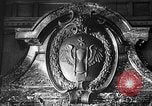
Nuremberg Trials reveal the Nazi enslavement of people in occupied countries and atrocities against Jewish people during World War II.
Opening scene, in 1946, is the courtroom where Nazi officials are being tried for war crimes at the Palace of Justice in Nuremberg, Germany, where the procecutor has completed charges 3 and 4, concluding the indictment against them. Sitting in first row of the dock are Hermann Göring (or Goering) (hidden behind soldier), Rudolf Hess, Joachim Von Ribbentrop, and William Keitel. The camera focuses on Fritz Sauckel, as he is identified as the Nazi slave labor chief. Supporting documents are shown. Film footage scenes of slave workers being rounded up and working on shipping docks, emptying rail cars, repairing railroads, and digging in open pit mines, under Nazi military guard. Next are shown views of Hermann Goering walking in an occupied village in 1942, overseeing the confiscation of all of the livestock. German soldiers releasing and rounding-up cattle, sheep, and pigs that had belonged to citizens of an occupied village. Dr. Wilhelm Frick is shown. He is charged with eliminating elderly, insane, or uncurable sick Germans, considered "Useless Eaters" and subject to Nazi euthanasia programs. Several frail and sick or mentally disabled persons are shown. Crosses are shown marking burial places of these persons outside the institutions in which they died. Next, several German Jewish men in civilian clothes are seen rushing to a work site where they are put to work as slave labor digging with shovels under direction of a Nazi military officer. Scene shifts to Nazi Storm Troopers (Sturmabteilung) harrassing German Jewish shopkeepers, writing anti Jewish messages on the windows, encouraging boycott, and preventing their businesses from operating. More views of Nazi Storm Troopers causing trouble in the streets. Next scene is Hermann Goering reading some dictates as Hitler and Hess, along with other Nazi officials, sit in attendance. The so called "blood purity" rules or blood purity laws of the Nuremberg Laws define German citizens narrowly and prohibit marriage between "German Citizens" and Jews. An unseen audience roars its approval. Jewish people are next seen being rounded up and beaten, mistreated, harassed, and evicted from home. Back at the trial, the prosecutor speaks of Nazi SS Brigadier General Jürgen Stroop cleaning out the Warsaw Ghetto, in Warsaw, Poland, in utter ruthlessness in 1943. Scenes of Polish Jews people being driven and dragged out by SS and Gestapo forces, many unclothed, and the entire place being dynamited afterward. View of a detonation system, and then a huge explosion and walls of the Warsaw ghetto in Poland area are seen crumbling to the ground. Buildings burning and people leaving with injured on a stretcher. Scenes of Nazi agents, Gestapo, and Wehrmacht Army chasing Jews from sewers using tear gas and driving them from buildings using light tanks and armored vehicles. Jews are rounded up, beaten with clubs, and dragged by Nazi German SS and Gestapo authorities who capture them. Back in the courtroom, Rudolf Hess is seen describing how Nazi doctors would screen arrested Jews as they entered concentration camps. Views of crowds of Jews entering a concentration camp near a railroad train depot. A large group of Jewish children at a camp. Children hold up their arms and the boys and girls reveal tattoo numbers on their arms. More views of women and children moving through outside paths of a concentration camp, surrounded in barbed wire and fencing. Views of so-called camp shower baths in which prisoners were killed by poison gas. Clothing of prisoners hanging outside the gas chambers, which the prisoners were told were delousing chambers. Views of the gas chamber shower heads and gas output vents. Views of naked prisoners, some seated and some laying down, inside a gas chamber. View of dead, naked prisoner bodies stacked up in a room. View of bags filled with gold from rings and teeth of the dead. Canvas bags and chests containing the teeth and gold jewelry, held in the Reichs Bank. Closeup of corpses. Bodies being loaded and unloaded from flatbed trucks and being dragged by camp inmates and German soldiers, and thrown into mass graves.
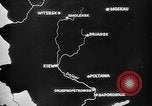
German infantry supported by tanks, artillery, rockets, and Stuka planes move up near Nevel, Russia
Animated map starts the film, showing the Eastern (Russian) front in vicinity of the Dnieper River, during beginning of winter, 1943-44, as German forces battle against Soviet forces in World War 2. German troops are seen in deep trenches and lying prone behind rubble. Light snow covers the ground. Closeups of German tiger tanks moving along a muddy path beside a river. German Panzergrenadiers taking a smoking break during a lull in combat. German soldiers trudging through mud as snow falls. They pass by some German artillery field pieces firing at Soviet positions. Heavy German guns firing. German troops hurrying toward entrenched positions. Closeup of two soldiers conversing as one points toward Soviet positions. A soldier takes up his defensive spot at the mouth of a dugout at the end of a trench. Closeup of two German soldiers smoking cigarettes. A German soldier reports to an officer at the front, who pins a medal on him and shakes his hand. Another view of a soldier smoking a cigarette. German soldiers walk past some knocked out tanks. Closeups as they pass the camera. One soldier looks skyward. A large formation of German Junkers Ju 87 (Stuka) dive bombers is seen overhead. View from a Stuka cockpit, as it dives emitting classic sound. Stuka aircraft diving and dropping bomb that are seen bursting on ground below. Good closeup of Stuka in a dive.
Mob uprisings against Fascists in Europe, during the end of World War II. The Third Moscow Conference of the Allied occupying powers. The Belsen trials.
A mob, seeking revenge against Fascist leaders, fills a city square. They pound on steel gates of a government building. Soldiers and police attempt to protect various persons from the mobs. Others are unprotected and suffer beatings and death. Bodies of Benito Mussolini and his Mistress Clara Petacci are seen hung upside down by Italian Partisans in Milan, Italy, on 28 April 1945. Scene shifts to image of postwar occupying powers, United States, Soviet Union, and Great Britain, whose flags are displayed in the center of a conference table during the Third Moscow Conference. Principals signing agreements, in November, 1943, providing, among other things, for lawful and orderly trials of war criminals, following World War 2. Seen signing are: Soviet Foreign Minister Vyacheslav Mikhailovich Molotov; U.S. Secretary of State, Cordell Hull; and British foreign Secretary, Sir Anthony Eden. View of General Dwight D. Eisenhower, leading a contingent of American wartime Generals on a mission to document Nazi atrocities at liberated German concentration camps. Closeup of a man directing local German citizens who were forced to observe the horrors of the camp. Closeup of an oven used to dispose of bodies of victims. Dead bodies of concentration camp victims strewn in a heap. A room filled with documentary evidence to be analyzed and used in war crimes trials. the body of German General Admiral Hans-Georg von Friedeburg , and of Heinrich Himmler, both of whom committed suicide. A hand holding cyanide capsules. Body of Leipzig City Council deputy mayor Dr. Ernst Kurt Lisso slumped over his desk, following suicide. Body of his daughter, Regina Lisso also a suicide victim. Nazi war criminals being rounded up by Allied military.One being carried on a stretcher. Another, a German officer, is taken into custody. Next, Josef Kramer, the Commandant of Bergen-Belsen concentration camp is seen under guard by a British soldier. British soldiers guarding the court room of the second Belsen trial, convened by the Allied occupational forces, in the Gymnasium building of Luneburg. View of the courtroom with defendants wearing numbers. Closeup of numbers 1 and 2, Josef Kramer, and Fritz Klein, respectively. View of Allied military officers sitting in judgment. Closeups of women defendants, including Irma Grese (number 9) and Elisabeth Volkenrath (number 11). Camera pans around the courtroom.
CRITICALPAST.COM: About Us | Contact Us | FAQs - How to Order | License Agreement | My Account | My Lightboxes | Shopping Cart | Advanced Search | Featured Collections | Website Terms & Conditions | Privacy Policy ©2026 CriticalPast LLC.
License Agreement |
Terms & Conditions |
Privacy Policy
©2026 CriticalPast LLC.