


 Francais
 Deutsch
 Italiano
Refine Your Search
Goodenough Island New Guinea 1943 stock footage and images
- Showing 889 to 894 of 13636 results more
more Hide
Hide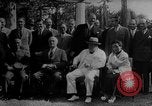
Mixture of scenes from Cairo and Teheran converences with glimpses of Soviet troops on the move and views of bombers and landing craft as well as an atomic test in the Pacific ocean.
Opening scene shows Chinese Generalissimo Chiang Kai-shek seated with U.S. President Franklin D. Roosevelt, British Prime Minister Winston Churchill, and Madam Chiang in their Cairo meeting at a residence of the American Ambassador to Egypt, Alexander Kirk, on November 25, 1943, during World War 2. Foreign ministers of the countries stand behind their leaders. Closeups of the three Country's leaders. Scene jumps to Teheran, with Soviet Leader, Joseph Stalin, President Roosevelt, and Prime Minister Winston Churchill, seated on a veranda of the Soviet Embassy. Suddenly scenes of tanks, trucks, and Soviet troops moving on the Eastern front are seen. Some of the troops move by horse-drawn sleighs through the snow. A line of U.S. Army Air Forces B-17 bombers taxiing on an airfield. View from a B-17 in flight. View f as a cluster of bombs falls from B-17 and explodes on the ground. Animated map illustrating paths of aircraft attacks against the German Atlantic Wall from England. Landing craft underway in an amphibious assault. Brief view from a ship of a post-war test atomic explosion in the Pacific ocean
U.S. Navy Dr. Walt Miner gives historical background of LSD (Lysergic acid diethylamide) drug in the United States.
The film gives an introduction and briefs the history of illegal drug LSD (Lysergic acid diethylamide). U.S. Navy Doctor Walt Miner speaks about revealing the facts about LSD which can be documented. He speaks about the historical background of LSD. He says that LSD is synthesized from lysergic acid derived from ergot, a grain fungus that typically grows on rye. He says that ergot is a fungus that grows on grains and other cereals. He speaks about Swiss chemists Albert Hofmann and Stahl who tried to make modifications in LSD molecule in 1938. He mentions the event of 1943 when Dr. Hofmann intentionally ingested 250 micrograms of LSD in his laboratory and how he felt uncomfortable. Dr. Walt Miner further explains how unique and powerful LSD drug is and says that the most unique thing about LSD is effective dose of the material. Miner states that effective dose for LSD can range from 0.5 micrcograms to 1.5 micrograms per kilogram of body weight.To explain the effective dosage of LSD, he displays a piece of wax paper where a mark is made with a pen. A penny is placed beside that mark to compare the two sizes. Dr. Miner informs that the ink mark weighs some micrograms. Dr. Miner takes one drop of human blood from a tube and says that this one drop contains 330 million cells and in comparison to that the weight of LSD to produce its effect is equal to the weight of two blood cells.

The recruitment of women as Marines in the United States, during World War II.
A film titled: 'Lady Marines' on the recruitment of women in the United States Marine Corps, during World War 2. Views of Marines engaged in combat. U.S. Naval guns firing. A Marine dive bomber in action. Splashes in water from explosions. Marines in an amphibious assault on the beach. Paramarines making a jump. Tanks moving on the field. U.S. Marines firing machine guns. Paramarines boarding an airplane. Views of U.S. Marines in non-combat assignments in Washington, DC. Exterior of the U.S. Capitol building. Trucks being refueled. Marine mechanics maintaining vehicles. Marines engaged in administrative and logistical wartime support activities. A Marine typing a document on a typewriter. Comments about the need to free trained Marines for combat. A scene of Japanese soldiers celebrating a victory. A poster with the photograph of a woman reads: 'Be a Marine'. On February 13, 1943 the Marine Corps Womens Reserve is formed. Women are recruited to relieve Marines for combat. Women Marines salute.
U.S. shuttle-bombing of German positions and military installations under Operation Frantic during World War II.
Film title slate indicates "Operation Titanic" but it, in fact, depicts "Operation Frantic" with U.S. shuttle bombing operations over Germany from bases in Great Britain, Italy and Russia during World War II. United States Army Air Force B-17 Flying Fortresses in flight. Aerial view of bombers in flight with several aircraft flying in formation leaving behind contrails. View inside bomber aircraft with bombardier preparing to drop bombs. View of bomb bay door opening and closeup of hand near bomb drop switch. Bombs awawy view as bombs are dropped from American aircraft. German defenses are bombed along the invasion coast of France (just prior to D-Day) on June 2, 1944. Aerial views of B-24 and B-17 bombers also in flight bombing German military installations in German-occupied northwestern Europe. Aerial view of a target area. Smoke rising up from bombardment. Two different U.S. Army Air Force B-17 Liberator aircraft are seen falling from the sky toward crashes after being hit by German enemy fire. One of them has smoke trailing from it, and the other is in a free fall. Railroad and marshaling yards are also bombed over Debrecen, Hungary on June 2, 1944, with aircraft continuing on (shuttle bombing) rather than returning to base. United States Army Air Forces B-24 Liberator flying in formation on June 21, 1944. Aerial view as they bomb the Focke-Wulf Fw 190 engine aircraft factory near Basdorf, Germany. German factories are bombed. B-17 aircraft on the same date are seeing in formation and bomb railway stations, freight yards, and factory targets, along with the Nazi German Ministry of War, Ministry of Propaganda, and Gestapo headquarters in Berlin, Germany. Heavy flak bursts seen in the air near the aircraft. Dogfight scenes as several German airplanes are shot down. Machine gunners aboard U.S. bomber aircraft firing at German fighter aircraft and shooting down 43 of them, according to narrator. Aerial view of ball turret rotating below bomber and firing guns at German fighter aircraft. The B-17s and B-24s bombing the targets. Synthetic oil plants and refineries are bombed at Ruhland Germany, east of Leipzig. Planning for the operation was done on December 7, 1943. A document about the operation is typed. Animated map shows Nazi positions and method of shuttle-bombing, allowing American aircraft to bomb from Soviet bases, and allies broadly to bomb German targets from bases in the United Kingdom, Italy, and Soviet Ukraine.
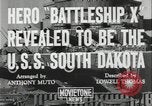
Views of USS South Dakota aka "Battleship X" during World War 2.
Slate reads, "Hero Battle Ship X revealed to be USS South Dakota" Aerial view of USS South Dakota at sea with airplane wing tip in foreground. Sailors assembled on the deck of the USS South Dakota. Overhead view of ship's guns. The ship had been dubbed "Battleship X' for reporting to the press around January 1943 when it was undergoing repairs. Guns firing on the USS South Dakota. An officer speaks.
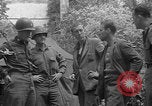
Escaped U.S. Army bomber pilots speak with officers after rescue during World War 2
Two escaped U.S. Army Air Force aircraft pilots, shot down in enemy territory in December 1943 during World War II, speak with U.S. officers after their rescue in 1944. Both pilots are dressed in civilian clothing, and one wears improvised shoes. (Footage shot around the time of the Battle of Cisterna).
CRITICALPAST.COM: About Us | Contact Us | FAQs - How to Order | License Agreement | My Account | My Lightboxes | Shopping Cart | Advanced Search | Featured Collections | Website Terms & Conditions | Privacy Policy ©2026 CriticalPast LLC.
License Agreement |
Terms & Conditions |
Privacy Policy
©2026 CriticalPast LLC.