


 Francais
 Deutsch
 Italiano
Refine Your Search
Goodenough Island New Guinea 1943 stock footage and images
- Showing 9025 to 9030 of 13637 results more
more Hide
Hide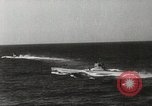
German submarines attack British ships in the English channel during World War II.
German submarines in the English Channel during World War 2, attacking British ships and North American aid ships to Britain. A u-boat submarine gradually disappears in water. A depth gauge meter inside the submarine. German Navy crew men at work inside the submarine and views of interior compartment and controls of German submarine. View of ships from the periscope of the submerged submarine. German submarine fires torpedoes as British ships are attacked by the submarines some of which are on the surface and some are underwater. Sailors at a submarine attack a ship. New ships are launched in the Atlantic from American and Canadian ship building ports. A ship named "Challenge" is christened and launched down skids. Explosions in the sea as Allied ships drop depth charges and hunt German submarines. Sailors observe through binoculars from a ship. A man drinks from a mug. Cargo convoy ships in the Atlantic including one named "King William" supplying the British.
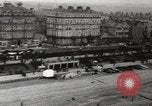
British soldiers with guns at beaches and soldiers check identity of people in England during World War II.
Aerial view of buildings and beaches on coast of England, United Kingdom, during World War 2. Narrator describes preparations by British soldiers for an invasion of England by German forces. British soldiers train for defensive operations. They run holding rifles and take up positions along the coast. Artillery gun barrel as the gun is fired. A group of soldiers run carrying guns. Two soldiers walk. A church and a field. A soldier checks the identity of a woman and a man. Another one stops a vehicle and checks the identity of a civilian driver. Soldiers board vehicles. British aircraft overhead in flight, on patrol against German attack. British troops hold guns and march. New recruits are processed: Man in civilian suit stands in queue to receive military uniform and equipment as he enters the British armed forces. A ship carrying troops from Canada departs its home port bound for the war front. Families of the troops wave from dock and wish them good bye.

Women training and working at war materiel factories in the United States (WW2)
Soldiers on tanks fire artillery mounted on the tanks. Aircraft in flight. Views of explosions in the battlefield. Soldiers walk in lines. The soldiers in front of tents. Anti-aircraft artillery crew fire at enemy aircraft during World War II. New recruits in civilian clothes arriving for training in military armed forces in the United States. Men are trained for the army. Workers in an American factory make war equipment and war materiel. Men work on airplanes. They carry tire tubes for aircraft. People move inside an aircraft production building. Women stand in a line. Women workers report at a war production plant. A woman is being interviewed. Female war materiel workers are seated on benches and an official briefs them about the job. The women receive uniforms including a one-piece coverall uniform, wiping cloth, a cap, hairnet, and safety glasses or safety goggles, and a towel. A woman takes out uniforms from shelves in a closet. A woman wears a pair of glasses and a cap. Women move inside the production factory on the factory floor. A female worker teaches another woman how to operate a lathe. A liquid comes out of a pipe of the machine in operation. Two women work on the lathe. A truck in front of the receiving department. Women at a table make a note of the incoming material. Women work with hammer on a sheet. Women check for flaws in the raw materials. American flag seen on the wall above the women workers.
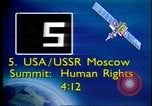
Officials speak on the issues of human rights and religious freedom as interest groups protest in the Soviet Union and the U.S.
The US-USSR Moscow Summit on Human rights in Moscow, Soviet Union. U.S. president Ronald Reagan speaks on issues relating to Human rights, and on Soviet shortcomings in adhering to the Helsinki Accords. Other officials seated in front. He speaks about various human rights, including the right to emigrate and travel. View of the Kremlin in Moscow and of Soviet pedestrians walking in city. U.S. Secretory of State George Pratt Shultz speaks about strategic arms reductions in light of the weapons race. The White house press secretary Marlin Fitzwater at a press conference. The board reads 'Department of State'. Exteriors of the building. View of protesters permitted to demonstrate in the Soviet Union indicating some improvement in conditions. In Washington DC, citizens march on streets demonstrating for the freedom of Soviet Jews. The soviet scholar Peter Reddaway speaks about the reforms and highlights reforms and changing Soviet policy on open-ended internment of mental health patients. People pray inside a church in the Soviet Union. George Weigel, the president of the James Madison Foundation, speaks of importance of religious freedom in the Soviet union on a news panel. Weigel states that religious freedom is a key test of Glasnost and Perestroika. Exterior view of the Ukrainian Catholic National Shrine of the Holy Family under construction in Washington DC, built by Ukrainian American Catholics. People in the Soviet Union protest, marching on a street and holding signs and pickets. A large military parade in the Soviet Union in Red Square.
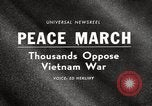
The anti war protests against the United States involvement in the Vietnam War.
Anti-war protests in the United States during the Vietnam War. Protesters march and demonstrate against the United States involvement in the Vietnam War from Central Park to the UN headquarters in New York City. Demonstrators in crowd holding protest signs. A number of African American marchers hold signs that read, "Black men should fight white racism, not Vietnamese freedom fighters." Another sign reads, "They are our brothers whom we kill." Masses of people including doctors, teachers, and businessmen on streets. People dressed in different costumes and 1960s hippie fashion as they protest. Young men participate in burning their draft cards while a crowd gathers around to watch the draft card burning. Pro-war counter protestors (sometimes called "Hawks") also demonstrating and arguing with anti-war activists. Pro-war banner reads, "End Hanoi Sanctuary. Let's bomb Hanoi to win the war and destroy the Communist conspiracy." Another Hawk sign reads, "Anarchy Cannot be Permitted in the USA. Fight Communism and Red Termites." African American civil rights activist Martin Luther King Jr. walks toward the United Nations building with other officials advocating peace. Policemen drag a protester. Scene changes to San Francisco: 50000 people carry banners as they protest the war in Vietnam and march to the Kezar Stadium (670 Kezar Dr, San Francisco, CA 94118, United States) for a mass assembly. People push each other during the protest as pro-war demonstrators clash with anti-war demonstrators and pacifists. A huge crowd gathered at a stadium.

German invasion of France,sinking of RMS Lusitania and resignation of William Jennings Bryan
Events during World War I. Sketches : workers in a German arms factory. German soldiers advance towards France. Animation of a map shows the German invasion of France through Belgium. Kaiser Wilhelm II, the German Emperor. Buildings damaged by invading Germans. U.S. president Thomas Woodrow Wilson advises Americans to stay calm. American people read papers. Cartoon depicts the President about his domestic reforms. The German atrocities in Belgium. Man holds a dead person. Sketch depicts Germany crushing everything on its way. The apprehensive people of America. Sketches of American man against a German leader. Trucks and taxi cabs on the Orne river. A gun barrel. Bombs being dropped on the German ships. Worker at a factory in America. Sketch of a man standing beside a flag having the dollar sign shows the prosperous America. Sketch shows the various resources required by the American industries. An American ship carrying war materiel. Sailors in German submarines. German submarines target allied ships. Sketches of U.S. president Wilson warning Germany. On 1st May 1915 RMS Lusitania a British luxury ship at sea as it starts from New York. Paper shows a warning by the German government. A German sailor on board a submarine as it targets a ship. The RMS Lusitania ship sinks killing many, including Americans. The U.S. secretary of State William Jennings Bryan and Thomas Woodrow Wilson with other officials. The former U.S. president Theodore Roosevelt addresses people opposing President Wilson's policy. The President prepares a note for Germany. Sketch of U.S. Democratic Presidential candidate William Jennings Bryan during his resignation. Sketch of Kaiser Wilhelm II.
CRITICALPAST.COM: About Us | Contact Us | FAQs - How to Order | License Agreement | My Account | My Lightboxes | Shopping Cart | Advanced Search | Featured Collections | Website Terms & Conditions | Privacy Policy ©2026 CriticalPast LLC.
License Agreement |
Terms & Conditions |
Privacy Policy
©2026 CriticalPast LLC.