


 Francais
 Deutsch
 Italiano
Refine Your Search
Goodenough Island New Guinea 1943 stock footage and images
- Showing 9079 to 9084 of 13637 results more
more Hide
Hide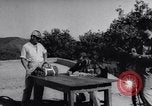
Communist Ernesto Che Guevara and Celia Sanchez join Fidel Castro's rebels in the Sierra Maestra Mountains.
The Cuban Revolution against Batista in years 1957-1958. A Cuban Revolutionary writes a note to be taken across by Fidel Castro's courier. A soldier watches as a courier gets onto a horse and rides away. Refuge area for the rebels in the Sierra Maestra Mountains. A professional Communist from Argentina, Ernesto Che Guevara, joins Fidel Castro's men. He rides a horse as he smokes a cigarette and talks to another man. Soldiers clean and prepare arms and ammunition, they make bombs. Castro's rebels bomb buses and railroad trains. Charred cars and trucks. Buildings on fire from rebel guerrilla strikes. Oil tanks and factories set on fire by them. Black smoke arises from fires as firefighters try to put out fires. Men on horses cross a stream as they bring supplies. Castro talks to new recruits and pro-communists. Celia Sanchez, who was part of the Moncada Barracks attack, talks to a rebel. Che Guevara smokes a cigar as he inspects rockets. Soldiers ready the rocket. Soldiers sit and talk, climb uphill on foot and on horses. Soldiers inside a dimly lit camp. The rebels attack and fire. A rebel doctor operates upon a soldier in a make shift operating room. The rebels attack and fight police and Cuban military forces loyal to Batista. Soldiers fire in standing and prone positions. Soldiers walk down a path in the jungle. They gather around a man seated on the ground as he takes notes. Women rebels take pictures of prisoners for publicity purposes. A rebel with a camera. 1958: Batista's men search for Castro. Soldiers walk uphill and cross a stream. A soldier in a deserted village. People near wrecked buildings and houses. A woman soldier speaks into a microphone for the rebel radio. A man adjusts the knob of a portable transistor radio.
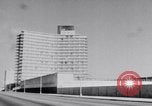
Prime Minister Fidel Castro launches his television program, implements censorship and joins hands with Communist countries.
Hotel Riviera in Havana. The staff at the hotel entrance. Hotel Capri. The deserted reception. Prime Minister Fidel Castro hosts his own television program called 'The Television World Asks'. Castro looks at a passport. He speaks over a microphone, points to a paper, makes long speeches. Evidence of sabotage on the table. The audience. Castro seated at the table. He responds to people's questions. He launches an attack on the Spanish ambassador. The ambassador reaches the studio and accuses Castro of slandering. Castro's men try to control him. Castro orders the ambassador out of Cuba. Castro's supporters follow the ambassador and shout slogans against him. People demonstrate with banners and boards. The Government takes control of all media and implements censorship. Workers inside a printing press. The Radio Continental building. The Ministry of Labor takes over the nation's tobacco and cigarette industry. The Cuban flag hung from a building. Cuba's Farm Minister arrives at an airport to meet Communist leaders. A large crowd gathered. Reporters take down notes. A man and a woman look at a fruit. A photographer clicks pictures. Women in a market. Women pack cartons. Sergei Kudryatsev chosen as the new Soviet Ambassador to Cuba. Czechoslovakian, Polish, Chinese and other Communist delegations in Cuba. They survey a housing complex under construction, and visit factories and industries.
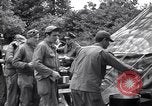
United States 9th Air Force in France; Army airmen in chow line and serving food.
The United States 9th Air Force airmen prepare to eat food in France. A chow line in progress. Tables lined in front of a tent. Containers of steaming food on the tables. The soldiers dish out food for themselves. Trees in the background. Two men in a field. A P-51 flies overhead. The plane does acrobatics in the distance. Pilots of the 354th Fighter Group give an aerial demonstration over their base at the new strip (A-2) just inside the Normandy beachhead in July '44. The town of Criqueville, France is nearby. (World War II period).

Planning and training for invasion of North Africa (Operation Torch) in World War II
'Tunisian Victory' shows preparations during World War 2. Film opens showing a sailor in the crow's nest of a ship in a convoy of American warships. Aerial glimpse of the convoy. Sailors working on teletype machines in s communications center aboard an American warship. Ships exchanging light signals at night. Scene shifts to a British naval convoy moving across the sea. View from bridge of forward guns on British King George V-class battleship. A single stack Navy destroyer ship. HMS Rodney with 3 over 3 forward gun turrets leads another warship protecting the convoy. The aircraft carrier, HMS Illustrious in camouflage paint. An American Navy Douglas Dauntless dive bomber seen from a ship. A U.S. Navy Consolidated PBY Catalina aircraft over the convoy. Brief view of a four-engine bomber flying over the convoy. Scene shifts to sailors on ship's deck in the American convoy. The British flag on one of its convoy ships. Scene shifts to the White House on June 18, 1942. President Franklin D. Roosevelt arriving with British Prime Minister Winston Churchill in a car. Lights burning at night in the White House. Closeup of hats of the British and American staff officers on a rack. World Globe showing German army thrusts to the North by Field Marshal Fedor von Bock into Ukraine and the Caucasus, and another by Field Marshal Erwin Rommel South toward Egypt. In Asia, the conquests of Japan are shown. President Roosevelt and Prime Minister Churchill are seated at a desk. Behind them are Roosevelt's assistant, Harry Hopkins and two uniformed officers. View of relief map showing planned joint offensive. British and American staff officers seated at a planning table. Pertinent maps being printed for the offensive. Closeup views of woman's hands typing on typewriter. Tight closeup view of a teletype tape coming across a machine that reads "ANFO GAZE ACROBAT RE NO K" A typist at a teletype machine with tape being made. A busy military communications center. A plan marked "secret" moving across a sliding document mechanism or slide. American and British war production workers arriving at military equipment production factories for work; large groups of war production workers. Workers at military equipment plants and factories in the the U.S. and the U.K., including many women workers involved in war production. A document labeled "SECRET OCSigO" Staff officers in planning session. U.S. Army Chief of Staff, George C. Marshall, seated with British Field Marshal Sir John Dill. More views of the Combined Chiefs of Staff at work viewing wall maps and table maps and plans. Steel mills in operation. American army troops training and preparing in battle drills, firing machine guns, battlefield advance training, swimming under water below flamethrower flames and below oil slicks on fire, leaping into water, practicing paratrooper jumps into water. New ships including Liberty Ships and warships being launched at American shipyards. War production workers inside a plant building B-17 bomber aircraft. An early version of Sherman tank (external bolts showing) and Sherman tanks being built in factory. Shipboard twin anti aircraft guns being test fired. Giant yards filled with newly manufactured weapons, armor, trucks, tanks jeeps, searchlights. U.S. Army generals walk in a group inspecting equipment. War materiel and troops and tanks being transported on railroad trains in America and Britain. Covered Lockheed P-38 Lightning aircraft being towed by trucks past a watching British police (Bobby) at night. Ships being loaded at docks. Troops and war materiel being loaded aboard ships in the U.S. and Britain. Crowd on dock (mostly women) waving goodbye to soldiers on a ship. Soldiers look out portholes and from deck as troop transport ships get underway. Hand sets ship engine control to slow. Soldiers entertain themselves. Soldier playing piano on deck of ship as fellow soldiers listen and tap feet on top of console piano. Closeup view of hands on piano and a soldiers boot nearby on the piano case. Soldiers smile and enjoy the music.
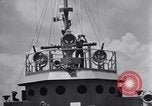
Allied Invasion of North Africa during World War II
Allied warships move towards North Africa during World War 2. A U.S. Navy sailor on a destroyer monitors sonar indicating presence of a submarine. A sailor looks through a pair of binoculars and another U.S. Navy sailor nearby has a pair of headphones. Loudspeaker signals call to general quarters. Sailors rush up the stairs. Numerous depth charges are launched and explode in the water. Next, a wide oil slick on the surface indicates the submarine has been struck by the depth charges. An officer looks through a pair of binoculars. A man speaks into a radio. Soldiers amuse themselves on a troop ship. One plays the piano and others playing play cards, read novel while eating an apple. Flags of Major General Patton and Rear Admiral H. Kent Hewitt aboard the USS Augusta (CA-31) off the coast of North Africa. Semaphore flags and signal lights communicate between ships. Soldier with 'map of West Africa' in his back pocket. Two soldiers read a language guide. An animated map detailing Plan Acrobat to invade North Africa. Map includes Casablanca, Algiers, Tripoli, and Libya. Soldiers exercise, peel potatoes and relax on a troop ship. Clothes hung on a line. British soldiers write letters home. A soldier pastes news on a bulletin board. The bulletin announces that the 'German Afrika Corps' are in full retreat. Night time aerial views of bombing of cities in Italy. Narrator states the bombing included Naples, Genoa, and Turin. Explosions and smoke on the ground below from the bombing. Aerial view of daylight bombing at lower altitude of a Renault tank factory. Submarine on surface at twilight. Eighth Army plane. General Eisenhower, General Mark Clark and French General Giraud. Night scene. Soldiers on the deck. German WWII headquarters at night with guards in Rome and at the The Reich Chancellery in Berlin. Hitler at Berghof . German switchboard, terminal, and radio communications. Messages passed between Allied ships via signal light and ship-to-ship cargo transfer. ( Note The Operation Acrobat discussed in this film is misleading. That plan was scrapped, and the Allied North African campaign was conducted as part of Operation Torch.)
Allied Forces Build up in Algeria to prepare for Spring offensive against German forces in Tunisia during World War II
At start of film, Allied forces are digging in after retreating from counterattacks by German forces in Tunis, during World War 2.. Rains create mud everywhere. A Lockheed P-38 fighter plane parked in foreground. Ground crews use shovels to free nose wheel of a B-24 Liberator bomber with engines running. A truck tows a C-47 transport plane from mud. Army trucks travel over road inundated by running streams. Soldiers standing in a jeep submerged in water. M2 tanks stuck in mud. Airmen huddled around an outdoor fire. P-38 fighter aircraft parked in the background. Soldiers eating around an outdoor fire. Animated map shows Allied battle lines stabilized in Algerian mountains, while German forces occupy the plains in Tunisia. German artillery batteries firing. British troops sheltering in damaged building. Allied wounded being transported atop, as well as inside a field ambulance. Interior of a transport plane configured for evacuation of wounded on litters. U.S. airmen including a woman in leather flying jacket, presumably an Army flight nurse, tend to the wounded aboard the medical evacuation flight. Wounded being transferred from an airplane to an ambulance. British patrols moving through the night. Heavy artillery firing. British soldiers silhouetted at dawn. They return carrying a wounded comrade on a litter. The British soldiers ("Tommies.") trying to clean mud from themselves and their weapons before heading out on patrols again at dusk. Allied soldiers moving on mules in a long line to obtain needed food and supplies. More views of the interminable mud. A British Hawker Hunter fighter plane taking off. A formation of Hawker Hurricanes peeling off to engage German aircraft. Closeup of one rolling over. A German Heinkel 111 bomber being attacked and trailing smoke. Pilot pressing gun firing button in cockpit and a German Dornier Do 17 bomber hit as British fighter plane passes it in cloud of black smoke. The German plane diving to crash in a fireball on the ground. U.S. B-24 Liberator bombers taking off and flying in formation. Formation of American B-17 bombers in flight. The American planes dropping bombs on Italy, Sardinia, and Sicily. Gunners in the bombers firing machine guns at attacking German fighter planes as their bombs keep dropping. Back on land in Algeria, mud still halted any Allied advance. Animated map showing both Allied and German forces building up on their respective sides of the front. Supply lines illustrated all the way back to factories in the United States and Britain. Allied war plants making bombers and munitions. Allied Soldiers assembling Army vehicles at a port. Lockheed lightning fighters being rolled out of a factory. Sign reading "Railroad Equipment Assembly Plant No. 1." Complete trains from locomotives to freight cars being completely assembled, loaded with freight and sent on their way. A formation of P-38 aircraft equipped with long range fuel tanks being ferried in flight from Brazil. It is led by a B-17 flying fortress bomber providing navigation. British Spitfire and Hawker Hunter airplanes heading to the front are seen taking off from an airfield in Gibraltar. A caterpillar tractor moving earth for a new road at the front. Trucks dropping materials for the road bed as soldiers with shovels smooth them on the surface. Soldiers installing Mardsen Matting pierced steel planking for an airfield surface as C-47 transport planes operate on the field. Crates of food supplies being unloaded at a port. War materiel stored in a large yard at a port.
CRITICALPAST.COM: About Us | Contact Us | FAQs - How to Order | License Agreement | My Account | My Lightboxes | Shopping Cart | Advanced Search | Featured Collections | Website Terms & Conditions | Privacy Policy ©2026 CriticalPast LLC.
License Agreement |
Terms & Conditions |
Privacy Policy
©2026 CriticalPast LLC.