


 Francais
 Deutsch
 Italiano

Refine Your Search
Goodenough Island New Guinea 1943 stock footage and images
- Showing 9601 to 9606 of 13663 results more
 Hide
Color Sound

Allied soldiers prepare material for especially prepared German broadcasts at Radio Luxembourg during World War II.
Radio Luxembourg operated by the Allied Forces' Psychological Warfare Division to break down German morale and induce nazi troops to surrender during World War II. The Radio Luxembourg station in Luxembourg. U.S. Army soldiers in the recording studio. They read information from a document over the microphone. Other soldiers seated inside. Towers at Radio Luxembourg, the most powerful long wave station in Europe. A man at the controls. officers check the wavelengths. for various locations of reach. The Radio Luxembourg news room. Army Intelligence and other military sources prepare material for the especially prepared German broadcasts. The recording studio: A soldier operates controls. Two soldiers seated at a table. They read from a document into a microphone.
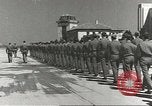
Superior officers award commissions and wings to USAAF cadets at Maxwell Field in Montgomery, Alabama (WW2)
U.S. Army Air Forces cadets at Maxwell Field in Montgomery, Alabama during World War II. Cadets marching. They march past a line of AT-6 Texan trainer aircraft. The cadets halt, do a left turn and open ranks. Several cadet graduates are given their wings and commissions. USAAF superior officers congratulate the cadets and present the wings. The cadets shake hands, then step back into rank. Several EM are cited. Infantry officers. Senior officers pin wings on infantry officers. The wing on the officer's uniform. Newly commissioned officers are congratulated by their families after graduation. Two new officers admire their wings and pose for the camera. Parked AT-6s in the background. The graduates at attention at "open ranks." Cadets in charge of men make hasty inspection and stop to square hat of Cadet. Superior officers award commissions and wings to the cadets. Graduates wave their hats, cheer, then break ranks.

Reinforcements for U.S. 35th Infantry Division are briefed. U.S. troops occupy Houffalize, Belgium during World War 2
The United States Army on the Western Front during World War II. A map depicts Allied offensives at Malmedy, Houffalize and Bastogne. New reinforcements for the 134th Infantry Regiment of the U.S. 35th Infantry Division are briefed by an officer near Bastogne, Belgium, on January 10, 1945. Aerial view of tanks and infantry of the U.S. 6th Armored Division moving across a snow-covered barren landscape as they attack German troops in Belgium West of the Luxembourg border. Officers observe through binoculars. U.S. patrols of 1st and 3rd United States Armies meet on January 16 as they capture Houffalize. View of bombed out buildings in Houffalize on January 18.. U.S. troops occupy Houfflaize. A damaged German Pz.III tank on a street and an overturned Panther tank with a hole in its underside in a river. The troops walk along bombed out buildings in Houffalize.

Views of newly restored House on Ellicott's Hill in Natchez, Mississippi, and unrestored structures on the same property
The Connelly's Tavern in Natchez, Mississippi. The exteriors of the Connelly Tavern or House on Ellicott's Hill merchant house on Canal Street, originally built around 1798 by James Moore. People enter the House on Ellicott Hill. Exterior views of damaged pillars and a crumbled wall of a building. Inside the Connelly's Tavern, a waitress carries a tray. A woman walks downstairs. Two women sit near a fireplace and talk. The waitress serves tea to the two women. Two women read from a book. A portrait on a wall of the house, restored by the Natchez Garden Club and New Orleans architect Richard Koch after the Club purchased it in 1934.

Marines refuel UH-1E Iroquois helicopters, in Khe Sanh, South Vietnam.
U.S. Marines setting up to refuel helicopters at a forward base in Khe Sanh, South Vietnam. They connect hoses and begin to transfer fuel. But a hole in the hose causes a serious leak with fuel running onto the ground. View of empty fuel bladder laying flat on the ground. The Marines set up new refueling lines to a full bladder. They open valves and fuel two Marine Corps UH-1E Iroquois helicopters that arrive in quick succession. (Vietnam War period).
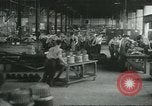
Workers returning to oil heater plants, rolling mills, Douglas Aircraft Plant, and Atlas brewing company in the United States
Renewed manufacturing activity throughout the nation recalls thousands of workers as the American industry forges onward and shows some signs of improvement during the great depression. Bloomington, Illinois: Workers manufacture oil heaters. They work on various machines and equipment. Middleton, Ohio: 2400 men at work in one of the big rolling mill companies. The workers arrive at the steel mill. Steel processing. Santa Monica, California: Men and women report for work at the Douglas Aircraft Plant. They work on a tight schedule for the new type Army torpedo and bombing planes. Men work on various parts of the aircraft. Chicago, Illinois: The Atlas Brewing Company, a huge brewery and bottling works where the production has been speeded to almost 30,000 bottles of beer an hour to meet a surge of demand following the passing of the Volstead Act allowing 3.2 beer (3.2% alchohol), near the end of prohibition in America. Beer Bottles move on conveyor belts. The bottles are filled, packed in crates and readied for transportation.
CRITICALPAST.COM: About Us | Contact Us | FAQs - How to Order | License Agreement | My Account | My Lightboxes | Shopping Cart | Advanced Search | Featured Collections | Website Terms & Conditions | Privacy Policy ©2026 CriticalPast LLC.
License Agreement |
Terms & Conditions |
Privacy Policy
©2026 CriticalPast LLC.