


 Francais
 Deutsch
 Italiano
Refine Your Search
Goodenough Island New Guinea 1943 stock footage and images
- Showing 9841 to 9846 of 13637 results more
more Hide
Hide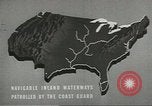
Coast Guard vessels, buoys, lighthouses, helicopters and life saving service stations in the United States.
Opening scene shows an animated map of the United States and its inland waterways. An extremely long barge assembly is seen moving along a waterway, with industrial plant on shore in background. Another view of barges being pushed, View from a ship passing a city skyline. A Coast Guard ship passing an inland passenger ship in icy waters. View from bow of the Coast Guard ship moving through the ice. he U.S. Coast Guard side paddlewheel river tender, "Willow" is seen docked on the Mississippi River. Black smoke is rising from one of her funnels. A team of men works at a river bank, installing an aid to navigation. View of another such aid. A Coast Guard riverboat for installing and maintaining navigation aids, moving on a river. Closeup of a Coastguardsman wearing flotation vest, on deck. A buoy being raised by a crane on the ship. Glimpse of a buoy floating in the water. A new buoy being lowered from the ship into the water. Closeup of two Coast Guard officers watching as the buoy is set in place. View from deck of ship as the buoy is lowered overboard. Aerial view of a lighthouse. View of lighthouse from ground nearby. Glimpse of a Coast Guard station on a sandy shore. A Coast Guard boathouse with three rescue dories visible inside. A pontoon equipped Coast Guard helicopter taking off from a moving ship.

Girls join the Women's Army Corps and display newly designed uniforms in the United States.
Girls decide to serve the country by enlisting in the WAC in the United States. In Los Angeles, California girls enlist in the Women's Army Corps (WAC). Their parents greet them as they entrain for Fort Des Moines, Iowa. WAC personnel stand in a pattern to form the word "WAC". The New York skyline. WACs wearing newly designed uniforms. A WAC personnel displays a uniform. The WAC personnel salutes and smiles.

President Harry S. Truman gives a short address while dedicating Friendship International Airport in Maryland, United States.
U.S. President Harry S. Truman dedicates Friendship International Airport in Anne Arundel County Maryland, United States, south of Baltimore. Aerial view of the new airport. A sign on a terminal building reads 'Friendship International Airport'. President Truman disembarks from an aircraft together with Baltimore Mayor Thomas D'Alesandro, Jr., and is greeted by officials. He reviews an honor guard. A crowd seated during the dedication ceremony. The President speaks into a microphone and gives a short address (sound is present in clip for this portion). (The airport was later renamed Baltimore/Washington International Airport, and subsequently, Baltimore-Washington International Thurgood Marshall Airport. Also known as BWI.)

Unemployed African American workers get work in offices and as musicians and painters thanks to the Works Progress Administration
Unemployed African American citizens in America during the Great Depression. Close up views of many idle, sad, and dejected African American men and women out of work, in lines, during the depression. A man looks at a bulletin board of an employment agency at 165 W 131st St in New York City. African American men and women stand in a bread line or food relief or unemployment line in United States. They get jobs through Works Progress Administration. African Americans working at factories, in classroom teaching, in offices typing, as an accordion musician, as a painter in a studio, as a bricklayer, and in an industrial kitchen. Views of smiling, happy African American workers, both men and women.
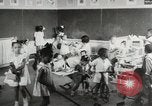
African American children at a nursery school in United States during Great Depression
African American children at a nursery school in the United States during the Great Depression. They play, eat, sleep and undergo medical check ups. Adult African American citizens learn to read and write. African American men and women in Harlem New York attend a Spanish language class. Many African American citizens get employed through Works Progress Administration (WPA) and are seen performing land record indexing jobs, filing, and typing with typewriters.
The United States demobilizes following World War II
Opening illustrated slate shows reduction of Amercan Armed forces personnel from more than 12 million in 1945 to only a little over 1 and a half million in 1947. U.S. Navy submarines are seen docked in storage. Men work spraying protective coatings over guns on Navy ships as they are placed in storage in the "Mothball Fleet." A lone sailor is seen on the deck of a ship with vast number of mothballed Navy destroyers in the background. A B-24 Liberator bomber being dismantled and a B-17 parked with engines removed, seen through stack of propellers in foreground. Airman sets a demolition charge. Views of several bomber aircraft being blown up as junk. Stacks of junked and scrapped American war materiel rusting. View inside a mill where molten metal is being processed (ostensibly recycled from junked war materiel). Narrator speaks of beating guns into plow shares. Several views of molten metal being poured into and from ladles. Views inside post-war factories returning to peace-time production, where industrial heavy equipment, railroad wheels, kitchen appliances, home appliances, rubber tires, and new 1946 Ford automobiles are assembled (looking exactly like the 1942 models).
CRITICALPAST.COM: About Us | Contact Us | FAQs - How to Order | License Agreement | My Account | My Lightboxes | Shopping Cart | Advanced Search | Featured Collections | Website Terms & Conditions | Privacy Policy ©2026 CriticalPast LLC.
License Agreement |
Terms & Conditions |
Privacy Policy
©2026 CriticalPast LLC.