


 Francais
 Deutsch
 Italiano

Refine Your Search
Goodenough Island New Guinea 1943 stock footage and images
- Showing 10279 to 10284 of 13663 results more
 Hide
Color Sound

Passengers play Casino Roulette game aboard SS Rex gambling ship off the California coast near Los Angeles.
Gambling ship SS Rex seen anchored off the coast in Santa Monica, California. View from on board the SS Rex as a smaller boat approaches from shore, delivering gamblers to the floating offshore casino. People ascend steps of the SS Rex. Inside the floating casino: Dealer seen dealing Blackjack for men seated at table with their chips. Players gathered around a Casino roulette game. Passengers play the game. Close-up view of Roulette wheel and table. Live mice seen under clear glass or lucite boxes are used in a new game of spinning roulette-like gambling, where the mice spin on the wheel as men and women gamblers place their bets.

A man secures stabilizer to ring tail,covers with drag ring,adjusts valve before the release of torpedo in United States.
New techniques in aerial torpedo attack, United States. An aircraft in flight over a sea. The aircraft releases torpedo in water. Torpedo moves. Men haul trolley loaded with the torpedo. The shroud ring or ring tail is in conjunction with the drag ring on nose of the torpedo. Using ring tail and drag ring with wooden stabilizer results in successful test drops. A man secures the stabilizer to ring tail with wooden dowels. The man covers the torpedo with a drag ring which helps to stabilize the torpedo during air travel, and seals the ring. The man adjusts the water trip delay valve which prevents the torpedo from burning up during long travels. Depth setting is done. (World War II period).
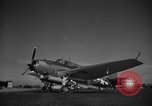
Men load torpedo onto aircraft parked at an airfield in the United States.
New techniques in aerial torpedo attack, United States. A Grumman TBF Avenger aircraft parked at an airfield. Men load torpedo onto the aircraft. The propellers start. A man signals as the aircraft taxis and takes off from the airfield. The aircraft in flight over a sea. The aircraft releases torpedo in water. (World War II period).
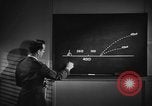
A man explains graphical presentation of the proper speed and altitude combination for torpedo release in United States.
New techniques in aerial torpedo attack, United States. A man explains the graphical presentation of the proper speed and altitude combination for torpedo release. An aircraft in flight releases torpedo in water. The torpedo moves in water. The torpedo launching guide. In double entry type graph, the combination of 2 coordinates gives the third coordinate. Dropping speed and dropping altitude data is entered in the chart. It gives the entrance angle. The man explains the concept of point of release to the point of hitting target using the graph. The cross wind effect on torpedo drop is explained. Time column on graph gives time of fall of torpedo. Release of torpedo with proper range is necessary. Radar ranging requires teamwork between the pilot and the radio man. Demerits of long and short range is explained. (World War II period).
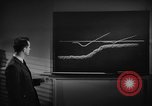
Diagrammatic presentation of full range of entrance angle for shallow and deep water for release of torpedo,in United States.
New Techniques in aerial torpedo attack, United States. A diagrammatic presentation shows the full range of entrance angle. The range for shallow water is18 to 22° and for open sea or deep water is 22 to 32°. Extreme angle to be avoided. A Grumman TBF aircraft in flight. The aircraft releases torpedo in water. Estimation of correct amount of lead depends on speed of target and target angle. Thumb rule explains the aiming allowance for ship vessels. The ship underway at sea takes a turn. (World War II period).

Aircraft in flight releases torpedo in water according to proper speed and altitude combination,in United States.
New dropping tactics in aerial torpedo attack,United States. An aircraft in flight releases torpedo in water. The release of torpedo depends on proper speed and altitude combination. A diagram shows the gliding of torpedo at target area. The aircraft in flight. Torpedo attack to be coordinated by dive bombing, strafing or rocket attack. (World War II period).
CRITICALPAST.COM: About Us | Contact Us | FAQs - How to Order | License Agreement | My Account | My Lightboxes | Shopping Cart | Advanced Search | Featured Collections | Website Terms & Conditions | Privacy Policy ©2026 CriticalPast LLC.
License Agreement |
Terms & Conditions |
Privacy Policy
©2026 CriticalPast LLC.