


 Francais
 Deutsch
 Italiano

Refine Your Search
Goodenough Island New Guinea 1943 stock footage and images
- Showing 163 to 168 of 13663 results more
 Hide
Color Sound

Indian Punjab soldier, rescued after escape from Japanese prison camp in New Guinea, is placed in ambulance during World War II.
L-5 aircraft of the U.S. Army Air Corps 25th Air Liaison Squadron, parked at an airfield in Saidor,New Guinea during World War II. Men stand near the L-5 Sentinel aircraft, that has just rescued an injured Punjab soldier (one of 20) who escaped from a Japanese POW camp. Two men carry the Punjab soldier on a stretcher and place him into an ambulance. Tent in the background. Ambulance drives away.
Ground crew repairs fuselage of USAAC L-5 aircraft at airfield in Saidor,New Guinea, during World War II
Crew work on L-5 Sentinel aircraft of the U.S. Army Air Corps 25th Air Liaison Squadron, at an airfield in Saidor,New Guinea during World War 2. Ground crew removes jack from under landing gear of an L-5. Other L-5's seen parked on the airstrip. Ground crew work around them. Man under L-5 aircraft makes repairs to fabric on the fuselage.
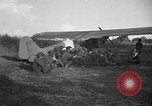
Indian Punjab soldiers freed from Japanese prison camp are interviewed by Australian soldiers in Senai, New Guinea, during World War II
Indian Punjabi soldiers freed from Japanese prison camp, are seated in shade under wing of a U.S. Army Air Corps L-4 Grasshopper airplane, at an air field in Senai, Papua New Guinea, during World War 2. They are being interviewed by an Australian Sergeant and an officer. The Punjab former prisoners have been provided uniforms including ranger hats. (They have short hair and no beards, so they may include Sikhs, Dogras, Pathans, and Punjabi Muslims, but haven't yet obtained material for their traditional turbans.) The Sergeant makes notes and sketches on a pad as the escaped POWs provide information about their experiences and information of possible value regarding Japanese forces. Scene shifts to the Punjab soldiers sitting in a grass-roofed hut, with the native Chief of Senai. Several of them sit in in front of the hut, smoking long-stemmed native pipes. The Senai Chief poses with a Punjab Sergeant. Two Stinson L-5 airplanes take off from the Senai field. A group of liberated prisoners prepares and eats a meal.

Japanese troops advance in New Guinea and bomb Port Darwin in Australia.
A map shows areas of conflict between the Allied and Japanese in the South Pacific. Japanese warships cruising in heavy seas off New Guinea. Japanese soldiers aboard the ship. Explosions in the water. New Guinea shoreline. Japanese troops with the Japanese flag advance through Salamaua in New Guinea. Destroyed Allied hangars and planes. Japanese planes take off. Pilots in the planes take refreshments. Japanese planes bomb Port Darwin on the north Australian coast. (World War II period).
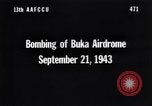
The bombing of Buka Airdrome on Bougainville Island by U.S. B-24 Liberators
Events relating to the bombing of Buka Airdrome on Bougainville Island on September 14th 1943. U.S. B-24 Liberator bombers and fighters in flight at a high altitude over the airdrome. B-24s dropping bombs. Impacts visible. Japanese fighter aircraft receiving fire from American aircraft. (World War II period).
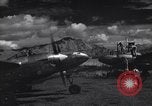
P-38 aircraft and ground crews of U.S. 49th Fighter Group in New Guinea, during World War II.
P-38 Lightning aircraft of the 9th Fighter Squadron, 49th Fighter Group, at Schwimmer Field near Port Moresby, New Guinea, during World War 2. Crew chiefs attend to P-38 aircraft, some with engines running. Ground crewmen manually maneuver nose wheel using towbar. Crew chief cleans the aircraft of American Ace, Captain Richard I. Bong. His P-38, named "Marge," displays large picture of woman and 27 Japanese victory flags ( Bong having just broken Eddie Rickenbacker's World War I record of 26 victories). Staff in control tower use light signals. Aerial view from airplane flying among cumulus clouds.
CRITICALPAST.COM: About Us | Contact Us | FAQs - How to Order | License Agreement | My Account | My Lightboxes | Shopping Cart | Advanced Search | Featured Collections | Website Terms & Conditions | Privacy Policy ©2026 CriticalPast LLC.
License Agreement |
Terms & Conditions |
Privacy Policy
©2026 CriticalPast LLC.