


 Francais
 Deutsch
 Italiano
Refine Your Search
Goodenough Island New Guinea 1943 stock footage and images
- Showing 229 to 234 of 13635 results more
more Hide
Hide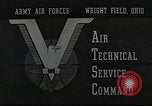
A Japanese Mitsubishi A6M3 Type 32 Zero fighter plane being tested at Wright Field, Ohio, during World War II
Army Air Forces records describe this as flight tests conducted at Wright Field on a Japanese Mitsubishi Type 0 MK2-SSF Hamp fighter plane, Army Air Forces (AAF) No. EB-201. (Recognized later, as a variant of the Zero, these Mitsubishi A6M3 Type 32 planes were renamed "Zeke 32.") Flight tests were made from January 9th to March 10th, 1944, to compare this aircraft with AAF fighters and to verify tests made in Australia by the Special Duties and Performance Flight of T.S.-7, Directorate of Technical Services, Melbourne. Test pilot in the cockpit with engine running. Closeup of pilot (possibly Captain Ralph C. Hoewing, who became first Commandant of the AAF Test Pilot School). He takes off from the airfield. and is seen in flight. Various aerial views of the Zero are seen including: flying overhead and from above as it flies over Ohio farmland. The pilot enters a shallow climb; and is seen from above and behind. He performs a slow descending roll. Finally, he buzzes the airfield at low altitude and high speed, and then brings the aircraft in for a smooth landing. (Note: This aircraft was rebuilt by the Allied Technical Air Intelligence Unit in Hangar 7 at Eagle Farm Airfield, Brisbane, Australia, from the wrecks of five Mitsubishi A6M3 Type 32 Zeke's captured at Buna, New Guinea, during the war.) [ Ref. WWW. hangar7.org.au ]
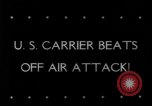
A Japanese bomber aircraft drops bombs and a carrier is set afire but it remains afloat in the Pacific Ocean.
Carrier-based airplanes fight Japanese airplanes off New Guinea, Australia during World War II . A U.S. aircraft carrier underway in the Pacific Ocean prepares for attack. Aircraft parked on the deck. An aircraft takes off. Gunners ready the guns mounted on the deck. A Japanese aircraft in flight. Flaks burst in the sky. The gunners fire the guns. An explosion on the outer deck. The carrier crew runs on the deck and fires. A Japanese bomber aircraft drops bombs. A bomb hole on the deck. The gunners still fire. Crew members pull a hose and spray water on the bombed area. The carrier is set afire but remains afloat.
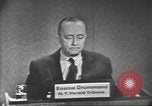
John Kennedy and Nixon debate over the prestige of America prior to the presidential elections in the United States.
Presidential election debate held between Democratic nominee Senator John F. Kennedy and Republican nominee U.S. Vice President Richard Nixon in the United States. New York Herald Tribune newspaper correspondent Roscoe Drummond asks Senator Kennedy that how can American prestige be measured abroad. Senator Kennedy responds stating that America is identified with the cause of freedom and if other countries have to choose between America and a Communist country, they would choose America. He further speaks that there are many indications that prestige of the United States is not as high as it once was. Kennedy summarizes some of these indications and relates to it by mentioning the example of Sputnik space program by the Soviet Union in 1957 (during the Space Race). Kennedy speaks about the economic development of the Soviet Union. He says the Soviet Union will be ahead of any other country scientifically and militarily by 1970. He mentions votes by different countries in the United Nations dealing with Red China. He says that Guinea and Ghana, two independent countries now are supporting Soviet foreign policy at the UN. NBC correspondent Bill Shadel asks Richard Nixon to speak on the topic. Vice President Nixon responds by speaking about the economic development of the Soviet Union. He speaks that the Soviet Union is a very primitive economy and that the United States is well ahead economically. He says that if the United States is going to maintain its strength and its prestige, they must not only be strong militarily and economically but must be firm diplomatically also. Bill Shadel says that an entire hour was devoted to answering questions from the reporters. He says that each candidate was questioned in turn and each had the opportunity to comment on the answer of his opponent. Shadel says that the reporters were free to ask any question on any subject, neither candidate was given any advance information on any question that would be asked. He says that the fourth debate is scheduled for Friday, October twenty-first.
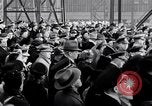
Launching of USS Wisconsin (BB-64). Philadelphia Navy Yard, December 7, 1943. Governor and Mrs. Goodland of Wisconsin.
Rear Admiral, M.F. Draemel, Commandant of the Philadelphia Navy Yard, introduces Assistant Secretary of the Navy, Ralph, A. Bard, who speaks to large group of Navy Yard personnel and visitors and spectators. The occasion is the launching of the second USS Wisconsin (BB-64) on December 7, 1943. Governor of Wisconsin, Walter S. Goodland and his wife are present. Mrs. Goodland is the official sponsor.
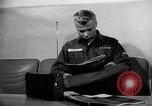
The story of AFN ( American Forces Network) Radio. Founding announced in 1942. First broadcast in 1943; growth in 1944.
U.S. Army soldier reads newspaper while listening to radio. Soldiers doing their respective chores, listen to AFN (American Forces Network) Radio. General Marshall and General Eisenhower announce the creation of AFN, in 1942. July 4, 1943, the first broadcast of AFN. General Eisenhower mingling with paratroopers of the 101st Airborne Division, on the eve of D-day. U.S. B-26 aircraft in flight. United States soldiers aboard landing craft and wading ashore at Normandy, France, on D-day, June 6, 1944. Soldiers tuning radios in the field. United States Sherman tanks and infantry move along country road in France. Audio includes portions from AFN broadcasts, including an announcer saying "You are listening to AFN Paris. This is the American Forces Network, on the road to Berlin." Road sign points to St. Lo. Group of U.S. soldiers gathered around a jeep with a radio, listening to AFN, in Germany. (World War II period).

Analysis of the German labor force from 1939 to 1943 (WW2)
Analysis of the Germany's labor force, military strength and effects of World War II on manpower. German soldiers march. Men work in factory on equipment and machinery. Women work in factory. A cemetery of World War 1 soldiers in Germany. Narrator explains how loss of man power from world War 1 deaths, and subsequent lower birth rate leads to war production worker needs being filled by many young German women and even German boys and girls working in industrial factories also. Wounded German soldiers being treated in field during World War 2. A map points Germany, Sudetenland and Austria. Graphs examine labor force by sex, age and military replacement availability; compare the labor force according to sex from 1939-1943; detail the increase of work force through the women part time workers and the veterans. Women weld equipment in a factory. Men do mining work. Narrator speaks of foreign workers (such as from Poland, Netherlands, Czechoslovakia, Yugoslavia), and how some now serve "under economic pressure and compulsion" (as forced labor or slave labor). Views of forced labor crews working digging earthworks. Laborers also work on building or repairing railroad stations and track work. Lines of prisoners of war, also used for labor, walk under German guard as lines of German uniformed troops walk in the opposite direction. Graphs compare the labor force in agriculture, industry, trade services, transport and government.
CRITICALPAST.COM: About Us | Contact Us | FAQs - How to Order | License Agreement | My Account | My Lightboxes | Shopping Cart | Advanced Search | Featured Collections | Website Terms & Conditions | Privacy Policy ©2026 CriticalPast LLC.
License Agreement |
Terms & Conditions |
Privacy Policy
©2026 CriticalPast LLC.