


 Francais
 Deutsch
 Italiano

Refine Your Search
Goodenough Island New Guinea 1943 stock footage and images
- Showing 247 to 252 of 13663 results more
 Hide
Color Sound
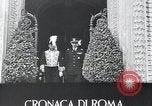
New Japanese ambassador to Kingdom of Italy, presents credentials at Quirinal Palace in Rome, Italy (WW2)
Zenbei Horikiri, the new Ambassador of Japan to the Kingdom of Italy, presents his credentials to King Victor Emmanuel III in Rome, Italy during World War II. Hokiri stands with an Italian officer during the ceremony at the Quirinal Palace. To his right, behind him, similarly dressed, is Shun'ichi Kase,secretary to Japanese Foreign Minister Yōsuke Matsuoka. (Shun'ichi later served as chargé d’affaires in Italy commencing in 1943.) Japanese and Italian officers are part of the two-nation entourage that emerges from the palace following the event. They proceed down the steps of the Quirinal Palace (Palazzo del Quirinale, Piazza del Quirinale, 00187 Roma RM, Italy) and across the Piazza del Quirinale, where camera shows a glimpse of one of the statues at the Obelisk and Fountain of Castor and Pollux (containing sculptures of Castor and Pollux as horse tamers). Next, a motorcade of the officials' cars drives out of the palace complex, past two guard posts.
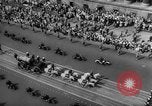
Funeral services for Franklin D. Roosevelt in Washington DC and at Hyde Park, New York (WW2)
Funeral procession of President Franklin D. Roosevelt on the streets of Washington DC. Horse drawn carriage with casket escorted by men on motorcycles. Crowd lined up on sidewalks. Various U.S. military units march. Funeral procession arrives at White House. Casket is carried into building. Casket is placed in East Room, lying in state. Scene change to funeral services for FDR at Hyde Park, New York. President Truman and Franklin D Roosevelt's wife among the mourners. A volley is fired over the president's grave. Symphonic music track in background is interspersed with audio quotations from Roosevelt, including, from his State of the Union on January 7, 1943: "Therefore, let us all have confidence, let us redouble our efforts. A tremendous, costly, long-enduring task in peace as well as in war is still ahead of us. But, as we face that continuing task, we may know that the state of this Nation is good--the heart of this Nation is sound--the spirit of this Nation is strong--the faith of this Nation is eternal." Also heard at the beginning of the clip is Roosevelt saying, "American fighting men looked to the statesmen of the world to finish the work of peace for which they fought and suffered. We failed them then. We cannot fail them again, and expect the world again to survive," from his address to Congress on Yalta, March 1, 1945 (World War II).
Life in Britain on eve of War. Chamberlain, Hitler and Mussolini signing the Munich Agreement during World War II.
An Allied propaganda film to solidify Anglo-American solidarity within the ranks as well as to counter Nazi propaganda aimed at weakening the alliance shows British soldiers in Great Britain during World War 2. 1938: in the United States New York Yankees win the pennant in baseball; scene of Yankees team members shaking hands. View of aviator Douglas Corrigan nicknamed Wrong Way Corrigan after his accidental flight from New York to Ireland instead of California as planned. View of trains on the 6th Avenue Elevated (or Sixth Avenue El) before that service was halted in Manhattan New York City. British citizens go about their daily life. Derby horse race in a stadium. A British boy and his father shovel dirt for a backyard garden. Players play a football (soccer) game at Wembley Stadium in England as spectators cheer the 1938 FA Cup Final with Preston North End taking the Cup versus Huddersfield Town as George Mutch scores the winning goal. Scenes in Germany: People cheer for German Chancellor Adolf Hitler and give Nazi salute. Newspaper headlines about Czech occupation. Graves in a cemetery. British Prime Minister Arthur Neville Chamberlain, Adolf Hitler Italian Prime Minister Benito Mussolini sign the Munich Agreement. Despite a peace agreement Hitler invades Czechoslovakia. People read 'Military Training Act, 1939'. British soldiers march along a road. View of Adolf Hitler smiling and laughing. Artillery is fired. A poster reads 'Britain Declares War on Germany'. Airplanes in flight and drop leaflets over Germany. German airplanes in flight. Parachutists jump from the airplanes. Hitler talks to officers and considers the war to be over. Radio news broadcast of the British declaration of war on Germany by Neville Chamberlain. Many different British citizens and families shown in living rooms and work places gathered around radios to listen to the so called "We shall fight on the beaches" speech of Winston Churchill on June 4, 1940. Clip includes scenes from 1938 through 1940; from a film produced in 1943.
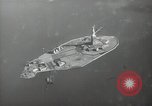
A New York City Police airplane in flight over Liberty Island. New York Harbor, Manhattan Island, as seen from another aircraft
Aerial view of the Statue of Liberty on Liberty Island in Upper New York Bay. Aerial view of ships in New York Harbor. An airplane in flight. Airplane is flying over the New York Bay and the skyscrapers and tall buildings of the Manhattan skyline. Aerial view of New York harbor. 'Police' can be seen written on the aircraft.
Launches of several U.S. Warships during World War II
Preparations for launch of the USS Hancock (CV-19) at Fore River Shipyard, Quincy, Massachusetts, on January 24, 1944. . Shipyard riggers removing supports from under the ship's hull. Platform at bow is decorated with bunting. Scene shifts to Brooklyn Navy Yard, New York, and the launching of the USS Missouri (BB-63), on January 29, 1944. Crowd gathered around the bow as the Missouri goes down the ways. Another change of scene to the Newport News Shipbuilding and Dry Dock Company of Newport News, Virginia. Here the ways are emptied following the launch of the Light Cruiser, USS Hancock (CL-81) on June 19, 1943. The Hancock can be seen in the water. Tugs attend to the newly launched Cruiser.
New York Harbor, Liberty Island, and views of Manhattan Island, New York City in the United States
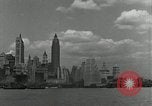
View of New York City skyline in the United States. Statue of Liberty situated on Liberty Island. Cruise ships, ferry boats and sail boats are seen moving near the statue and near lower Manhattan. Some of the scenes appear to be dawn or dusk with the city skyline more dark.
CRITICALPAST.COM: About Us | Contact Us | FAQs - How to Order | License Agreement | My Account | My Lightboxes | Shopping Cart | Advanced Search | Featured Collections | Website Terms & Conditions | Privacy Policy ©2026 CriticalPast LLC.
License Agreement |
Terms & Conditions |
Privacy Policy
©2026 CriticalPast LLC.