


 Francais
 Deutsch
 Italiano
Refine Your Search
Goodenough Island New Guinea 1943 stock footage and images
- Showing 2575 to 2580 of 13657 results more
more Hide
Hide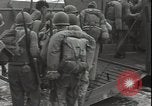
U.S. Marines leave Guadalcanal, Solomon Islands as army takes over during World War II.
U.S. marines departing Guadalcanal as they are relieved by U.S. Army troops of the 23rd Infantry Division. They board landing craft, vehicle, personnel (LCVP), aka Higgins boats, of the USS Neville (AP-16). Two of the marines scrambles aboard one of the boats as its ramp is almost closed. View of marines packed aboard the LCVP as it gets underway. Two transport ships are anchored in the background. The most distant one is the USS Neville (AP-16). Scene shifts to beach crowded with departing marines and Higgins boats. Closeup of a marine holding a cigarette while eating a sandwich, and another with a bandage on his forehead. Numerous views of the beach crowded with marine; palm trees overhead; higgins boats departing to the USS Neville, and two transport ships anchored in the background. Closeups of marines on shore waiting for more Higgins boats to transport them. Scene changes to U.S. Marine Corps Brigadier General William Rupertus, Assistant Commander, 1st Marine Division; U.S. Army Major General Alexander Patch, Commander, 23rd Infantry Division (Americal Division) and U.S. Army Brigadier General Edmund Sebree, his Assistant Commander, posing for the camera as they ostensibly discuss a map. They shake hands with each other. General Sebree exchanges salutes with General Rupertus, and they all walk away. Next, the three generals pose for closeups. Film ends showing columns of marines moving along the sides of a road cut through a forest of palm trees.
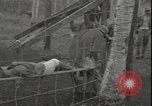
U.S. Army Military Police guard Japanese prisoners on Guadalcanal, Solomon Islands during World War II.
Japanese prisoners of war carry a wounded Japanese POW on a litter into a fenced prisoner compound on Guadalcanal during World War 2. A sign at the compound reads: "Prisoners of War Camp." Japanese prisoners, all dressed in the same prisoner uniforms, march in casual formation under guard by U.S. Military police.. They leave the compound and march down a road accompanied by MPs.
United States 1st Marine Division troops bomb Peleliu Island, Palau.
U.S. 1st Marine Division operations on Peleliu, during World War 2. U.S. F4U Corsair aircraft, flying low and slow, with gear down, drop napalm incendiary bombs on Japanese troops dug in on a ridge. Huge explosions seen. A C-47 transport airplane taxis on airfield. F4U Corsairs are seen parked and tents are pitched nearby.Several C-47s are parked on a ramp. Three F4Us taxi past them headed to the runway. F4Us take off and one is seen bombing Japanese positions on the ridge. Slate notes 1st Marine Division and D+24. Major General William Henry Rupertus,kneels on one knee, in sand, as another officer (shirtless) briefs him. They briefly discuss tactics and then walk away. Marine rifleman firing into burning wreckage of a Japanese position. Marine firing grenade from his rifle. Two Marines stand on beach with LVT (landing vehicle tracked) on the sand, nearby. They point at large ship offshore. Views of the Peleliu beachhead, with numerous ships and landing craft beached, including the second USS Seaward (LST 278) that collided with LST-129 and suffered considerable damage, On October 2, 1944. (LST-129 may be the LST seen next to LST-278.)
Recovery of wounded U.S. marines during amphibious assault on Peleliu, Palau Islands, in World War II
A DUKW speeds toward the USS Mount McKinley (AGC-7) in World War 2. It is seen tied up alongside with several wounded Marines aboard. Crewmen and Marines carry the wounded aboard the McKinley on litters (stretchers).
11th Marine Aircraft group drop bombs on Peleliu Island, Palau.
F4U Corsairs or U.S. Marine Aircraft Group 11, bombard Japanese positions on Prostitute Ridge, Peleliu, Palau, during World War 2. They fly a number of sorties, dropping general purpose bombs on fortified Japanese positions, very close to U.S. Marine positions. Marine pilots fly low and slow, with landing gear extended to assure accuracy in their bombing.
F4Us of Marine Aircraft group 11 use skip-bombing against Japanese dug in on Peleliu Island, Palau, during World War II.
F4U Corsairs of U.S. Marine Aircraft Group 11, use skip bombing to strike Japanese in fortified caves on Peleliu, during World War 2. They are seen striking targets on Prostitute Ridge. Meanwhile, Marines in Horseshoe Valley hurry as they carry a wounded Marine on a stretcher past some U.S. Army M4 Sherman tanks. Another view of Corsair making low slow bomb run. Scene shifts to a Corsair landing on the Peleliu airfield, while construction vehicles are still working to repair it. Scenes of the airfield, with mixture of tents, some still-standing buildings, and men working on the sand runways.
CRITICALPAST.COM: About Us | Contact Us | FAQs - How to Order | License Agreement | My Account | My Lightboxes | Shopping Cart | Advanced Search | Featured Collections | Website Terms & Conditions | Privacy Policy ©2026 CriticalPast LLC.
License Agreement |
Terms & Conditions |
Privacy Policy
©2026 CriticalPast LLC.