


 Francais
 Deutsch
 Italiano
Refine Your Search
Goodenough Island New Guinea 1943 stock footage and images
- Showing 3031 to 3036 of 13659 results more
more Hide
Hide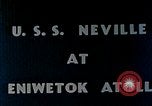
Bombing by the U.S. troops, Landing Craft Vehicles lowered and Landing Craft Personnel circle in Eniwetok Atoll.
Battle of Eniwetok during World War II. United States Ship Battleship USS Nevada (BB-36) at Eniwetok Atoll (sometimes spelled Enewetak or Eniewetok) in the Marshall Islands. Stern view of hospital ship USS Solace (AH-5) in the pacific. Bombardment by the United States forces. Water splashes due to bombardment. Officer of United States looks at the artillery bombing by telescope. Troops on deck. Landing Craft Vehicles (LCV) are lowered from ship. Troops on LCV. Landing Craft Personnel (LCP) circle in the water.
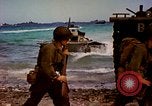
Amphibious tank approaches the beach, unidentified plane in flight and U.S. officer look at the chart in Eniwetok, Atoll.
Battle of Eniwetok during World War II. Amphibious tank approaches the beach. U.S. soldiers on the beach. Another tank hits the beach. Tank moves up the slope, soldiers around it. Tank unloaded from Landing Vehicle Tracked (LVT). Medium tank passes. Palm trees destroyed. U.S. officers look at the chart. Unidentified plane in flight. Troops on island.
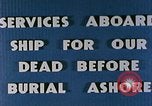
U.S. flag at half mast, unloading of equipment from LCP and Soldiers carry dead bodies on a stretcher in Eniwetok, Atoll.
Battle of Eniwetok during World War II. United States flag at half mast. United States soldiers and officers on a ship. Dead bodies of U.S. soldiers on stretchers. Officer reads a prayer. The U.S. flag. Soldiers salute. U.S. officers and soldiers on Landing Craft Personnel (LCP). Soldiers unload equipment from LCP. Soldiers carry wounded on a stretcher. Soldiers carry dead bodies on stretchers. Dead bodies on Island.
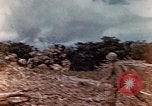
U.S. marines in mopping up operations during battle of Saipan in World War II
Final phase in battle of Saipan, during World War 2. U.S. marine throws hand grenade at Japanese defenders dug in bunker on the island. After the grenade explodes, marines fire rifles at the bunker. Bodies of two fallen Japanese soldiers.
President Kennedy receives Indian Prime Minister Jawaharlal Nehru and Ms. Indira Gandhi at Newport and in Washington.
U.S. President John F Kennedy receives Indian Prime Minister Jawaharlal Nehru and his daughter Ms. Indira Gandhi at Newport airport, Rhode Island. American ambassador to India John Galbraith, Indian students from Brown University and the press are also present. Military honor guard holding flags stands with airport terminal in background. Scene changes to Washington DC. Daytime view of exterior of U.S. Capitol building under a bright blue sky. Wide view of Washington Monument and reflecting pool. Scene in a park with yellow and orange colored autumn leaves on trees and ground, and adults and children walking in the park, wearing typical early 1960s fashions. Wide view of tidal basin and Jefferson Memorial in the distance. Arrival of President and Mrs. Kennedy accompany the visiting Prime Minister and his daughter on Air Force One aircraft as it arrives in Washington DC. Military honor guard holds flags and military band members play music, including the U.S. Army Herald Trumpets fanfare ensemble. The arriving officials are received by Vice President and Mrs. Lyndon B Johnson, Secretary of State and Mrs. Dean Rusk, and other dignitaries. President Kennedy speaks at a podium with microphone and welcomes the Prime Minister on his third visit to the U.S. Prime Minister Nehru then speaks and expresses gratitude for the welcome and for the friendship expressed by the President. View of Air Force helicopter taking off to fly the guests and the President to the White House after the ceremony.

Operation Crossroads atomic tests. Mushroom cloud from atomic Test Able
Aerial view of mushroom cloud rising from detonation of atomic bomb in Test Able of the atomic tests at Bikini Atoll, Marshall Islands. The mushroom cloud rises straight up from the Bikini Lagoon. Bikini Atoll visible in background.
CRITICALPAST.COM: About Us | Contact Us | FAQs - How to Order | License Agreement | My Account | My Lightboxes | Shopping Cart | Advanced Search | Featured Collections | Website Terms & Conditions | Privacy Policy ©2026 CriticalPast LLC.
License Agreement |
Terms & Conditions |
Privacy Policy
©2026 CriticalPast LLC.