


 Francais
 Deutsch
 Italiano
Refine Your Search
Goodenough Island New Guinea 1943 stock footage and images
- Showing 3385 to 3390 of 13659 results more
more Hide
Hide
Japanese airplanes take off from the flight decks for the air attack on Pearl Harbor, Hawaii, United States.
Japanese air attack on Pearl Harbor, Hawaii, United States. Japanese carriers Kaga and Zuikaku underway at sea. Officers on the deck of a Japanese ship. Japanese sailors push airplanes on the flight deck of a Japanese carrier. A pilot runs down the flight deck to an airplane. Japanese officers being briefed on the flight deck. Japanese pilots run to embark their airplanes. Air 'boas' on the bridge of the Japanese carrier give a 'launch planes' signal. Japanese planes are launched from the carrier. A Japanese torpedo bomber in flight. The airplanes fly in formation and approach Pearl Harbor. Pearl Harbor burns under Japanese air attack. Bombs explode on Ford Island. (World War II period).
Japanese soldiers advance towards a battlefield along a muddy road during the Battle of Malay Sea and Singapore.
Japanese artillery fired in the Malay jungle, Kuantan during World War II. Imperial Japanese Army (IJA) soldiers load and fire artillery. Smoke rises due to the firing. A map of Singapore showing British positions. The map zooms into Pulau Ubin island. A soldier watches enemy action through binoculars. Japanese troops cross the Straits of Johor from Malay to Singapore in small boats and wade ashore with equipment. Shirtless Japanese gun crewmen load shells into artillery. A Japanese soldier puts a blade on his bayonet. The artillery fired and airplanes drop bombs as screaming Japanese infantry advance along a muddy road. British and Allied prisoners of war (POWs) are being searched and led away by Japanese guards.
Guests aboard USS Arizona Memorial at Pearl Harbor in Hawaii, United States.
USS Arizona Memorial at Pearl harbor in Hawaii, United States. Officer on deck of USS Buchanan as he looks at the ceremony taking place at the memorial through binoculars. Guests aboard the memorial. Colors at half-mast. Memorial with colors at half-mast during dedication. Guests on beach at Ford Island, looking towards memorial.
Wreath floats over top of a sunken Arizona dropped from USS Arizona Memorial at Pearl harbor in Hawaii, U.S.
USS Arizona Memorial at Pearl harbor in Hawaii, U.S. Memorial during dedication. Guests aboard the memorial. Two staff officers salute as they face band on key. Guests stand before their chains on memorial. Officers and guests seated during services. Guests leave their chairs after services. Colors at half mast. Several wreaths hang from railing on Arizona Memorial. Wreaths hang from railings, another wreath floats over top of sunken Arizona. Some sections of Arizona above water. Ford Island ferry moves away from the memorial.
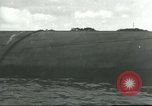
Views of the wrecked USS Utah and USS Arizona seen soon after the Japanese attack on Pearl Harbor in Hawaii
Wrecked parts of ships destroyed after the Japanese attack on Pearl Harbor during World War II. Capsized USS Utah (AG-16) seen off the western side of Ford Island, as filmed from a smaller boat passing along the length of its upturned hull. Wrecked parts of USS Arizona with turrets awash and twisted superstructure, as seen from smaller boats moving beside it. Closeup views of damage to the USS Arizona (BB-39). Mountains, buildings and trees in the background. Navy sailors on smaller boats passing near the damaged ships, including a group of sailors on a ship tender of the USS Arizona, with writing "Ariz" for "Arizona" written on the side.

German Invasion of Norway during World War II.
German invasion of Norway (Operation Weserubung) during the World War Two. German Junkers Ju-52 transport aircraft in flight over snow-covered rocky terrain. Navigator at his station in Ju-52. German soldiers and bicycles inside cabin of a Ju-52. Harbor and seaplanes seen below. Ju-52 lands at airfield. Many other Ju-52s parked. German troops offload personal gear and weapons, and then march across the field. A sentry posted at Oslo Air Base building. Explosions just outside the perimeter of airfield. A squadron of German Me-109 aircraft fly overhead. German antiaircraft batteries protecting the airfield. German Heinkel He-111s bombing a Norwegian island. Close view as bombs are released from bomb bay. German Luftwaffe Pilot in cockpit.
CRITICALPAST.COM: About Us | Contact Us | FAQs - How to Order | License Agreement | My Account | My Lightboxes | Shopping Cart | Advanced Search | Featured Collections | Website Terms & Conditions | Privacy Policy ©2026 CriticalPast LLC.
License Agreement |
Terms & Conditions |
Privacy Policy
©2026 CriticalPast LLC.