


 Francais
 Deutsch
 Italiano
Refine Your Search
Goodenough Island New Guinea 1943 stock footage and images
- Showing 421 to 426 of 13636 results more
more Hide
Hide
American men and women do sand-planing along the Atlantic coast in Southampton, Long Island, New York
American men and women do sand-planing along the Atlantic coast in Southampton. Sand-planing is a combination of winter sledding and summer aqua-planing, with a mid sized board, reinforced with aluminum, dragged behind a jeep at 30 miles per hour. Ropes are tied to an Aluminum board at one end, and to a jeep at the other end. Jeep pulls the aluminum board on which a person stands and sand-planes. The boards in some views enter the shallows of the surf (early skim boarding or skimboard concept).
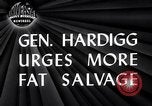
Major General Hardigg's speech on fat and oil recycling efforts; view of Halloran Army Hospital kitchen, Staten Island, New York
United States Army Major General Hardigg speaks about the need for saving waste fats and oils for recycling and reuse in the war effort during World War 2. Kitchen of Halloran Army Hospital is shown with Chefs preparing chicken and other foods, and saving fats. Homemakers and housewives shown straining fats through strainers to reserve and save fats. A housewife speaks to another woman. A girl presents a can of reserved fats to a store clerk who weighs it and gives the girl back a ration receipt.
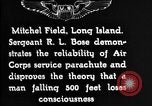
Sergeant R. L. Bose demonstrates reliability of Air Service parachutes at Mitchel Field on Long Island, New York.
Sergeant R. L. Bose demonstrates reliability of Air Service parachutes and disproves a theory that a man falling 500 feet or more loses consciousness. Civilians and military spectators watch the demonstration. Views from the airplane as Sergeant Bose free-falls from 3000 feet, delaying his chute opening until 1500 feet. Some of his free fall in slow motion. He makes a routine parachute landing. Spectators and an ambulance come as a precaution to his landing point.
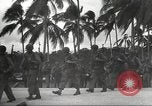
U.S. amphibious forces underway in the Pacific Ocean from Guadalcanal to invade New Georgia during World War II.
Amphibious forces of United States Army leave Guadalcanal harbor to attack enemy positions on the Solomon Islands during World War II. U.S. troops and equipment are loaded aboard LCIs (Landing Craft Infantry). Marines and infantry board the LCIs. Landing crafts loaded with troops head for an LST (Landing Ship Tank) anchored at Guadalcanal harbor. Amphibious forces underway in the Pacific Ocean head for New Georgia on the Solomon Islands. Soldiers look through binoculars. U.S. Army Air Force fighter aircraft in the sky. .
Captain Theodore J Van Kirk, navigator of B-29,'Enola Gay' interviewed at Tinian Island base, Marianas Islands in WW II
Atomic bombing mission in Japan by the United States Army Air Force, during World War II. U.S. military base in North Field, Tinian Island in Mariana Islands, South Pacific. Captain Theodore J. Van Kirk, the navigator of 'Enola Gay' (B-29 which dropped atomic bomb on Hiroshima) is asked about his experience, by Public Affairs Officer, Major John F. Moynahan (seen only from the back at very end of clip). Captain Van Kirk stands in front of Enola Gay and states his belief that the new bomb they carried would be a great help in shortening the war.
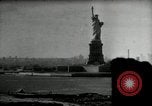
Views of Statue of Liberty and New York harbor, United States. Festivities in New York harbor. Exercises in Ebbets Field.
Views of the Statue of Liberty and New York harbor. An aircraft carrier moving slowly in New York harbor, past lower Manhattan. The Statue of Liberty, with many visitors walking across Liberty Island, is at base of the statue. An ocean liner billowing smoke in the distance. Passengers on deck of an excursion boat headed toward the Statue of Liberty. They are wearing warm coats. Two girls are eating ice cream cones. Views from the pilot house of the boat. Another view of passengers on the boat, with Statue of Liberty in background. Woman holds her hat against the wind. Views from stern of rapidly moving boat in the harbor. Navy boats and U.S. Sikorsky H-5 helicopters maneuver all around Liberty Island. New York City fire boats shooting torrents of water into the air in salute. Unrelated -- Near end of clip there is a brief view of men in white athletic clothes, possibly sailors or soldiers, performing bayonet drill exercise activities using rifles with fixed bayonets, at Ebbets Field (55 Sullivan Place; Brooklyn, New York) in Brooklyn, New York (home of the Brooklyn Dodgers baseball team). Spectators are in the stadium. Advertisements posted on the baseball field fences, including one for Abe Stark's clothing store.
CRITICALPAST.COM: About Us | Contact Us | FAQs - How to Order | License Agreement | My Account | My Lightboxes | Shopping Cart | Advanced Search | Featured Collections | Website Terms & Conditions | Privacy Policy ©2026 CriticalPast LLC.
License Agreement |
Terms & Conditions |
Privacy Policy
©2026 CriticalPast LLC.