


 Francais
 Deutsch
 Italiano
Refine Your Search
Greek-Civil-War stock footage and images
- Showing 631 to 636 of 27579 results more
more Hide
Hide
U.S. President Johnson and A.G. Katzenbach present Voting Rights Act draft bill; scenes from third Selma to Montgomery march.
Exterior view of White House in Washington DC with a light covering of snow on the ground. Interior view of White House with U.S. President Lyndon Baines Johnson as he signs a letter to legislators urging quick passage of the Voting Rights Bill in Washington DC. U.S. President Lyndon Baines Johnson and U.S. Attorney General Nicholas deBelleville Katzenbach seated at a desk. The Attorney General briefs the press about the bill. Journalists take notes about the proposed bill. Scenes from the third Selma to Montgomery Civil Rights March, beginning on March 21, 1965. African American civil rights leader Dr. Martin Luther King Jr. and other activists, including John Lewis seen marching arm-in-arm at different parts of the parade route, including past the state house in Montgomery, Alabama. Martin Luther King Jr. prepares to address marchers in Montgomery regarding a meeting he had to plan future marches. John Lewis also on the scene.

American political leader Martin Luther King, Jr and other leaders during their third Selma to Montgomery freedom march in Alabama.
A large crowd gathers during the 3rd civil rights freedom march from Selma to Montgomery in Alabama. People marching on a street in a large number, led by Martin Luther King, Jr and other civil rights leaders including John Lewis. African American political leader Martin Luther King, Jr. addresses the people. Buildings in the area. A sign reads: 'Edmund Pettus Bridge'. People seated on the ground at a camping area for much of the group on the first night. A helicopter in flight overhead.
Signing of the National Voting Rights Act of 1965 in the United States.
The National Voting Rights Act of 1965 is enacted into law in the United States. The exterior of the Capitol building. Cars parked along the sides of the street in front of the building. U.S. President Lyndon Baines Johnson addressing audience gathered in the Capitol. People seated on chairs. The President speaks about the voting rights act. People applauding. American civil rights leader Martin Luther King Jr standing with the other officials and civil rights leaders such as Roy Wilkins, James Farmer, and John Lewis, as President Johnson signs the Voting Rights Act in the President's Chamber of the Capitol.

Workers celebrate on the completion of the Mont Blanc tunnel in France.
The Mont Blanc tunnel being built in France. View of snow covered peak of Mont Blanc and gondola on steel cable ascending mountain. French and Italian workers inside the tunnel celebrate the completion of the tunnel from Chamonix, on the French side of the mountain, to Courmayeur, on the Italian side, cutting the road travel distance between Paris, France and Rome, Italy by 125 miles. Italian and French officials celebrate during the ceremony. Civil Engineer and Professor Loris Corbi, head of the Italian team, greets André Borie, the lead French Civil Engineer. Workers celebrate and drink champagne to toast the achievement.
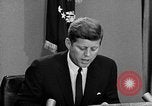
U.S. President Kennedy asks for support of the citizens for ending the discrimination against African Americans, in his speech in the U.S.
U.S. President John F. Kennedy's Civil Rights Address in Washington DC. United States President Kennedy seated at a desk and speaks over a microphone. Following events in Alabama, the President speaks about ending the discrimination of blacks by whites in the United States. He says that it's time for the Congress to act. President Kennedy says that he will ask the Congress of the United States to act, to make a commitment it has not fully made in this century to the proposition that race has no place in American life or law. He talks about the necessary measures that Congress can provide. The President, in his speech, asks the Congress to enact legislation giving all Americans the right to be served the facilities which are open to the public. He talks about his meeting with the business leaders and urges them to take voluntary action to end this discrimination. The President says that he has also asked the Congress to authorize the Federal Government to participate more fully in lawsuits designed to end segregation in public education. He also speaks about giving employment for African American citizens. President Kennedy, in his speech, pays tribute to those citizens of North and South who have been working in their communities to make life better for all. The President asks for support of all the citizens so that the discrimination can be removed and civil rights upheld.

President Johnson delivers a speech and people express grief after the assassination of Martin Luther King Jr. in the U.S.
From production "April Aftermath", showing mourning and grief throughout the United States after the assassination of Martin Luther King, Jr. on April 4, 1968. The flag of the United States is lowered at half mast. People watch on television President Johnson's speech about the assassination of Martin Luther King Jr. (leader in the American Civil Rights Movement). Families are seen at home gathered around the television to watch the speech. Views of several families of husband and wife and children gathered in their living rooms viewing television sets to watch the address. Most are white families. One family is an African American family watching television. President Lyndon B. Johnson delivers a speech. The Seal of the President of the United States on a dais. President Johnson declares April 7 as a national day of mourning for the civil rights leader. Mourning ceremonies are conducted in all churches and pilgrims of the United States. Television broadcast the faces of leaders and the news about the assassination and people expressing grief. A large crowd of civilians gather at a condolence meet. People in a line enter a building to express their grief. They come outside the building. A large crowd of civilians gather and attend the condolence ceremony. They express grief.
CRITICALPAST.COM: About Us | Contact Us | FAQs - How to Order | License Agreement | My Account | My Lightboxes | Shopping Cart | Advanced Search | Featured Collections | Website Terms & Conditions | Privacy Policy ©2026 CriticalPast LLC.
License Agreement |
Terms & Conditions |
Privacy Policy
©2026 CriticalPast LLC.