


 Francais
 Deutsch
 Italiano
Refine Your Search
Greek-Civil-War stock footage and images
- Showing 7489 to 7494 of 27483 results more
more Hide
Hide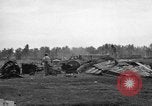
United States soldiers inspect a wrecked Japanese fighter plane during Philippine invasion of Lingayen Gulf in World War II.
United States soldiers move inwards during the Philippine invasion of Lingayen Gulf in World War II. They inspect a wrecked Japanese Air Force plane in a field. American soldiers climb on the wings of the airplane. The burnt fuselage and destroyed engine of the plane. Symbol of Imperial Japanese Air Services on the fuselage of the plane. Trucks loaded with troops driven away from the field.
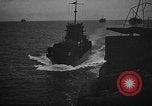
Landing Vehicles, cargo ships and destroyers of the U.S. Navy sail in a sea in the Pacific Theater during World War II.
United States Marines advance during the invasion of an island in the Pacific during World War II. A convoy of battleships sail in the sea. A Landing Ship Mechanized (LCM) moves alongside a Landing Ship Tank (LST). U.S. soldiers in full gear aboard the LST. A soldier in the gun tub of the LST keeps a watch on the sea. A U.S. Navy destroyer and other small boats near it in the sea.
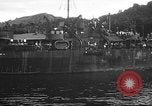
Military jeeps and trucks are offloaded from Landing Ship Tanks stationed at a beach in the Pacific during World War II.
United States Navy offloads material and equipment on a beach during invasion of an island in the Pacific during World War II. A Landing Ship Tank (LST) loaded with supplies and soldiers at the beach. Soldiers, army trucks and jeeps with chained wheels on the deck of LST. Trucks and jeeps drive out of LST on the beach. Several LCVPs ( Landing Craft Vehicle Personnels) tied together at the beach. Another LST loaded with jeeps and army trucks on its deck. Smoke arises from an explosion on a distant beach.

Swimmers dive as U.S. Navy LST-554 gets underway towards Palau Islands for Peleliu Invasion during World War II.
United States Navy LST-554 starts voyage towards Palau Islands for the Peleliu Invasion during World War II. Swimmers dive from LST deck and swim in the sea. The swimmers jump from other boats and swim towards the boats. U.S. Marines aboard the LST (Landing Ship Tank) talk to each other and play cards. Military vehicles and equipment under cover aboard the LST.

U.S. task force underway for Peleliu (Palau) Invasion during World War II.
Opening slate reads LST 554, and date 8-13. Views of U.S. invasion task force vessels underway toward Peleliu Island (Palau), during World War 2. A 110 foot wooden Subchaser, number SC 633 is seen close, to starboard of camera boat (LST-554) and refueling lines are stretched between the LST and the Subchaser. Ensign Maynard K. Ross of Philadelphia, PA, directs the take-up of slack in the refueling lines while a Navy Commander on the LST bridge oversees the operation. (Note: SC 633 ended up running aground during the invasion.) Break in sequence and scene shifts to glimpse of slate reading August 20, 1944, and then view aft on LST 554. On the bridge, 21-year-old Ensign Charles Kahler, of Schenectady New York, uses a sextant to shoot sun lines. Another officer is seen taking relative bearings with a pelorus. Sailors are resting on deck. A series of splashes are created in the water by gunners testing their weapons. LST 557 is cruising to starboard. Puffs of black FLAK smoke appear overhead as antiaircraft weapons are tested.
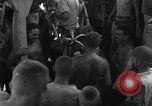
Ship's company take part in a line-crossing ceremony aboard LST 554 during World War II
U.S. Sailors and Marines participate in traditional nautical ceremonies marking the crossing of the Equator, aboard the Landing Ship Tank, LST 554, during World War 2. This involves "Shellbacks" (sailors who have already crossed the equator) intiating "pollywogs" (sailors who have never crossed the Equator) into the Kingdom of Neptune. "Pollywogs" are seen assembled below, and then brought up on deck where they are subject to various forms of horseplay and embarrassment (all in good fun). Some are seen in silly lookout poses. One is seen nearly atop the ship's mast. One, naked, pours water over the head of another. Another is made to dance with a mop. Then two are made to dance together, after which they must mop the deck. Finally, the Pollywogs have their heads shaved, and dunked in water, after which they run a gauntlet of shellbacks who hit them hard (with soft paddles). Initiates being sprayed with water on deck.
CRITICALPAST.COM: About Us | Contact Us | FAQs - How to Order | License Agreement | My Account | My Lightboxes | Shopping Cart | Advanced Search | Featured Collections | Website Terms & Conditions | Privacy Policy ©2026 CriticalPast LLC.
License Agreement |
Terms & Conditions |
Privacy Policy
©2026 CriticalPast LLC.