


 Francais
 Deutsch
 Italiano
Refine Your Search
Greek-Civil-War stock footage and images
- Showing 7519 to 7524 of 27483 results more
more Hide
Hide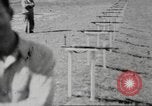
U.S.Army Air Corps recruits receive small arms training at a basic training base in Florida, during World War II
Opening scene shows rifles placed on each of a series of stands along the firing line of a rifle range at a basic training base in Saint Petersburg, Florida, during World War 2. U.S. Army Air Corps recruits are lined up side-by-side with their instructors, behind the firing line, awaiting instructions from the Range chief (unseen). Upon his order, they advance and take up prone positions, in pairs, at each firing position. Each recruit is assisted by his instructor and fires his rifle while his instructor observes and notes results. Non-commissioned officers (NCOs) monitor from behind the firing line. Camera pans across the firing line. Next, men are seen lowering bulls eye paper targets and replacing them with new ones that they raise high overhead, and signal with flags, when done. Views of the targets. Next trainees stand along the firing line, with Thompson M-1928 A1 submachine guns at ready. Upon command, they fire bursts from their weapons at silhouette targets. Bullets seen striking targets and dirt hill behind them. Face of Hitler and swastika are scrawled on one target.
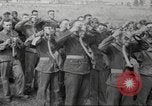
U.S. Army Air Corps recruits undergoing gas mask training at a basic training base in Florida during World War II.
U.S. Army Air Corps recruits l receive gas mask familiarization at a basic training base in Saint Petersburg, Florida duringf World War 2. Trainees are seen donning gas masks in preparation. Closeup of some trainees in their masks. The group enters through a doorway labeled "Danger Gas Chamber." Next, they are see exiting the doorway, carrying their masks and exhibiting some effects from tear gas, which they have been deliberately subject to as part of their familiarization training. Closeup of several men with tearing eyes from the brief exposure. Change of scene shows a smoke screen flowing over the ground. A jeep carrying several officers emerges from the smoke. Next, a cadre of trainees emerges on foot.
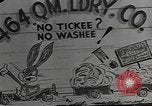
The U.S. Army Quartermaster Corps provides numerous support services to troops in the South Pacific in World War II
The U.S. Army Quartermaster Corps delivers laundry and myriad other services in the South Pacific during World War 2. Opening scene show a cartoon sign by the 464th Quartermaster Laundry Company featuring Bugs Bunny in a jeep pulling mobile laundry equipment in wagons. Next, U.S. troops are seen in jungles subject to rain and mud of the South Pacific. A soldier crouches in a riverbed and washes his clothes. A mobile laundry installed near a river. Soldiers using washers and dryers in the facility. Views of larger fixed installation Quartermaster laundry, such as in New Caledonia; Fiji; and the New Hebrides. Quartermaster salvage and repair workers operating sewing machines as they repair military clothing. A sign identifies "Island Quartermaster C&E Repair Shops" (Clothing and Equipage Repair Shops). Here workers sort, repair, and remark sizes on salvaged clothing. Two workers sit in a mound of garments that they cut into rags and toss into a heap behind them. Two workers repair broken shoes. Soldiers' feet seen walking through mud. A stack of army shoes needing repair. A team of army workers using modern machines to repair them. View of finished shoes, as good as if repaired in the U.S.A. Sign identifies Orthopedic Department where a man works on specially designed and fitted shoes prescribed for an injured soldier by a medical officer. A nurse and a doctor place the special shoe on a patient. A nurse assists the patient to walk. Typewriters needing repairs line shelves. Technicians are seen at work stations, repairing typewriters. The final sequence begins with a sign reading: "Tent Repair, Drive in here. All tents must be clean, dry, and folded properly." Quartermaster workers raise a tent inside a shelter and then identify and repair a hole in it by applying fabric glue and a patch.
Chemical Warfare Service troops wearing gas masks during World War I training in the United States.
A division commander of Chemical Warfare Service tells assembled World War 1 trainee soldiers that, properly trained, they should be able to perform their duties, in simulated combat, for at least one hour, in full protective gas masks, without loss of efficiency. Soldiers seen training in field wearing gas masks. Officer in charge of gun crew is wearing new diaphragm microphones so that gun crew can hear while wearing their gas masks. He drills gun crew with commands.
A Chemical Warfare Service officer gives advice to soldiers about gas warfare, as they prepare to leave for World War 1 combat
Chemical Warfare Service training in the United States during World War I. An officer addresses a group of soldiers, giving last minute advice as they prepare to depart for active combat in France. He discusses persistent and non-persistent agents and conditions of temperature inversion favorable to gas attack.

World War II soldiers suffering neurological and psychiatric disorders taken to the Mason General Hospital in the United States
Film 'Let There Be Light' shows World War II casualties afflicted by neuropsychiatric disorders (Post Traumatic Stress Disorder or PTSD, today), and being treated with methods such as hypnosis and "narcosynthesis" to address their "battle neurosis." A medical ship stands in a harbor in the United States. Patients are taken out of the ship. The psycho neurotic patients taken to the Mason General Hospital. Patients taken out of the the ambulance.
CRITICALPAST.COM: About Us | Contact Us | FAQs - How to Order | License Agreement | My Account | My Lightboxes | Shopping Cart | Advanced Search | Featured Collections | Website Terms & Conditions | Privacy Policy ©2026 CriticalPast LLC.
License Agreement |
Terms & Conditions |
Privacy Policy
©2026 CriticalPast LLC.