


 Francais
 Deutsch
 Italiano
Refine Your Search
Greek-Civil-War stock footage and images
- Showing 7867 to 7872 of 27484 results more
more Hide
Hide
B-29 bombers being manufactured and they bombard the Rama VIII Bridge in Bangkok, Thailand during World War II.
United States Army Air Force B-29 Superfortress bombers in action in Thailand during World War II. Men work in a plant in the United States as they manufacture B-29 bombers. Men work on the body of the aircraft. In China, fuel barrels being loaded onto an aircraft for transporting. Chinese troops roll the barrels and pile them up at an air base for refueling B-29 aircraft. Fuel being unloaded from the barrels into a huge storage tank. Piled up barrels. A B-29 aircraft takes off and in flight. The Rama VIII Bridge in Bangkok, Thailand being bombarded by the B-29s. Bombs impact and billows of smoke rise up.
United States aircraft take off and land aboard an aircraft carrier in the Pacific Ocean during World War II.
United States aircraft come aboard an aircraft carrier in the Pacific Ocean during World War II. A United States Navy Task Force underway at sea. Aircraft on the deck of the ship. An aircraft takes off as a signalman waves. The aircraft in flight. The fighter bomber aircraft return to the carrier after striking Japanese positions in China, Formosa and islands off the coast of Japan. The aircraft land and taxi on the flight deck. An aircraft lands and falls over the side of the aircraft carrier while taxing. The pilot is rescued and carried away on a stretcher. An aircraft takes off from the deck.

American Forces led by General MacArthur land at the Lingayen Gulf and advance to Manila, Philippines during World War II.
The United States campaign against the Japanese in Luzon, Philippines during World War II. An Allied convoy of ships underway in the Pacific Ocean towards the Lingayen Gulf. Naval guns fire at the coast and at Japanese airplanes. U.S. Army Generals Walter Kruger and Douglas MacArthur keep a watch over the convoy of ships. General MacArthur and other officers come ashore at the Lingayen Gulf. Troops unload equipment at a beach. Infantrymen advance inland. The Filipinos greet the soldiers as they advance towards Manila. The soldiers with the Filipinos. People cheer as the American soldiers enter Manila. Animated map of the Philippines depicts the location of the Lingayen Gulf and the advance of American soldiers from the Lingayen Gulf to Manila.
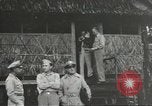
U.S. Army Chief of Staff, George C. Marshall, visits 6th Army Headquarters during World War II
George C. Marshall, U.S. Army Chief of Staff, stands on the top step of a wood and woven palm building, headquarters of the U.S. 6th Army, on Goodenough Island, New Guinea, during World War 2. Lieutenant General George C. Kenney, Commander of Allied Air Forces and the U.S. Fifth Air Force, stands with two other officers on the ground in front of the hut. General Douglas MacArthur Supreme Commander of Allied Forces in the Southwest Pacific Area (SWPA) joins Marshall and poses, standing to his left. General Marshall leaves the building to enter a car. Next, he is seen standing on the ramp of an airfield. MacArthur is also seen briefly, standing next to Marshall. General Marshall converses with Lieutenant General Walter Kreuger, Commander of the Sixth United States Army in the South West Pacific Area, and with General Kenney. General MacArthur and General Kenney, followed by other officers, walk back from a B-17 bomber (General Marshall's airplane) after saying goodbye to General Marshall. General Kreuger remains at the door of Marshall's B-17, bidding Marshall farewell. The B-17 is next seen taking off from the runway.
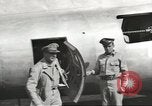
General Douglas MacArthur visits elements of the 6th Army in New Guinea, during World War II
General Douglas MacArthur (Supreme Commander of Allied Forces in the Southwest Pacific Area) steps from a B-17 bomber at the airfield on Goodenough Island, New Guinea, during World War 2. He converses with Lieutenant General Walter Kreuger, Commander of the Sixth United States Army in the South West Pacific Area. Next they are seen sitting in a spruced up patrol boat underway in waters not far from the island (seen in background). A line of Landing Vehicles Tracked (LVT-1s) filled with soldiers, is seen moving across a field. On continues past an audience of sailors and soldiers, and enters the waters off the island. It continues, kicking up a wake as it moves through the water. A line of LVT-1s filled with troops, waits to also enter the water.
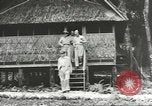
General Douglas MacArthur inspects 6th Army headquarters in New Guinea, during World War II
General Douglas MacArthur (Supreme Commander of Allied Forces in the Southwest Pacific Area) steps from the wood and palm structure, serving as Headquarters of the 6th Army, on Goodenough Island, New Guinea, during World War 2. He poses with Lieutenant General Walter Kreuger, Commander of the Sixth Army in the South West Pacific Area. Members of Kreuger's staff pose with them. After the picture-taking, MacArthur shakes hands with one of the staff officers, as the group make their way to jeeps. Next, MacArthur is seen posing with several armed soldiers wearing steel combat helmets. They salute MacArthur as he walks away. General Kreuger stands in front of the headquarters hooch conversing with two of his staff. He and one of his staff hurry to a jeep, with two stars on the front plate. They drive away. . Generals MacArthur and Kreuger are seen sitiing in back seat of a jeep with modified roof cover. MacArthur converses with staff officers. They are next seen walking through a grove of trees, with staff officers behind them. Later, MacArthur leads the entourage along a pathway, with tents visible in background. As they walk, he converses with Major General Edwin F.Harding, Commander of the 32nd Infantry Division. An official photographer lingers in background. MacArthur and Kreuger lead the group past a large mess tent. (At this point the footage repeats starting back with their entry into the grove of trees and ending as they pass the mess tent.) After that MacArthur is seen speaking to two bareheaded officers. He then speaks with several soldiers, individually, as Generals Kreuger and Harding stand nearby. MacArthur converses with a Field Grade officer. He visits an infirmary tent and speaks to a patient and to members of the medical staff, including a woman Lieutenant nurse. He and General Kreuger are seen inspecting various areas in the camp.
CRITICALPAST.COM: About Us | Contact Us | FAQs - How to Order | License Agreement | My Account | My Lightboxes | Shopping Cart | Advanced Search | Featured Collections | Website Terms & Conditions | Privacy Policy ©2026 CriticalPast LLC.
License Agreement |
Terms & Conditions |
Privacy Policy
©2026 CriticalPast LLC.