


 Francais
 Deutsch
 Italiano
Refine Your Search
Greek-Civil-War stock footage and images
- Showing 805 to 810 of 27579 results more
more Hide
Hide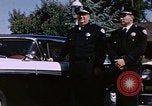
Conventioneers arrive by buses and cars to attend F.B.I. National Academy Convention held in Palo Alto, California
FBI National Academy Convention held in Palo Alto, California. Several cars parked in the premises. Conventioneers stand in front of the cars. Gate of one of the car is open. A number plate of a car reads 'MEK 935'. The conventioneers laugh and talk. Trees and building in the background. Two men in civil dress come to greet them.
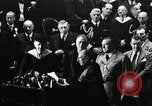
President Franklin D. Roosevelt's address on the 200th anniversary of the University of Pennsylvania in the United States.
U.S. President Franklin D. Roosevelt addresses a gathering at the 200th anniversary of the University of Pennsylvania in the United States. President Roosevelt is the guest of honor at the university's anniversary. The President is flanked by dignitaries, academicians and professors at the university. A large crowd of students gathered for the event. President Roosevelt addresses the crowd on the occasion. He begins by thanking the university for the honor. He says that, instead of having chosen 1740 for the foundation of the university, if the year was 1739, the 200th anniversary would have fallen in an election year. A huge applause from the crowd. The President says that even the period in which the university was founded was a strange period of relapse in the history of civilization of the world since in some lands it had been a custom to burn books of scholars and use government decree to derive morality and culture and education. And how, in the world today, people think clearly of the hard work their predecessors put in to attain the liberty and freedom they enjoy today.
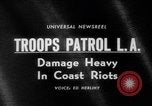
Burning buildings and aftermath of the race riots in the Watts area of Los Angeles, California.
Loss and damage in the city after race riots in the Watts area of Los Angeles, California, during the Civil Rights movement. Night time views of the streets in the largely African American section in Los Angeles. Smoke and flames rise from buildings. Buildings on fire, set by arson during the riots. Interiors and exteriors of the buildings on fire, spanning many city blocks. Policemen arrest two men and lead them away. The devastated areas in the city, and a few buildings which are left intact. Armed National Guard troops in the streets on patrol to prevent further looting and damage. Damaged buildings on either side of the road. The Watts area of the city where a curfew was put into effect. A soldier with a rifle patrols the area. The remains of buildings in the area. Views from a moving vehicle of block after block of gutted and destroyed buildings. A special task force on alert. Policemen come out of a truck and National Guardsmen exit a bus. A helicopter in flight over the area. The police vehicles on the streets, and police in the streets behind makeshift covers for protection.
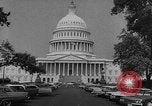
Voting Rights Act signed in U.S. Capitol by President Lyndon B Johnson, with leaders present including Martin Luther King Jr.
The signing of the Voting Rights Act of 1965 in a ceremony in the President's Room near the Senate Chambers in the U.S. Capitol, in Washington DC. President Lyndon B. Johnson talks to other Senators and Congressmen during the signing of the Voting Rights Act. Wider view of other attendees at the signing, including John Lewis in background and other civil rights leaders. A leader whispers in the ear of Martin Luther King Jr., in foreground.
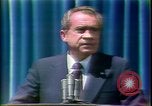
In San Clemente, California U.S. President Nixon talks about the existence of wiretaps during the Kennedy administration.
U.S. President Richard Nixon talks about the role of wiretaps in national security during a press conference in San Clemente, California. A journalist questions the President about his statement regarding the 10 additional wiretaps that could have been initiated by late U.S. Senator Robert F. Kennedy, which would have lead to the discovery of the Oswald plan and thus prevented U.S. President John F. Kennedy's assassination. The President responds that 10 more wiretaps could have found the conspiracy, if it was a conspiracy in the first place, then it would have been worth it. The President also talks about the high number of wiretaps in the National Security area during the Kennedy administration for national security purposes. The taps on news organizations, news people and civil rights leaders were all justified. The journalist then asks the President if he thought that President Kennedy's assassination threat mattered more to the national security wiretaps. The President does not agree with this and believes that the assassination was a breakdown in the President's security. He also states that he personally does not prefer to have secret service.
James Meredith chosen by the Republicans to run against Powell in a special election
James Meredith speaks to the press after being chosen by the Republicans as their candidate to run against Congressman Adam Clayton Powell in an upcoming special election. The Civil Rights figure, Meredith, is seen talking to reporters.
CRITICALPAST.COM: About Us | Contact Us | FAQs - How to Order | License Agreement | My Account | My Lightboxes | Shopping Cart | Advanced Search | Featured Collections | Website Terms & Conditions | Privacy Policy ©2026 CriticalPast LLC.
License Agreement |
Terms & Conditions |
Privacy Policy
©2026 CriticalPast LLC.