


 Francais
 Deutsch
 Italiano
Refine Your Search
Greek-Civil-War stock footage and images
- Showing 985 to 990 of 27579 results more
more Hide
Hide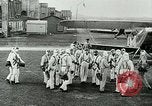
From the Pre-war RAF (1930s) to the new British RAF aircraft of the beginning of World War 2.
From the Pre-war RAF to the RAF in World War II. Pre-War (1930's) British pilots and aircraft. A line of parked Hawker bi-planes (1930's). Formation display at pre-war Hendon Air Pageant. The Schneider Trophy won by Supermarine. This racing plane design helped Mitchell design the Supermarine Spitfire. A Supermarine S-2B sea plane takes off and seen in flight. Workers work for the production of aircraft. An assembly line of aircraft. Men work on the bodies of aircraft. A Royal Air Force Vickers Wellington medium bomber taxis and takes off. Lines of parked AW Whitleys. A front line medium bomber. A Bristol Blenheim light bomber aircraft takes off. A Beaufighter night-fighter in flight. Short Stirling aircraft stationed. A Halifax heavy bomber takes off and in flight.
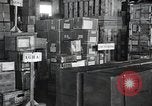
War supplies from different parts of the world, construction of shipyards, and building war ships in the United States.
War equipment and ships built in industries of the United States during World War II. Crates containing war supplies from all over the world stacked. Massive large columns of United States Army Soldiers and huge columns of United States Navy sailors in review, marching and standing in formation. Men work on the construction of shipyards and ships in shipyards. War production workers work on different machines to make and assemble ship parts. A crane lifts a part of a warship to be assembled. Men wearing protective masks do arc welding on parts of ships. A line of ships at dock. Scenes of many different cargo ships, Liberty Ships, battleships, cruisers, submarines, destroyers and aircraft carriers launched. Some of the ship names seen include: SS Zebulon Pike, SS Patrick Henry, SS John C Fremont, SS John Fitch, SS Ethan Allen, SS Mormacwren, SS Irving S Olds, a ship of the Lykes Lines, the U.S. Navy destroyer USS Bristol (DD 453), USS Hancock (CV-19), Men walk down the steps towards the ships. Men load supplies onto ship. Soldiers board transport ships. A Soviet cargo ship with a large flag "USSR" on it. A convoy of ships at sea.
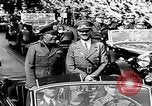
Twentieth Century scenes spanning German annexation of Austria; Italy-Ethiopia conflict; Korean War; and Vietnam War.
Adolf Hitler and Benito Mussolini standing together in an open car during a motorcade in Munich, in 1938. Civilian spectators render Nazi salutes as they pass. Next, British Prime Minister, Neville Chamberlain, arriving for the Munich treaty conference, steps from a British Airways Lockheed Model 14 passenger plane. An honor guard of helmeted and white-gloved German soldiers stands at attention during his welcome. Adolf Hitler climbs stairs of Berghof together with Chamberlain and Hitler's interpretor, Paul Otto Schmidt, on September 15, 1938 for their conference. Crowds of Germans give Nazi salute and cheer as Hitler and Mussolini appear on a balcony. Prime Minister Chamberlain back from the conference, speaks to the crowd at Heston Aerodrome on 30 September 1938, saying, among other thing, "We regard the agreement signed last night, and the Anglo-German naval agreement as symbolic of the desires of our two peoples never to go to war with one another again." Damaged buildings and ruins of city. Mussolini giving an impassioned speech. Italian cavalry carrying out a charge in Ethiopia. Italian troops employing machine guns in the Second Italo-Ethiopian War circa 1936. Italian infantry charging across sand dunes. Ethiopian Emperor Haile Selassie at the League of Nations podium. Nazi Swastika eagle statue. A formation of German troops, during the Anschluss (German annexation of Austria,in 1938). Hitler at a podium. People rendering Nazi salute in annexed city. At this point, the film transitions to 1950 as North Korean troops cross the 39th parallel and start the Korean War. A nighttime artillery barrage. North Korean troops firing a Browning M1917 machine gun and rifles. The feet of American soldiers are jumping out of foxholes as U.S.M26 Pershing tanks fire their guns from tilted positions below hills. A Pershing tank crosses a bridge back into South Korea, where a sign reads:"You are now crossing the 38th parallel, Co.B 728 MP." Scene shifts again, to President Lyndon B. Johnson delivers speech about Vietnam at a news conference on July 28, 1965, in which he states,among other things, "Three times in my lifetime...Americans have gone to far lands to fight for freedom..." as he explains U.S. involvement in Vietnam and the Vietnam War.
Life in Britain on eve of War. Chamberlain, Hitler and Mussolini signing the Munich Agreement during World War II.
An Allied propaganda film to solidify Anglo-American solidarity within the ranks as well as to counter Nazi propaganda aimed at weakening the alliance shows British soldiers in Great Britain during World War 2. 1938: in the United States New York Yankees win the pennant in baseball; scene of Yankees team members shaking hands. View of aviator Douglas Corrigan nicknamed Wrong Way Corrigan after his accidental flight from New York to Ireland instead of California as planned. View of trains on the 6th Avenue Elevated (or Sixth Avenue El) before that service was halted in Manhattan New York City. British citizens go about their daily life. Derby horse race in a stadium. A British boy and his father shovel dirt for a backyard garden. Players play a football (soccer) game at Wembley Stadium in England as spectators cheer the 1938 FA Cup Final with Preston North End taking the Cup versus Huddersfield Town as George Mutch scores the winning goal. Scenes in Germany: People cheer for German Chancellor Adolf Hitler and give Nazi salute. Newspaper headlines about Czech occupation. Graves in a cemetery. British Prime Minister Arthur Neville Chamberlain, Adolf Hitler Italian Prime Minister Benito Mussolini sign the Munich Agreement. Despite a peace agreement Hitler invades Czechoslovakia. People read 'Military Training Act, 1939'. British soldiers march along a road. View of Adolf Hitler smiling and laughing. Artillery is fired. A poster reads 'Britain Declares War on Germany'. Airplanes in flight and drop leaflets over Germany. German airplanes in flight. Parachutists jump from the airplanes. Hitler talks to officers and considers the war to be over. Radio news broadcast of the British declaration of war on Germany by Neville Chamberlain. Many different British citizens and families shown in living rooms and work places gathered around radios to listen to the so called "We shall fight on the beaches" speech of Winston Churchill on June 4, 1940. Clip includes scenes from 1938 through 1940; from a film produced in 1943.
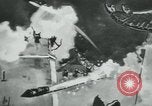
Troops used rockets to fight against enemies in foreign countries and during the U.S- British War of 1812 and the Mexican-American War.
Historic use of rockets in wars in foreign countries Sketches and pictures depict arrows and rockets used by Chinese people to fight against the enemies. British troops using rockets to fight against the Americans during the Anglo-American War of 1812. Rockets used during the Mexican-American War in the year 1846. View of Dr. Robert H Goddard, who launched the first liquid fueled rocket in U.S. experiments. He is seen in his working laboratory standing next to a rocket he was developing for possible use in World War 1 .
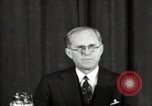
Joseph Kennedy speaks over radio in Washington DC and refers to World War II as war of industries and not armies.
Former U.S. Ambassador to the UK, Joseph Kennedy, records a speech for radio in Washington DC during World War II. Kennedy speaks about mobilization of troops in World War II and says that it is a war of industries and not armies. He further says that speeding up rearmament is the only way to stay out of war.
CRITICALPAST.COM: About Us | Contact Us | FAQs - How to Order | License Agreement | My Account | My Lightboxes | Shopping Cart | Advanced Search | Featured Collections | Website Terms & Conditions | Privacy Policy ©2026 CriticalPast LLC.
License Agreement |
Terms & Conditions |
Privacy Policy
©2026 CriticalPast LLC.