


 Francais
 Deutsch
 Italiano
Refine Your Search
Greek-Civil-War stock footage and images
- Showing 10129 to 10134 of 27486 results more
more Hide
Hide
Polish people honor dead heroes of the Resistance in Warsaw, at end of World War II.
Officials assembling to honor fallen Polish Resistance heroes. A speaker stand displaying the Polish Military Eagle Insignia is set up in a square in Warsaw. Demolished and damaged buildings are seen in the background. Cars arrive carrying officials. Polish military and police stand along the square and many people are assembled behind them holding flags of all sorts. Closeup of well-dressed civilian officials presenting an official Government citation for Kyzyzem Grunwaldu (the cross of Grunwald). A Polish general stands with officers of Allied forces, including British and French, and a Polish civilian official. A group of uniformed Allied military men and women standing in front of war-torn ruins. Polish troops parade followed by Polish girls and boys carrying a large banner. View of numerous crosses marking graves of fallen in the ruins. Camera pans over scene of desolation and destruction. Wreaths placed at a memorial site among the ruins. Crude lettering in concrete wall reads something about being part of the wall where Resistance Fighters were killed. Details and date are obscured. Multiple scenes of bombed out and destroyed buildings. A man walking away through rubble.

Scenes at an Orphanage in Dachau, Germany, at end of World War II.
The time is at end of World War 2. Slate describes this film as the Orphanage at Dachau. A bucolic scene shows horse-drawn wagon moving along country road, with twin spires of a church, visible in the background. Camera zooms in on church spires and roof, and then to a sign near the door reading,"DP Childrens Center, UNRRA, Team 182." (DP means Displaced Persons, UNRRA stands for United Nations Relief and Rehabilitation Administration.) At the entrance, itself, a sign reads:"Ausländer Kinderstation, UNRRA, Ausschuss 182 (Foreign children's ward, UNRRA, committee 182). Children run down the stairs of the building and are seen, next, outdoors in a grassy churchyard of the camp, where they form a circle, hold hands, and dance and sing. Scene shifts to indoors in a high-ceilinged room filled with daylight from several large windows where the children sit for a nourishing mid-day meal. Men in military-like uniforms pass trays of food to children standing in line. A similarly-dressed woman helps several very small children down the stairs. A line of babies sit at a long table and are fed by a Nun in habit. Closeups of the babies trying to feed themselves. Next scene shows a Nun washing the babies, in a nursery, with cribs in the background. View of many pre-school age babies seated on the floor playing together with toys. Outside, in the grounds, school age boys play football (soccer), while schoolmates watch from the sidelines and cheer.
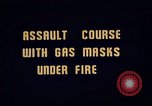
Soldiers training at the United States Army Ranger school, Fort Shafter, Territory of Hawaii, during World War II
Soldiers go through the assault course with gas masks, under fire, at the U.S. Army Ranger Combat Training School in Fort Shafter, Hawaii, during World War 2. Opening scene shows several trainees in gas masks carrying rifles with fixed bayonets, advancing through rough terrain in which tear gas fumes are seen. Closeup of one soldier, wearing steel helmet and mask, but otherwise stripped to the waist, as he bayonets a stuffed dummy target on the course. He uses his bayonet on another dummy that drops down on him as he scrambles out of a tunnel. Views of other soldiers passing through the same portion of the training course. As they leave the tunnel, they encounter more gas that billows across their path. Change of scene shows the soldiers climbing over obstacles placed in their path. Closeups of some trainees scrambling over obstacles. Some soldiers are seen crawling as camera pans to sniper firing from a palm tree. Next, they must traverse another obstacle and engage two more dummies with their bayonets, next to barbed wire fence. As they pass a steep hill, an explosion occurs raising smoke and causing rocks and dirt to fall down towards them. Next, they must make their way along a ravine lined with barbed wire. One fires his rifle. Closeups of several trainees climbing out of a water filled ravine and crossing a stream on makeshift footholds. Soldiers must run on a log to cross a creek, as explosive charges explode around them. They emerge from a tunnel and charge up a steep dirt hill to encounter another dummy to bayonet. Film ends displaying a sign that exhorts soldiers to embrace killing and reminding them survival requires that they KILL or be KILLED. It is signed by Lieutenant General Lesley James McNair, Chief of the Army Ground Forces. It ends: "WE are not going to be killed!"
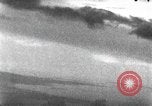
Rockets launched by an A-1H Skyraider hit a wooded area next to a shoreline in Vietnam during the Vietnam War.
U.S. Navy carrier air attack in Vietnam during the Vietnam War. Contrails leave wing tips of an aircraft as it climbs steeply. Bombs under the wings of the aircraft. Aerial view of the terrain. Rockets are launched from a United States Navy A-1H Skyraider aircraft. The A-1H aircraft pulls up before the rockets hit the ground. The rockets streak towards a wooded area next to the shoreline of the Mekong river. The aircraft in flight. It climbs steeply over the river.
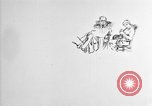
Chalk-Talk cartoons of a family depict the use of Thrift Stamps in the United States during World War 1
Cartoons about U.S. Thrift Stamps in the United States during World War I. Chalk-Talk type cartoons : Girls wash dishes. A mother and a father sit in a living room. The father says 'They're helping the government and saving money'. A caption below a table 'Washing dishes is easy now that the girls are saving up thrift stamps'.
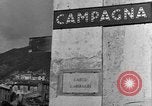
Men clear debris and damaged buildings in Campagna and Eboli, Italy, during World War II.
Wreckage in an area near the Sele River in Eboli, Italy during World War 2. A sign on a wall reads 'Campagna'. A man shovels amongst ruins in the foreground. Men clear debris. A discarded picture of Mussolini lying on a heap of rubble. A bullet ridden sign on a highway reads 'Eboli'. Wrecked city of Eboli.
CRITICALPAST.COM: About Us | Contact Us | FAQs - How to Order | License Agreement | My Account | My Lightboxes | Shopping Cart | Advanced Search | Featured Collections | Website Terms & Conditions | Privacy Policy ©2026 CriticalPast LLC.
License Agreement |
Terms & Conditions |
Privacy Policy
©2026 CriticalPast LLC.