


 Francais
 Deutsch
 Italiano
Refine Your Search
Greek-Civil-War stock footage and images
- Showing 10513 to 10518 of 27487 results more
more Hide
Hide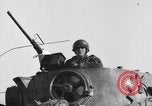
Army vehicle loaded with U.S. soldiers move along the streets of the city in Worms, Germany during World War II.
Activities of U.S. Army 4th Armored Division in the damaged city of Worms in Germany during World War II. U.S. soldiers sitting in a tank move along the streets. German civilians on the streets. Trucks loaded with U.S. soldiers move along the streets of the city.
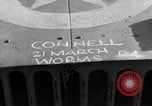
Damaged and burning buildings, houses and a railroad station in Worms, Germany during World War II.
Activities of U.S. Army 4th Armored Division in the heavily damaged city of Worms in Germany during World War II. Damaged and burned buildings of the city. Views of rubble in the wrecked town. The muzzle of a German gun in the foreground. Wreckage in the streets. A building on fire with flames visible through the windows. Collapsed walls of wrecked buildings. An automotive service station building in the distance with a Standard Oil or Shell Oil company sign and a BMW logo symbol sign. U.S. armored vehicles and jeeps move nearby. A few citizens walking in the streets. Various bombed buildings and a wrecked railroad station. Debris strewn over the streets. A sign showing the way to "Hamburg" on a street.
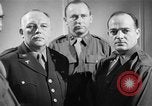
World War 2 Combat Exhaustion patients undergo personality tests, receive sleep therapy and various treatment in the U.S.
Treatment for combat exhaustion cases among U.S. soldiers following combat in World War II. U.S. officers talk about operation plan of a hospital and speak about three sections including admission, treatment and rehabilitation. A patient undergoes a physical examination. A dental survey and necessary laboratory studies. Doctors seated at table to perform an intelligence tests and mental examination. Psychiatric and other personality tests and intelligence test are administered including Rorschach test and Kohs block design test. The doctors check the psychiatric and physical report of the patient by looking at an X-ray. Patients receive sleep therapy: A nurse and an army doctor give narcosis therapy (continuous sleep treatment), by administering barbituates that keep a patient asleep for 18-20 hours per day for several days. Insulin is used on "loss of weight" cases: Combat exhausted soldiers lying on beds and receiving insulin before breakfast by nurses to stimulate their appetite. A nurse checks the weight of a patient during treatment. A nurse checks the diet which will be given to the patients in a kitchen. A patient receives an electric shock therapy treatment. A doctor injects a medicine into a patient. The patients go through physical exercises to maintain physical fitness. The patients are reeducated to know the causes of diseases. (Note: Clips deals with treatment for Combat Exhaustion, also later termed Post-traumatic Stress Disorder or PTSD.)
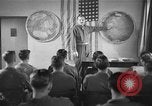
U.S. Army officers discuss treatment for combat exhaustion cases among World War II Army soldiers
Reenactment dealing with treatment for World War 2 combat exhaustion cases among U.S. soldiers. Army personnel receive training to know the reasons for exhaustion and the methods to rehabilitate the soldiers. The flag of the United States on a wall. U.S. Army officers seated at a table. The army personnel and an officer are in discussion about combat exhaustion. Personnel receive answers of their questions in the discussion. (Note: Clips deals with treatment for Combat Exahaustion, also later termed Post-traumatic Stress Disorder or PTSD)
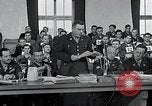
Scenes from Malmedy War Crimes Trials in Dachau, Germany, and prosecutor speaking about the Battle of the Bulge.
The Malmedy War Crimes Trials in Dachau, Germany. The defense counselor talks to the court about the "Bill of Particulars". The prosecutor quotes in part German Chancellor Adolf Hitler's order to his commanders to disregard the Geneva rules as to the treatment of Allied prisoners in the coming "the Battle of the Bulge". He goes on to tell how "German soldiers sang the sword and blood songs thus releasing them from any regulations as to the treatment of prisoners".
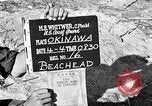
A man directs landing craft traffic and a line of soldiers handle supplies off an LCVP in Okinawa, Japan during World War II.
Landing craft traffic at a beachhead in Okinawa, Japan during World War II. U.S. Army radiomen use a radio field set. A man holds a bullhorn to direct the landing craft traffic. A line of soldiers handle supplies off an LCVP (Landing Craft, Vehicle, Personnel).
CRITICALPAST.COM: About Us | Contact Us | FAQs - How to Order | License Agreement | My Account | My Lightboxes | Shopping Cart | Advanced Search | Featured Collections | Website Terms & Conditions | Privacy Policy ©2026 CriticalPast LLC.
License Agreement |
Terms & Conditions |
Privacy Policy
©2026 CriticalPast LLC.