


 Francais
 Deutsch
 Italiano
Refine Your Search
Greek-Civil-War stock footage and images
- Showing 7 to 12 of 27563 results more
more Hide
Hide
Communism growing over Central and Eastern Europe after World War 2, and development of Marshall Plan.
Events after World War II. Harvesting in U.S. farms. Closeup view as a tractor plows fields. Men on horseback driving sheep. Woman serves a Thanksgiving turkey dinner to her family gathered at a nice dining room table in the United States. Her children look at the food with smiles. Contrasting scenes show Europeans starving and living in poverty amid post-war ruins. Hungry women and children looking for food. A child in a soup line. Women wait in a line to receive grain that is weighed on a scale (possibly Soviet area). Globe spins. Joseph Stalin and other Soviet officials watch a military parade in Red Square in Russia. Retrospective scenes of the meeting of Russian and U.S. troops at the Elbe River late in World War 2. Communist rally in Paris. A protester holds up a hammer and sickle symbol. A demonstration of protestors in Athens, Greece, around time of Greek Civil War, and another Communist demonstration in Rome, Italy. Map depicts communist control growing over Central and Eastern Europe early in Cold War. High aerial view of Washington DC with a lower altitude airplane flying over the U.S. Capitol. Exterior view of State Department (Old Executive Office Building) in Washington DC. View of Secretary of State James F Byrnes working at his desk. Byrnes speaks of U.S. role in world affairs while at a conference in Stuttgart, Germany. Scenes from a meeting of the Big Four foreign ministers in 1947. Scenes changes to North Portico of White House. Swearing in ceremony of George C. Marshall as Secretary of State. President Harry S Truman shakes hands with Secretary George Marshall. Night view of London landmark buildings. View of door at No. 10 Downing Street in London. View of brutal winter conditions in Europe in February 1947. Citizens try to dig out a train stuck in snow. Women in line in Britain for a rationed good, still saddled with its own postwar reconstruction. Narrator relates that Britain was unable to continue to provide massive military and economic aid to the Greek regime and appealed to the U.S. to handle the situation. Secretary of State Marshall and President Truman seen talking together in front of a fireplace mantle. Marshall boards aircraft for a visit to Moscow. Truman in a White House meeting, seated at oval table with his advisors and cabinet. Truman addressing joint session of congress unveiling Truman Doctrine on March 12, 1947. He asks for funds for Greece and Turkey. Globe highlights USSR. Door sign reads 'Policy Planning Staff - George F Kennan - Director'. Director Kennan seen at his desk. He advocates a long term, patient but firm and vigilant containment of Russian expansive tendencies. Reconstruction in Europe. Ground level and aerial views of bomb destroyed European cities, and workers cleaning up rubble from bombing in World War 2. Brief scene from the meeting of 16 nations in Paris on July 3, 1947. Scenes from United Nations meeting held in Lake Success New York in September 1947. George Marshall at podium addressing delegates of UN. Russian delegate Andrey Vyshinsky commenting on Marshall Plan. Signing of Marshall Plan agreement by international delegates meeting in Paris in September 1947.
U.S. President Harry S. Truman unveils Truman Doctrine in address to Joint Session of Congress in Washington
United States President Harry S. Truman addresses the Joint Session of Congress in Washington, unveiling what became known as the Truman Doctrine. He urges the Joint Session of Congress to take steps to halt communism by providing financial aid to Turkey and Greece (during Greek Civil War).
Greek children being released at the Greek- Yugoslavian border under the aegis of Red Cross.
Greek children being released along the Greek Yugoslavian border. Men at the Greek Yugoslavian border as Greek children captured by the Red guerrillas during the civil war are released under the aegis of the Red Cross. Children and woman loaded onto a vehicle. A girl thanks Colonel De mellow. Children hold apples and oranges and wave after being released from captivity.
British forces liberate Greece from German occupation and Greek Prime Minister Papandreou during a ceremony, in World War II.
Allied forces liberate Greece from German occupation and civilians cheer for them, during World War II. British convoy of warships and boats reach the harbor of Athens. Commanders look at the harbor. British Army with Polish and Greek regular army soldiers march on roads towards Athens. Civilians cheer, hail, welcome them, raise posters and banners- including a photo of British Prime Minister Winston Churchill. Greek and British soldiers visit ancient Greek monuments such as the Parthenon. Greek Prime Minister George Papandreou reviews honor guard of combined British, Greek and Polish forces. Greek civilians on roads and buildings hail Prime Minister Papandreou who pays homage to Greek soldiers and salutes them. Greek girls carry national flag to a monument and Papandreou and others follow them.
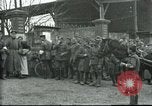
Greek troops allied with the French in Macedonia during World War I
Greek troops gathered at a town in Macedonia during World War 1. Some are near a compound gate by a bulletin board. Several who wear white armbands, are also on bicycles,or horseback. One waves a homemade Greek flag. A considerable number stand behind them. All are in Army uniforms. The French tricolor flies from a large building behind them. Next, those with white armbands (and means of transportation) move forward from the group.Scene shifts to An officer standing in front of a building, with white armband soldiers around him. The makeshift Greek flag hangs from a porch behind them. Scene shifts to Greek officers in peaked caps, speaking with two in side caps (garrison caps) and field uniforms.
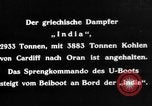
German U-Boat sinks Greek ship "India" in 1917 during World War I. U-Boat crew captures and examines sea turtles, in 1915.
Opening scene shows a tramp steamer listing to starboard.during World War 1. She displays "India, Greece" in large letters on her side. Slate indicates that an explosives technician from a U-Boat had climbed aboard and set charges on the Greek Steamer, "India" as she is stopped in the Atlantic during World War 1. The India is carrying a cargo of coal from Cardiff Wales, to Oran. The ship is seen listing. Smoke still rises from her stack. Slate states that the cross on the hull of the sinking "India" is the Greek national emblem. The ship sinks lower and finally slides out of sight, with smoke rising above the water from her exploding boilers. (Note: This German U-boat is the SM U-35, which was operating in the western approaches to the Straits of Gibraltar after leaving the Mediterranean on 11-12 April. It carried a professional cinematographer on board. Two years earlier, on June 12, 1915 , the U-35 also sank the British ship, "Crown of India." ) The next sequence shows an image of the German Daily Express newspaper for Monday May 10, 1915. Dead! it reports in bold print: The world has a duty to conduct a Hunt for turtles. Scene shifts to deck of surfaced German U-boat, showing a dinghy arriving alongside, from which several giant sea turtles are unloaded. Crew members examine the turtles on the deck of the submarine. At least one appears to be dead. Next scene shows lookouts on conning tower of the U-Boat, as they see smoke on the horizon. (The Imperial German Naval war flag is displayed on the conning tower.) The Captain calls for full speed ahead on both engines, and the controls show that being selected. (World War i; World War 1; WWI; WW1)
CRITICALPAST.COM: About Us | Contact Us | FAQs - How to Order | License Agreement | My Account | My Lightboxes | Shopping Cart | Advanced Search | Featured Collections | Website Terms & Conditions | Privacy Policy ©2026 CriticalPast LLC.
License Agreement |
Terms & Conditions |
Privacy Policy
©2026 CriticalPast LLC.