


 Francais
 Deutsch
 Italiano
Refine Your Search
Greek-Civil-War stock footage and images
- Showing 12649 to 12654 of 27563 results more
more Hide
Hide
Second Sino-Japanese War
Opening scene shows formation of Japanese Mitsubishi G3M bombers in flight. View of bombardier at bomb sight inside a bomber. Bombs falling from the aircraft, upon the Chinese city of Shanghai, on a day in September, 1937. Ground level view of bomb exploding and Chinese civilians running for cover. A huge explosion throwing earth up. Aerial view of smoke rising from bomb strikes below. More ground views of bombs destroying structures. Chinese people fleeing across a bridge. Cluster of bombs falling from a Japanese airplane. More explosions and destruction. view from a G3M bomber, of others with bombs falling from them. View from above of civilians filling a street as they run for shelter. People on the ground rushing in all directions. Some are in horse-drawn carriages with luggage on top and other in rickshaws, apparently fleeing the city altogether. Bombing victims lying on the ground near destroyed structures. Heavy dark smoke rising from the attacks. Scene shifts to Japanese army officers entering the Yasukuni shrine in Tokyo. Behind them is A Shinto Tori (Gate) and behind that, the monument (statue) of Omura Masujiro. Scene shifts again, to view of the Temple of Heaven, an ancient Imperial Sacrificial Altar in Peking (Beijing) China. Chinese agriculture. Crowds of Chinese people. Stone statue of traditional Chinese lion. Picture of 1851 oil-on-canvas painting by the German American artist Emanuel Gottlieb Leutze, of Washington crossing the Delaware. Drawing of 15th century ship similar to one in Columbus'1492 voyage to America. Drawing of Roman Empire era building. Michelangelo’s statue of Moses. Drawing of ancient Egyptian pyramid and statue. Drawing of Chinese city and environs representing 4 thousand years ago. Extant ancient Chinese shrines and statues. Animated Relief map of China and surrounding countries of U.S.S.R., India,Burma,Thailand, Indo-China, Philippines, and Japan. Animation outlines China Proper. It also shows Manchuria and scenes from there of desolate mountainous land, with miners at work extracting raw materials. Mongolia and Sinkiang are outlined. The Gobi desert is seen with a long camel caravan crossing it. Closeup of nomads transporting animal skins by camel. The last region outlined is Tibet. The ice covered Himalayan mountains are shown. Buddhist monks praying in the courtyard of a shrine in Tibet. The Yellow, Si Kiang, and Yangtze Rivers are shown on the map. Views of Chinese sailing vessels.
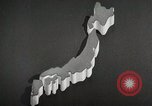
Views of China and Japan in the period leading up to the 2nd Sino-Japanese war
Film opens with outline map of Japan shown in contrast to 20 times larger China and figures representing China's 6 times greater population. Map of China is shown in pieces representing its numerous internal fiefdoms. In contrast, Japanese soldiers are shown marching in review before their singular leader, Emperor Hirohito and other national military leaders. Film shows contrasting 20th century characteristics of China and Japan. Sun Yat-sen, who figured prominently in post-Imperial China, and is considered the founding father of the Republic of China, is shown speaking to crowds. Narrator states that in 1911, this man fathered a peoples' revolution which brought to an end, China's ancient Imperial government. View of Chinese people marching and carrying flags and banners. Books are shown comparing China's Sun Yat-sen to America's George Washingon. Sun Yat-sen's political statement, shown in Chinese, contains words similar those in Abraham Lincoln's Gettysburg address. View of schools and colleges built in the new Republic of China. Chinese students shown in libraries. A couple dining in a Chinese hotel restaurant, overlooking other buildings. A tall clock tower looms at the same height outside their window. Steel being erected for a tall building. Architects at work. Scientist looking through a microscope. Technicians at work in a chemistry laboratory. Medical staff and patients in a modern hospital. Children in school under compulsory education program. Chinese people exercising their freedoms of expression and religion. The funeral of Sun Yat-sen, in 1925, attended by his successor, Chiang Kai-shek, and other Chinese leaders in military uniforms. Chinese people attending an outdoor ceremony. Examples of areas needing modernisation. Chinese workers using manually operated machinery to process fabrics. Commercial vessel plying a river using wind and sail only. Views of steam locomotives and trains being introduced to link parts of China. Trucks moving goods over roads (still unpaved). Miners working in open air mines, digging coal and iron. Molten tin being poured from a crucible. Machines performing complex tasks in a fabric mill and women tending spinning and knitting machines. School children engaged in collective outdoor games and exercise drills. Scene shifts to Japan, where Emperor Hirohito, on a white horse, leads military leaders in reviewing Japanese forces. A formation of Japanese Model 97 medium tanks passing in review, with tank commanders saluting from their turrets. Glimpse of Japanese steel mill. Headline in World-Telegram newspaper of 14 february, 1934, reads: "Tokyo House Passes Huge Arms Budget." A Los Angeles newspaper of 23 November, 1934, expands on the same story. New Orleans Times-Picayune, Sunday, 5, May, 1936, reports that Japan is strained by its huge arms costs.
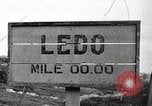
Construction and completion of the Ledo Road from India to China during World War II
Film opens showing road sign reading: "LEDO Mile 00.00." Scene shifts to rail lines at terminus of the Assam-Bengal railroad in the Indian Province of Assam. Surveyors are seen working in jungles. Engineers use machetes and construction machinery, like caterpillar tractors, to cut through the dense growth. Others saw and chop down trees and use explosives to clear the land. Explosives are seen detonating and tractors clearing the debris. Earth moving equipment and jack hammers being used to form a roadbed. View of two engineers setting and detonating a charge in a rock. A steam shovel loads earth into a dump truck. Road scrapers work in parallel to smooth the dirt roadbed. View of road after monsoon rains reduced one roadbed to a sea of mud and another inundated by water. To avoid these problems, rebuilding efforts begin by construction of causeways and bridges. Teams of workers lay planks for this. Closeup of worker tightening a clamp on a pontoon bridge under construction. Work gangs rolling and placing heavy logs as part of a bridge. Workers use a crane to lift segment onto a steel bridge under construction. Men bulding wooden and steel truss bridges. Aerial views from an airplane flying over various sections of the finished Ledo Road. A truck covered by a painted canvas reading: First Convoy over the Ledo Road, Pick's Pike Lifeline from India to China." Brigadier General Lewis A. Pick, Chief Engineer for the project, is seen, next, shaking hands with Lieutenant General Daniel Isom Sultan, Commander India-Burma theater, as he prepares to lead the convoy. View of the convoy starting out, led by the decorated truck. (Narrator states the road was now called, "The Stillwell Road." Views of the trucks proceeding and crossing causeways and bridges. Aerial view of the road twisting and turning across the high mountains. The convoy arriving in Kunming China greeted by Chinese troops and flags. Later, the convoy drives through the city streets of Kunming, with General Pick standing in a jeep, leading the way, and crowds of Chinese people cheering from the sidelines. In final scene, General Sultan states that the next project is a pipeline along the road.
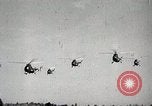
Technological advances in the United States after World War 2 shared with other NATO member countries
U.S. Marines dropped off from U.S. marine helicopters at a landing zone during maneuvers. and then running on a field. Representatives of United Nations permanent member countries in a weekly conference session meeting of the permanent council. Exterior views of U.S. Capitol building with American flag flying. U.S. Congress in session in Capitol building. Technological advances in U.S. U.S. President Eisenhower on a visit passes beneath a sign "Atoms for Peace" and observes various displays dealing with atomic power and nuclear power. An early nuclear power plant in Idaho, and view of an electical power plant control room that uses power from the nuclear plant. Doctor in a hospital checks a patient using a atomic scanner. American workers work in Oil fields in the United States -- view of many oil rigs in one area and two oil workers working on an oil rig. Tractors and modern large harvesting devices being used in farms. Miners sit in mining rail carts and then enter a mine on the rail cart. Sign on wall at coal mine entrance reads, "Inland Steel Company." And below it another sign, "Price Mine Number 1. 1950." (deep mining operation in Price, Kentucky). Mechanical mining cutter used in mine is seen turning out many large chunks of coal. Rail carts transport raw ore out from the Price, Kentucky coal mine.
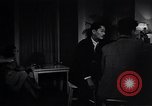
Modern Japanese women and their professions in the years after World War 2
Postwar Japanese women working in various professions in the early 1950s. Japanese women wear Western outfits, go to bars and restaurants for a drink and a smoke. The woman approach men inside a bar. Japanese women smoking with men. A Japanese woman opens sliding door and joins her family for dinner. She begins to talk about her day. Her father nods with disapproval while her younger sister, wearing a High School sailor-style Seifuku uniform, looks on. Men reading a newspaper. A Japanese couple walks in the park. They find a boy fishing on the lake. Japanese women in parliament. Japanese women working as scientists, as nurses and as doctors in hospitals and surgical operating rooms. Japanese woman heads a corporate company meeting. Japanese women work as corporate secretaries. Woman works with farmers. NHK radio station featuring a Japanese woman, who is seated in a broadcast booth. A Japanese woman at a newspaper operation inspects newspapers coming off a printing press. Japanese women as musicians and western ballet dancers. Japanese woman playing a violin with an orchestra. Japanese woman playing the piano. A Japanese woman painting while wearing a kimono. Japanese woman lecturer comes out of a college building. Japanese men gather and talk outside a building. A Japanese woman casts her vote in a ballot box. Japanese civilians in voting poll. The National Diet is filled with parliamentarians.
Scenes of professional, working American women in the post-war early 1950s
Film "American Working Women" Clock above Exit sign in Sonotone factory. Women, including Hazel Kennedy, assembling hearing aids. Women in wash room checking hair in mirror and applying lipstick. Women clocking out at Sonotone factory. Wide shot workers leaving Sonotone hearing aid factory, 2269 Saw Mill River Road Elmsford, NY 10523. Bank teller at White Plains Federal Savings and Loan, 182 East Post Road White Plains, NY 10601 puts away money at end of day. Man in suit who is bank Vice President looks at his watch and says goodbye to his secretary as he leaves the office. Secretary Joan Morgan applies lipstick while looking into her compact mirror and then puts on her coat. A man paces outside bank building, looking at watch. He greets his girlfriend Joan and the couple hold hands. Cancer researcher Martha Hanson puts white mice into a cage in her lab at the Sloan-Kettering Institute for Cancer Research, 1275 York Ave. New York, NY 10065. View of numbers on elevator at Sloan-Kettering as doors open. Martha passes through lobby at Sloan-Kettering. Wall engraving in background reads, "Within these walls a few labor unceasingly that many may live" Ann Maloney puts away Silver Slipper hosiery boxes at Marie's Lingerie shop. Sign on wall reads, "First Quality 54 Gauge Nylons". A tall model of a woman's leg is on the counter top. Ann puts money into cash register drawer. Woman (Hazel) driving her 1941 DeSoto Custom automobile. She picks up her husband in front of the hardware factory where he works. Husband and wife kiss in automobile. Close up honking car horn. Children run out of house and into car. Hazel parks car at 12 Curry Road Hastings-on-Hudson, NY 10706 at the intersection of Curry Road and Ronny Circle and the family enters front door of house.
CRITICALPAST.COM: About Us | Contact Us | FAQs - How to Order | License Agreement | My Account | My Lightboxes | Shopping Cart | Advanced Search | Featured Collections | Website Terms & Conditions | Privacy Policy ©2026 CriticalPast LLC.
License Agreement |
Terms & Conditions |
Privacy Policy
©2026 CriticalPast LLC.