


 Francais
 Deutsch
 Italiano
Refine Your Search
Greek-Civil-War stock footage and images
- Showing 12787 to 12792 of 27563 results more
more Hide
Hide
Italian newsreel coverage of Japanese attack on Pearl Harbor, Hawaii starting World War II in the Pacific.
Japanese battleships and aircraft carriers including Kaga (ahead) and Zuikaku (trailing to port) underway in the Pacific Ocean towards Pearl Harbor. Japanese planes line up on aircraft carrier. Japanese pilots briefed. Japanese pilots run for their planes, board and take off from carrier. Two Nakajima B5N (Kate) Dive bombers taking off, in succession, from aircraft carrier deck. A Mitsubishi A6M "Zero" taking off. A formation, of B5N aircraft , in flight, carrying torpedoes underneath. View from Japanese attacking airplanes as they bomb the Naval Air Station on Ford Island. Heavy black smoke rising from the ground. Next bombers attack the capital ships on Battleship Row. Burning U.S. battleships. Still photographs annotated (in Japanese) point to the various ships targeted, including the USS California, USS Arizona, USS Maryland, USS Utah, and USS West Virginia.
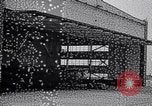
Ford Motor Company celebrating production of the 5000th, 7000th and 8000th B-24 bombers in World War II
A tug pulls the "Lucky 7," the 7,000th Ford Liberator bomber (B-24) from a hangar at the Ford Willow Run plant. Views of the "Lucky 7," on the tarmac with other B-24s. scene shifts to an earlier period, showing a B-24 with labeling on its fuselage, reading: "5000th Ford Built Liberator." Henry Ford, in a straw hat, handles some papers with a British officer, as his grandson, Henry Ford, II, and an American military officer, stand nearby. Plant manager,Mead L. Bricker, is seen momentarily, at left of the group. Henry Ford shakes hands with the British officer. Closeup views of aircraft's engine and propeller with Hamilton Standard logos displayed on propeller blades. View of the aircraft's leading edge deicers (boots) and the "Lucky 7" sign painted on its fuselage. Closeup shows signatures of Henry Ford and Henry Ford II, next to the large painted 5000th sign. Change of scene to a later time, showing the 8000th Ford built B-24 Liberator bomber. It is labeled: "Ford's 8000th Liberator,"and displays "8" intertwined with the letter "V." U.S. Army Air Forces officers and Henry Ford,II, along with Ford executives, including plant manager, Mead L. Bricker, pose in front of the B-24. Henry Ford,II (using his left hand) scribes a line with a pen, under the bottom of the "V," and poses for the camera.
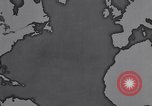
American naval forces join with British in Operation Torch to attack at Casablanca in Morocco, North Africa during World War 2.
Animated map shows the advancement of American forces toward North Africa, being joined by British Naval forces near Gibraltar for Operation Torch. American and British allied naval fleets position at key locations near Oran, Algiers and at Casablanca for simultaneous attack. United States Navy fleet starts its attack after being fired upon by shore batteries of Vichy French forces at Casablanca, commencing the Naval Battle at Casablanca. Carrier aircraft swarm the skies above the harbor at Casablanca. Antiaircraft guns fired by Vichy French. Huge explosions in water and on ships. Guns aboard a battleships fired. The unfinished French battleship Jean Bart is hit by a U.S. battleship's 12 inch shell. The ship Jean Bart erupts in flame and emits heavy smoke. Several destroyed French ships in harbor at Casablanca.
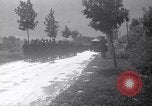
Platoons of First Division AEF troops training at Gondrecourt, France, during World War I.
Troops of the 1st Division, American Expeditionary Forces (AEF) march by platoons at their training area at Gondrecourt, France, in the summer of 1917. Several officers on horseback accompany them and an army truck, as well.
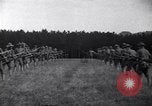
American troops learn techniques for using bayonets and hand grenades, at Gondrecourt training area,France, in World War I
First Division troops of the American Expeditionary Forces at their training area.Gondrecourt, France. Two lines of soldiers stand far apart facing each other and practice bayonet moves, under direction of instructor at far end of the formations. They then run across the field in a series of short segments and practice thrusting movements with bayonets afixed to their rifles. Several are seen climbing out of a trench and running forward with poised bayonets. American and French instructors train the soldiers in technique for throwing hand grenades. The French instructors then line up and demonstrate the proper technique. (Actual hand grenades are not used.)
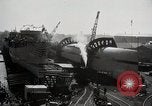
Destroyer Escort, USS Currier (DE-700) is launched at Bay City in Michigan, USA during World War 2
The eve of launching Destroyer Escort, USS Currier (DE-700), at Bay City in Michigan, USA. View of the Defoe Shipbuilding shipyard. A ship upside down showing rolls. Men knock out support beams of USS Currier. Men work on ship. Men work on propellers of ship. Rope is cut. USS Currier slides down ways. Mrs Betty Baker Currier christens ship. Views of another ship hull upside down, under construction. Spectators watch the ship as it is moved upright by a giant crane and hook assembly. Spectators watch ship righted. Men work on this next ship in queue.
CRITICALPAST.COM: About Us | Contact Us | FAQs - How to Order | License Agreement | My Account | My Lightboxes | Shopping Cart | Advanced Search | Featured Collections | Website Terms & Conditions | Privacy Policy ©2026 CriticalPast LLC.
License Agreement |
Terms & Conditions |
Privacy Policy
©2026 CriticalPast LLC.