


 Francais
 Deutsch
 Italiano
Refine Your Search
Greek-Civil-War stock footage and images
- Showing 1279 to 1284 of 27579 results more
more Hide
Hide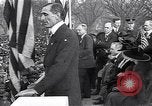
World War I - War bond rally with speech by U.S. Secretary of the Treasury, William Gibbs McAdoo.
U.S. Secretary of the Treasury, William Gibbs McAdoo addressing a big crowd in Washington DC at a War Bond rally. Other leaders on the stage with him. U.S. Flag beside speaker. The White House visible in the distance.
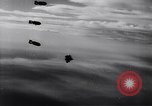
Air war over Germany in final phases of World War II in Europe. B-17s bomb railroad tracks, marshaling yards and numerous other targets.
Relentless bombing of Germany by Allied Forces in World War 2. Bombing on important roads and buildings in German cities by the bombers of the United States Army Air Force. B-17 bombers of the 306th Bomb Group,out of Thurleigh, England (Triangle H tail code) seen in formation. They drop bombs from high altitude on a German city. Black flak clouds and contrails are seen. Immense explosions and destruction on ground from saturation bombing. Serial blasts at a railway marshaling yard, on a road. Bombs gliding towards target leaving a smoke trail behind. Buildings bombed by Allied bombers.
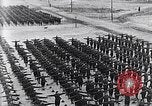
Soldiers of the United States Army train at an army base, preparing to deploy to the war front, during World War I.
Soldiers of the United States Army at an Army camp during World War 1. Soldiers during calisthenics physical training session. Large lines of of soldiers in formation warm up and perform various exercises. Next scene shows soldiers practicing a running ascent of an elevated platform and then a leap off to a lower level, with bayonets fixed, as they bayonet sandbags, all simulating a charge into an enemy trench. The soldiers arranged into formation for review by officers. Officers of the troops sit on horseback at the front of the lines. View of many trucks and jeeps for transporting soldiers and supplies. Soldiers attend an instructional demonstration of automobile repair.
U.S. Army holds German prisoners of war on Normandy beachhead following D-Day in World War II
The day following the D-Day invasion of Normandy during World War 2. German prisoners walk on wet sands of the beach, guarded by U.S. Army military police. Various Allied ships in background. German prisoners held temporarily between fences of barbed wire on the beach.
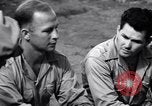
Rescued American war prisoner Edwin Petry describes his escape from a Japanese prison camp in World War 2
A MIS-X officer representing the Prisoners of War Branch interviews American soldiers who escaped from and were then rescued from Japan's 10-A camp in Palawan, Philippines. Private first class Edwin A Petry describes the murder of American soldiers by forcing them to enter a bomb shelter, pouring gasoline, setting the gasoline alight and shooting the men who tried to escape. With the help of a map he also describes how he along with a companion managed to escape from the prison camp by crashing through the barbed wire and swimming across the bay. They were later evacuated to Morotai by 13th Army Air Force Catalina.
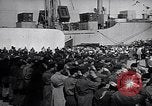
Soldiers of United States 591st Engineering Corp return home from the European theater of war in World War 2
A newsreel titled '2,000,000th G. I, head for home' shows soldiers of United States Army 591st Engineering Corp head for home after 22 months from European theater of war. Charles Hudgins being presented a plaque by an officer as other soldiers look on, as Hudgins is the 2,000,000th soldier to return. American soldiers say goodbye to dear ones before embarking a ship at a European port. Second half of clip shifts subject matter, showing exterior views of the landscape and grounds of the Culzean Castle in Ayrshire, Scotland, then owned by the Kennedy family, who donated it in 1945 to the National Trust for Scotland, with the stipulation that the top floor apartment of the Castle would be offered to General Eisenhower for his use for the rest of his life (it was later nicknamed the "Scottish White House" by then President Eisenhower). Views of the castle grounds, walls, gates, defense cannons.
CRITICALPAST.COM: About Us | Contact Us | FAQs - How to Order | License Agreement | My Account | My Lightboxes | Shopping Cart | Advanced Search | Featured Collections | Website Terms & Conditions | Privacy Policy ©2026 CriticalPast LLC.
License Agreement |
Terms & Conditions |
Privacy Policy
©2026 CriticalPast LLC.