


 Francais
 Deutsch
 Italiano
Refine Your Search
Greek-Civil-War stock footage and images
- Showing 127 to 132 of 27563 results more
more Hide
Hide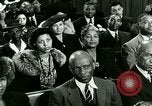
Film illustrating participation of African Americans in U.S. history from Colonial times to after the Civil War
Opening scene shows African American congregation in church, during World War 2, listening to their preacher speak about liberty. Closeup of the Minister speaking. As he refers to the seed of Liberty taking root in Boston, a plaque on the gate of the Granary Burial Ground of 1660 is shown reading: "Within this ground are buried the victims of the Boston Massacre, March 5, 1770." The gate swings open revealing the cemetery. Next, an illustration of British Redcoats shooting into a crowd on that occasion is shown. Closeup of the illustration shows an African American, named Crispus Attucks, falling as the first victim of the gunfire. A monument to him on Boston Common, is then shown. Closeup of the monument. Excerpt from a film about the Revolutionary War shows reenactment of the battle off Concord. The 221-foot granite obelisk at Bunker Hill, Boston, is seen, marking the site of the first major battle of the American Revolutionary War. A musket is seen with a sign attached reading: "Gun belonged to Peter Salem, a colored man who carried it at Lexington, Concord, and Bunker Hill, and with it shot Maj. Pitcairn." (Refers to Major John Pitcairn, a Scottish Marine officer, killed at the battle of Bunker Hill.) Illustration and painting of Peter Salem with his musket in the company of other patriots, is shown, as well as a glimpse of a mass reenactment of the battle of Bunker Hill. Next is seen the famous 1851 oil-on-canvas painting of Washington Crossing the Delaware, by the German American artist Emanuel Gottlieb Leutze. Closeup of one oarsman, identified as African American, Prince Whipple. Film Reenactment of the ragtag American army at Valley Forge in the snow, shows their suffering. Among them is an actor in the role of African American, Salem Poor, who had purchased his freedom from slavery and fought with Washington's army. A bell ringing and the American flag of 13 stars signifying the 1776 Victory. Film reenactments of pioneers including whites and African Americans working together, felling trees and building forts and barns, and the like. Scene shifts to a man of war ship under sail firing a salvo from its cannons. This is followed by illustrations of Commodore Perry in the battle of Lake Erie, during the War of 1812. In a dory with Perry is a black man named Tyler Thompson. War ships exchange gunfire. Narrator cites Perry's famous words of victory: "We have met the enemy and they are ours." Scene shifts to a painting of American general Andrew Jackson and his troops, at the Battle of New Orleans, in 1815. A battle reenactment shows a black American soldier participating. Postwar view of American ship building activity. View of a large sailing vessel. Cannon fire ushers in the Civil War in 1861 as Confederates fire on Fort Sumter. Images of combat are overlaid by the statue of Abraham Lincoln in his memorial at Washington, DC. Next, settlers are seen heading West in a wagon train. Camera focuses on a black couple who are part of the wagon train. White and African American men work side-by-side building a railroad. An early steam locomotive races along the tracks. .
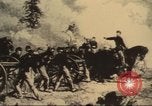
Union soldiers print the first issue of Stars and Stripes newspaper during the Civil War in the United States.
The history of the Stars and Stripes newspaper. Union soldiers print the first issue of Star and Stripes newspaper in a captured press in the U.S. on 9th November,1861 during the Civil War. World War I scenes show soldiers disembarking from a ship and advancing on a battlefield. Commanding Chief of the American Expeditionary Force John J. Pershing writes for the newspaper. Soldiers greet the Chief and wish him luck. After the end of World War I newspaper publication is ceased. During World War II the newspaper publication starts in London, England in 1942. Publication of the Pacific Stars and Stripes newspaper after the end of hostilities in Europe. Headlines in various editions of the Stars and Stripes.
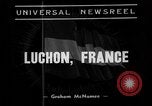
Refugees come to France due to outbreak of a civil war in Spain.
Spanish Civil War. Refugees come to Luchon, France after crossing over Pyrenees. Spanish men walk down a slope. Women and children carrying their belongings come to France to escape the evils of the war. A man eats a meal. Soldiers loaded in railroad trains leave for the war front.
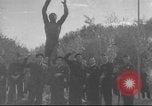
Activities in Republican areas of Barcelona and Valencia, at onset of Spanish Civil War
Film opens showing Catalan volunteers during the advent of the Spanish Civil War, standing in front of a statue dedicated to Catalan Volunteers who had fallen in World War I. (It is a larger-than-life bronze statue of a nude male figure with arms upraised, created by Catalan sculptor Josep Clarà. It stands in the Parc de la Ciutadella in Barcelona. It was dedicated on July 14, 1936.) Camera pans across the group, some in military uniforms, and others in mufti. Scene shifts to a street in Valencia, Spain, where men in business attire surround a man standing at a microphone, speaking. The general scene is festive, with flags and banners seen in places and people dressed in their best. "Plaza de la Generalitat Catalana" is written across a building front, identifying the location. View shifts to large well-dressed crowd, applauding the speaker. Closeup of the principal speaker and two companions at the microphone. Next, a large uniformed band of musicians is seen being conducted and playing for the crowd. Angled closeup of the band director. Another uniformed music director leads the crowd in a patriotic song. Some boy scouts are see participating. A troop of Boy Scouts, some shouldering rifles, march to accompanyment of a Boy Scout drum corps. View changes to men informally gathered around a large round structure. They smoke and socialize. Scene shifts to Parc de la Ciutadella in Barcelona, where spectators watch as a man places a huge bouquet of flowers on the ground in front of the statue dedicated to the fallen Catalan Volunteers of World War 1. View of statue silhouetted against the sky. Camera pans down the statue.
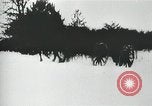
Bolshevik leader Lenin, Commander of the Red Army Leon Trotsky and Russian soldiers during the Civil War in Russia.
Scenes from the Russian Revolution and years immediately after in Russia, roughly 1918-1921. Troops moving in the snow. Vladimir Ilyich Lenin, the Bolshevik leader, makes peace with the Germans. The Civil War breaks out in Russia. White Russians continue war with World War 1 allies, against Germany. Czarist Cossacks seek to restore the monarchy of Nicholas II. Photograph of the Russian Czar and family sitting outdoors on the ledge of a wooden building. Secret police seen arresting people. Bolshevik firing squad executes three prisoners, who fall dead into a mass grave behind them. Lenin, holding a kitten in his hand, seated at a table. March 7, 1921: Workers and sailors gathered on the streets, in Kronstadt, demanding peace, freedom, and bread. Red Army Troops disperse the crowd, shooting many of them. Leon Trotsky, Commander of the Red Army, states that the slaughter was necessary. Trotsky seen walking with other officers. People on the sides of a path watching Trotsky. Families looking over dead workers and sailors in a field.
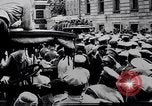
Russian soldiers gather in Moscow and demonstrate during Russian Civil War in Russia.
A huge crowd of soldiers gather on streets of Moscow, Russia, as pamphlets are distributed during Russian Civil War (also during time frame of World War 1). A soldier reads posters pasted on a wall. A huge crowd of soldiers gathers around, and many sit upon, the Statue of Grand Duke Nicholas Nikolaevich at Manege Square, Moscow. ( Note: The statue,by Pietro Canonica. Was erected in 1912 and destroyed in 1918.)
CRITICALPAST.COM: About Us | Contact Us | FAQs - How to Order | License Agreement | My Account | My Lightboxes | Shopping Cart | Advanced Search | Featured Collections | Website Terms & Conditions | Privacy Policy ©2026 CriticalPast LLC.
License Agreement |
Terms & Conditions |
Privacy Policy
©2026 CriticalPast LLC.