


 Francais
 Deutsch
 Italiano
Refine Your Search
Greek-Civil-War stock footage and images
- Showing 13441 to 13446 of 27563 results more
more Hide
Hide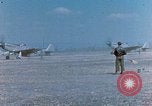
Runway control officer uses flag to control takeoffs of P-51 aircraft at Allied air base in Germany, near end of World War II.
P-51 planes of United States Army Air Force taxi and take off under direction of runway control officer who uses a flag to control takeoff intervals
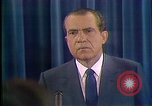
U.S. President Nixon mentions violent acts of protesting students against Vietnam War, during a press conference, Washington DC.
United States President Richard Nixon departs from West Berlin, Germany, during his official visit to Europe. People wave at President Nixon from apartment windows. President Nixon's motorcade drives on crowded roads in West Berlin and reaches the Charlottenburg Palace (Spandauer Damm 10-22, 14059 Berlin, Germany). Gate of the Charlottenburg palace. Equestrian statue of Frederick Wilhelm, Elector of Brandenburg, on the grounds of the Charlottenburg Palace. Civilians gathered greet him and raise banner to welcome President Nixon. Sign read as “Richard Nixon Ein wirklich Berliner” (“Richard Nixon a real Berliner” in English). View of the Siemens factory in West Berlin.
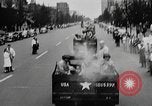
A motorcade of U.S. Generals in Philadelphia, Pennsylvania during World War 2
Returning Heroes Parade on June 4, 1945, in Philadelphia, Pennsylvania. Generals Carl Spaatz and Omar Bradley sit on either side of Pennsylvania Governor Edward Martin, in an open jeep. Spectators stand at road sides. Large number of school children waving American flags. A policeman on a motorbike with the American flag escorts the motorcade. . Spaatz and Bradley pose with Governor Martin and Philadelphia Mayor, Bernard Samuels, for photographs. The Generals and the officials march on a street. The Generals stand, with Governor Martin, in an open jeep. People standing on railroad platform.
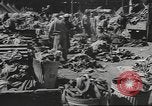
Numerous scenes of U.S. Army Quartermaster salvage operations in Italy during World War II; also brief aircraft crash scene.
U.S. soldiers in the textile repair section of a Quartermaster Salvage Depot, are seen sorting military clothing of all types to be recycled an reissued, or otherwise used as rags for cleaning purposes. Workers from the local populace are hired as paid employees in these salvage operations. A woman removes bundles of used army uniforms from a horse drawn cart and gives them to children who carry them to other women and children who are seen working on various levels of a building, where they mend and otherwise repair and restore the garments. A man works at a sewing machine on the ground floor of the building. But the women and girls seen are all engaged in hand sewing. Scene shifts to a section of the depot yard where tents are being examined, sorted and repaired. Large tents are suspended from a crane to facilitate inspection. The next scene shows interior of a mobile repair shop designed for the Signal Corps, where soldier technicians work on electrical and electronic equipment. A soldier repairs an SCR 536 (better known as handy talky) and an Army Technician fourth grade (T/4) works on an SCR-508 mobile Signal Corps Radio. He tests each tube and connection. A Staff Sergeant removes parts from a BD 72 field switchboard. Outside, several local civilian men employed by the Depot, are physically salvaging useful items, such as brass knuckle joints from metal tubing. Another pulls worn copper wire from an armature. Elswhere in the yard, soldiers and local helpers salvage lead plates from old storage batteries, where they are melted down over a fire and poured into old army helmets, serving as improvised ingot molds. A huge collection of spent artillery shells covers a vast area in the depot. They are loaded aboard barges and brought to ships for transport back to the U.S where they will be repacked and reused. Soldiers collect unserviceable tires for reshipment back to the U.S. Soldiers inspecting a pile of tires. Soldiers inspecting rubber tubes and checking them for leaks. A pile of inflated tire tubes left to sit awhile before being inspected. Outside the infantry too repair shop, soldiers repaint pick mattocks and set them out to dry. Using tools they invented, two soldiers remove wooden handles from shovel blades and from ax handles, in the infantry shovel repair department. Inside the building, soldiers are seen repairing stoves in the stove repair department. One ignites a stove and checks its flame. In a corner of the shop, a worker repairs gasoline lamps. Several are seen illuminated. Soldiers hammer out dents in mess kits and use compressed air and stone molds to take dents out of canteens. One disinfects mess gear by dipping in a lye bath and then in water and repeating that procedure again. He hangs them in the sun to dry. At one spot (where no smoking is written on the wall in Italian) a soldier works repairing 5 gallon (Jerry) gasoline cans using air pressure and water immersion to detect any holes. A jerry can is brazed by a worker using an acetelyn torch and rod. A warplane is seen crashing in flames. Signs advertising salvage as savings, are seen in various places. Salvage trucks and cranes are seen along with glimpses of salvage crews at work. A cartoon sign by a destroyed building shows a GI with ax holding Hitler's head. It reads: "Behead Hitler. Turn in Salvage." Another cartoon sign shows a girl and reads: "You will bet back to me sooner, if you turn in your salvage." A GI whistles in admiration as he passes the sign to pick up two discarded jerry cans. He salutes the sign as he walks away.
U.S. Chemical Warfare Service trains troops to become accustomed to wearing gas masks during regular duties in World War I.
U.S. Chemical Warfare Service. U.S. soldier is wearied after exercise wearing gas mask . He is tired and sits besides tree after 15 minutes of exercise. He takes off his gas mask and lights a cigarette. In contrast, a company of soldiers returning from a five mile hike in gas masks show no undue weariness.They remove their helmets and masks and appear fine. A platoon commander inspects his troops wearing gas maskes, prior to entering a gas chamber for training.
U.S. Chemical Warfare Service troops take training for chemical war during an exercise in the United States.
U.S. Chemical Warfare Service. Troops, in training for chemical warfare, wear gas masks and enter a gas chamber in the United States.One soldier lacks confidence and must be encouraged to enter the chamber. Soldiers come out of the chamberand remove their gas masks. The reluctant trainee is now enthusiastic about the experience.
CRITICALPAST.COM: About Us | Contact Us | FAQs - How to Order | License Agreement | My Account | My Lightboxes | Shopping Cart | Advanced Search | Featured Collections | Website Terms & Conditions | Privacy Policy ©2026 CriticalPast LLC.
License Agreement |
Terms & Conditions |
Privacy Policy
©2026 CriticalPast LLC.