


 Francais
 Deutsch
 Italiano

Refine Your Search
Greek-Civil-War stock footage and images
- Showing 13495 to 13500 of 27563 results more
 Hide

Jim, a soldier fires from a dugout and advances ahead during World War II.
A training film about fighting against the enemy during World Wear II, dealing with themes of soldier nerves, fear, and combat stress The enactment shows American convoy of tanks advancing on the battlefield. Soldiers advance on foot. The soldiers relax on a field. An officer briefs the soldiers about fighting against the enemy. Jim, a soldier thinks about the attack, the casualities and his girlfriend. The fighting begins and tanks fire at enemy positions. Bombs explode. Machine guns being fired. The enemy aircraft drops bombs. Jim fires from a dugout. The enemy aircraft in flight. The dead American soldiers on the field. A U.S. tank advances amidst enemy attack. Jim gets out of the dugout and moves ahead. Bombs explode.

Enactment about US Army soldier facing fears in battle; U.S. tank catches fire after being hit by the enemy during World War II.
A training film about fighting against the enemy during World Wear II, focusing on themes of nerves, fear, and combat stress among soldiers. The enactment shows American soldiers as they fire at enemy during a battle. The U.S. tank fires. The tank catches fire and soldiers fall off the tank and die. The U.S. tank on fire after being hit by the enemy. Jim, an American soldier, fires rifle. He observes German soldiers bunching up and then being hit by machine gun fire. A fellow soldier near him is struck and dies.
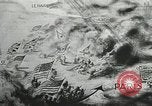
Allied Forces advance and French Army takes Paris in World War II.
Animated map shows American forces advancing toward Paris. Views of German troops disorganized and making their way individually among burning and destroyed military tanks and vehicles. A U.S. Army colonel confers with U.S. Armored unit officers, using hood of jeep as a table. U.S. Sherman tanks and tank destroyers moving along dirt roads toward Paris, at high speed and passing beyond the Orleans region. They move rapidly through groups of cheering French citizens in a French town. American armored units moving to bypass Paris. U.S. Army Air Force airplanes dropping maps to the armored units by parachute, because they were moving too fast to be supplied by ground. French forces, armed with American tanks, vehicles, and arms, are ordered to advance and take Paris. As they proceed, U.S. Army Air Forces support them from the air. Formations of P-51 fighter and B-26 bombers are seen. The French forces advance at rate of 25km per day. They are joyously welcomed as they pass through French towns on their way. Scenes of Paris. Local residents in line at a shop. German occupiers are seen beginning to leave Paris. A line of horse-drawn wagons is seen in the street. On August 14, 1944, Paris Police go on strike. They are seen drawn up in formation. August 15, 1944, the Gestapo left Paris. French citizens and police open fire on German Army vehicle. Parisians begin to hang the tricolor from their windows. French resistance fighters seen running in streets of Paris and firing weapons as they work to find remaining German forces. A doctor and several nurses run for cover. Parisians begin to fill the streets during liberation of Paris as elements of the French Army enter Paris. General Charles de Gaulle walking along a street in Paris.
German officers surrender to Allied Forces at end of World War II
Film begins with nighttime bombardments of rockets and artillery. Then at one minute after midnight, on May 9th, 1945, the guns stop. Next, a day earlier, German Field Marshal Wilhelm Keitel enters a conference room on May 8th, accompanied by German staff officers. He salutes with his Marshal's baton and takes a seat. He signs surrender document. Soviet Marshal Georgy Zhukov stands before being seated. British Air Marshal, Sir Arthur Tedder, is seen signing the document along with Marshal Zhukov. General Carl Spaatz, Commander of Strategic Air Forces in Europe, shakes hands with Marshal Zhukov. Several scenes of battlefield cemeteries are seen next. German officer prisoners are seen from the back as they walk with hands behind their heads. Views of Surrendered German senior military officers, including: German Admiral Erich Raeder; German Marshal Walter Model; German Marshal Wilhelm Keitel; and Marshal Hermann Goering (being disarmed).
American airmen at German prison camp Stalag VIIA, near Moosburg, Germany, after April 29, 1945 liberation in World War 2.
Liberated American prisoner reading the Stars & Stripes newspaper, at German prison camp for allied airmen (Stalag 7A) near Moosburg, Germany. Several American former prisoners being interviewed, include African American 2nd Lt. Alexander Jefferson, of the Tuskegee Airmen. Former prisoners posing in a group for the camera. Former prisoners strolling around the grounds of the prison, and sitting outside its buildings. (They are awaiting transport to local airfields where they will board C-47s to Camp Lucky Strike near Le Havre, France, for processing home.)

United States soldiers stand around on bomb littered street of Nuremberg, Germany during World War II.
Bomb littered streets in Nuremberg, Germany. Sign 'Nurnberg' with letter 'b' missing due bomb damage. Street littered with bomb damage. Bomb damaged buildings. Two United States soldiers stand around on littered street. German village nestled near edge of a river. German village in the valley. Interiors of U.S. Army Air Forces B-26 Marauder bomber aircraft in flight shows pilot.
CRITICALPAST.COM: About Us | Contact Us | FAQs - How to Order | License Agreement | My Account | My Lightboxes | Shopping Cart | Advanced Search | Featured Collections | Website Terms & Conditions | Privacy Policy ©2026 CriticalPast LLC.
License Agreement |
Terms & Conditions |
Privacy Policy
©2026 CriticalPast LLC.