


 Francais
 Deutsch
 Italiano

Refine Your Search
Greek-Civil-War stock footage and images
- Showing 13585 to 13590 of 27563 results more
 Hide
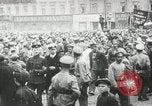
Post-World War 1 events in Russia
Crowd milling about in Kronstadt, West of Saint Petersburg,Russia, as group of Russian sailors, soldiers and civilians, marches in their midst carrying a Sign reading "Peace, Freedom, and Bread." On March 7, 1921, The Bolshevik government sends 60,000 troops under command of Mikhail Tukhachevsky to quell the disturbance. They are seen marching in the streets. Next scene shows women looking amongst the fallen for their relatives. View of Leon Trotsky (Commander of the Red Army) walking with some of his staff. View of human remains. Brief view of Lenin. Trotsky writing at his desk. Narrator mentions the State Security Agency called "Cheka," being replaced by the Joint State Political Directorate (AKA OGPU). Narrator calls it the Political Police. Vyacheslav Mikhailovich Molotov is seen walking with a group of Soviet workers and politicians ostensibly charged with overseeing the OGPU. Another scene shows Molotov conversing with Joseph Stalin (Iosif Vissarionovich Stalin). Mikhail Ivanovich Kalinin stands to Stalin's left. views of Stalin. Lev Kamenev, a leader in Moscow City politics. Russian families on a train platform preparing to travel in box cars (to Siberia?). farmers harvesting grain in Russia. A woman shopkeeper cuts a loaf of bread in pieces and weighs them on a scale for sale to a customer. American foodstuffs provided as aid to Russia. Some of the American food being unloaded at a pier. American Relief Administration Chief, Herbert Hoover, standing at a port. Food being distributed to Russian citizens, and to children. Newspaper of March 14, 1923, announces the Lenin suffers a stroke. In January, 1924, a newspaper headline announces that "Lenin is dead." Lenin seen in coffin. Funeral cortege, including principal Soviet leaders, carries the coffin outdoors in falling snow. Spectators watch and others follow in the solemn funeral march. Narrator states that "Stalin,Zinoviev, and Kamenev force Trotsky into exile." Soviet citizens are seen at hard labor under new "Five year plans."
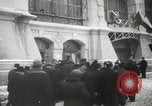
Life under Soviet domination in Eastern Europe following World War II
Legislators entering a hall in Czechoslovakia, in 1948. Inside,an image of the Small Coat of Arms of the Republic of Czechoslovakia (1920) dominates the scene. New scene shows Gustav Husak, acting Prime Minister, delivering an address urging support for the Communist Party. The next sequence shows violent Communist-led demonstrations, as armed trade unionists riot in the Prague streets, attacking the offices of the political opposition. Police attempt to restore order. On February 25, 1948, the communists achieve a Czechoslovak coup d'état. On February 27th, Czech President, Edvard Benes, receives a delegation including communist Premier Klement Gottwald and the 12 new members of the cabinet, at the Presidential Palace. He is seen signing documents accepting the communist cabinet. Change of scene shows Czech Foreign Minister, Jan Masaryk, giving a speech rejecting the change. (He remained in office, but died under suspicious circumstances on On March 10, 1948.) View of Masaryk in his casket. Mourners at his funeral.The Czech Parliament Building with flag at half staff. President Benes seen strolling, using a cane, accompanied by his wife, Hana Benes, in the garden of their summer home, Benesova vila, in Sezimovo Usti. Narrator notes that he refused to sign a new constitution drawn up by the communists. He died of natural causes at his villa on September 3, 1948. Scenes of his funeral and of him in his casket. Views of Benes' state funeral, with mourners lining the streets. View of British Prime Minister Winston Churchill. Narrator describes circumstances using Churchill's term "Iron Curtain." A communist parade in an Eastern European city. A person who was roughed up on the street. View of East German uprising in 1953, being suppressed with Soviet tanks. Uprising in Poland in 1955 being put down by local police and Russian soldiers. Polish musicians playing and examples of Polish political cartoons permitted under relaxed communist rule.
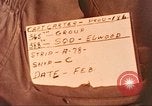
United States Army Air Force 365th Fighter Group strafe German held positions during World War II.
United States Army Air Force 365th Fighter Group over German held targets in February 1945. Aerial view of smoke rising from bombed buildings on the ground. View of green fields. A bomb damaged building.

German civilians and bombed city buildings after occupation by U.S. forces in World War 2
In the opening scene, many German civilians (mostly women) are seen queued up outside the corner entrance to a building in a German city, where they receive something from a man (who appears to be a clergyman). A dog is with someone at the corner. A private Opel Blitz bus, with belongings on the roof covered by a tarpaulin, passes in front of the camera. It is pulling a trailer, also covered with a tarpaulin. Scene shifts to closeup of a young blond boy standing in front of apartment houses. He smiles and poses. Debris covers the area between the sidewalk and the apartment building. As the boy moves, some structural damage to the building in the background is seen. Two United States soldiers in a Jeep pass behind the boy. Next, a woman walks on a sidewalk. Behind her are destroyed buildings. Another view of destroyed buildings in the city. More views of several people walking in a street lined on its sides by rubble from bombed out buildings. Views from rear of a vehicle moving along street of a destroyed business district. More views of wartime destruction. People (mostly women) gathered in a backyard, read announcements posted on a large bulletin board.
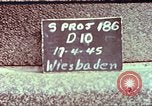
Views of Wiesbaden and Mainz, Germany, at end of World War II in Europe. German soldiers being relocated.
Opening slate reads April 17, 1945, Wiesbaden, Germany. A brick building in Wiesbaden with large arrow pointing downstairs, labeled "LSR", meaning Luftschutzraum (Air-raid room). Signpost in front of a building with damaged roof reads, "Radfahr-weg" (bicycle path). Below it an American army sign reads "WP-Water Point." U.S. soldier directs military vehicles, carrying surrendered German soldiers, as they cross the Rhein (Rhine) river, from Wiesbaden to Mainz on a pontoon bridge. The dome of Christuskirche (Christ Church) across the river, dominates the skyline
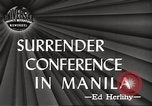
Japanese delegation meets with members of General MacArthur's staff to plan formal Japanese Surrender ending World War II
Japanese officials arrive to coordinate arrangements for a formal Japanese surrender, at a Conference in Manila, Philippine Islands. Headed by Lt. Gen. Torashiro Kawabe, Vice-Chief of the Army General Staff, the sixteen-member Japanese delegation descends steps from U.S. Army Air Forces C-54 transport Aircraft, tail number 44-9045, at Nichols Field, near Manila. General Kawabe salutes American Colonel Mashbir, coordinator of the Allied translator and interrogator Section. Major General Charles Willoughby, Director of Intelligence, leads them to waiting cars. Meeting in the City Hall in Manila, the Japanese officers surrender their personal swords and present documents delegating them powers Plenipotentiary by the Japanese Government. They file into a conference room, where they and American counterparts take their places across a long, black table. U.S. Army Lieutenant General Richard Kerens Sutherland, General MacArthur's Chief of Staff, presides over the discussions, accompanied by Major General S. J. Chamberlin, General MacArthur's Operations Officer. They are supported by Allied translators and interpreters. The conference is concluded successfully and sets the stage for the final formal surrender of Japan. (Note: Plans for this critical conference were developed by Colonel David Larr, Chief of Planning on General Chamberlin's staff.) The clip concludes with views of many U.S. warships and of cargoes being loaded in readiness for the occupation of Japan.
CRITICALPAST.COM: About Us | Contact Us | FAQs - How to Order | License Agreement | My Account | My Lightboxes | Shopping Cart | Advanced Search | Featured Collections | Website Terms & Conditions | Privacy Policy ©2026 CriticalPast LLC.
License Agreement |
Terms & Conditions |
Privacy Policy
©2026 CriticalPast LLC.