


 Francais
 Deutsch
 Italiano
Refine Your Search
Greek-Civil-War stock footage and images
- Showing 1375 to 1380 of 27579 results more
more Hide
Hide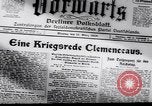
View from Berlin Germany, of events leading up to, and subsequent to, the Armistice in World War I.
Succession of Berlin, Germany, newspapers shown, from 1918 through 1919, chronicling progress of war towards the World War 1 Armistice, and subsequent problems and conditions in postwar Germany. Newspaper of November 12, 1918 addresses concerns about the conditions and the price of the truce. Crowd stands on a road covered with snow around statue of the Kaiser, with scaffold around it. Crowd in a square in War Bond rally. One of crowd carries a Communist red flag. Newspaper refers to gunfire in Berlin from Unter den Linden to Friedrichstrasse. Newspaper announces the Kaiser's abdication, which is then illustrated by reversed footage showing the Kaiser walking backwards and being lifted into his automobile, which then drives away backwards. Returning German soldiers are happy to see the war end, and sing in their returning trucks. An officer inspects war trenches that are now empty. Newspaper announce increasing domestic problems . Newspapers raise issue of German prisoners of War held in foreign countries. Troops are seen moving in streets and at checkpoints in Germany.
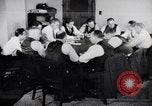
Film summarizing efforts by City of Dayton, Ohio to overcome labor shortage and meet defense production goals in World War II
The City of Dayton, Ohio's local war manpower and emergency committee members are seen gathered around a table to discuss what other than just more workers is needed to meet the war production goals set for the city during World War 2. An animated diagram superimposed on a drawing of a factory, charts the labor needs vs. labor supply. For the management side, the chart cites matters that need to be addressed, including: personnel management; plant layout; reduction in turnover, and absenteeism; and better working conditions, Regarding labor itself, the chart cites the following as needed: additional women; transfers from non-essential jobs; minority groups; part-time workers; and handicapped workers. Next, the emergency committee of community leaders is seen around a table. They are being addressed by Stanley C. Allyn, President of the National Cash Register Company, who notes that Dayton has partially solved its manpower shortage and expects to meet its war production goals.Camera pans over attendees, including labor leaders from AF of L and CIO; Government officials present, including Area Director and Deputy Regional Director of the War Manpower Commission, and Chief of Program Requirements for the Region; leading industrialists and retailers are shown. Local officials seen include the Mayor of Dayton and Secretary of the Chamber of Commerce as well as the Commanding Army Air Forces Generals of Wright Field and Patterson field. Mr. Allyn discusses further work to be done with as much emphasis on human relations as on the mechanics of production. An animated map shows Dayton and other areas of labor shortage, all over the United States. Workers in a factory are seen moving propeller blades across the floor by twirling them on end. Propellers assembled on their hubs are moved across the factory floor on wheeled stands. Artillery shells are seen protruding from containers. Browning aircraft machine guns moving along a conveyor belt. M3 Lee tanks being completed and moving across a factory floor. Glimpse of bombers in production. Army trucks lined up in formation at a factory yard. Closeups of General Dwight D. Eisenhower. (Narrator notes importance Eisenhower places on full support from the home front as essential to the war effort.)
Training film for U.S. troops with the Army of occupation in Germany after world War II
Opens with bell tolling Victory against Germany in World War II. Next, a slate reads: "Victory Leads to Peace," and a farmer is seen with cattle pulling a plow. But narrator says "the problem now is future peace," and a map of Germany is shown overlaid with "Your Job in Germany." A cartoon of a soldier is superimposed on the map, along with one of a World War 1 American soldier and a figure of possible future soldier with similar mission. Camera focuses on parts of German aircraft in a jumbled heap. Closeups of weary defeated German soldiers at end ot World War II. Glimpse of Adolf Hitler speaking and haranguing an audience from a podium in an animated and forceful way. Swastika flags displayed from houses in a quaint German town. Joseph Goebbels, Nazi Reich Minister of Propaganda, at a microphone. Glimpse of a German concentration camp. But as they appear, each of the Nazi elements promptly disappears, showing the scenes without such Nazi symbols and persons. Skeleton remains of bombed buildings. Flower displays. Bucolic German rural countryside and quaint old villages in peaceful settings. Camera focuses on a book titled "German History." Chapter I, titled "Blood and Iron," shows Image of Otto von Bismarck. German troops march in a parade. Narrator states that "under Bismarck, the German empire was built." (He formed the German Empire in 1871, unifying Germany with himself as Imperial Chancellor, while retaining control of Prussia at the same time.) The film shows mounted German lancers as it alludes to Bismarck's campaigns against Denmark in 1867; Austria in 1866; and France, in 1870. Germany's leaders celebrating its status, in 1871, as the mightiest power in Europe. Troops marching and girls dancing nearby. Farmers plowing field with a horse and cow. Classic peaceful rural alpine scenes with local people in agricultural pursuits. A group of local German musicians playing folk music as village people dance outdoors. Back to the book, Kaiser Wilhelm II is shown on Chapter 2, entitled: "Deutschland über Alles." Gathering of German soldiers in Pickelhaube (spiked helmets). A German Big Bertha howitzer firing. German troops marching against Serbia; Russia; and France (with view of war damaged French cathedral). German invasion of Belgium in 1940 (with view of clock tower resting in rubble). German troops seen in Italy, walking past battle-damaged buildings. German Zeppelin dropping bombs on British targets and view of bombed out London neighborhood. Next scene shows a capsized ship with survivors running across its hull. Film slate labels the scene as United States, as if it is a U.S. ship attacked by Germany. (Actually, it is the Austro-Hungarian Battleship, SMS Szent Istvan, torpedoed, by Italian torpedo boats, during World War I.) Next, American soldiers in trench are seen going "over the top" and into "no man's land" on the western front of World War 1. Glimpse through a window of Kaiser Wilhelm II, after defeat of Germany, in 1918. View of Germans in a Beer Garden. Picturesque view of German town. A German orchestra performing. American soldiers marching out of Germany, with flags waving. Back to the history book,as chapter III is revealed, entitled "Today Germany, tomorrow, the world," and featuring Adolf Hitler. German troops invading Austria (where a civilian lies dead on the ground). German troops entering Czechoslovakia (where local people in tears render the Nazi salute). They march into Poland (where a girl weeps over someone, not seen, on the ground). They march into France (where a wounded, bandaged child cries in a bed). Next, is a scene from England, where a British child victim of bombing lies dead in the remains of a shelter. German troops invading Norway, Holland, Denmark, Belgium, Luxembourg and Russia (where a woman tries to rouse a dead woman). They invade Yugoslavia (where women sit near coffins of children) and Greece (where a woman rescues a naked child). A U.S. merchant ship explodes after being torpedoed by a German submarine (unseen). Scenes of destruction with people plucking dead victims from rubble of buildings. American troops invading Normandy, France on D-day, June 6, 1944. Several American soldiers fall to German gunfire on the beach. Wounded American soldiers being transported in jeeps on the battlefield and being placed on landing craft for evacuation. Americans walking past huge piles of destroyed aircraft parts. A landing craft filled with wounded American soldiers. American wounded and dead on a battlefield. Sailors abandoning a burning American ship by jumping into the sea. A sailor picked up in a life boat. A wounded American soldier being dragged from the beachhead at Normandy. Various wounds being treated by U.S. Medical Corps personnel. More scenes of American wounded being moved on stretchers. Scene shifts abruptly to German people folk dancing. Film concludes with question marks about the future.
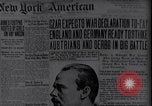
Headlines of prominent newspapers show rising tensions in Europe, assassination of Archduke and Russia's entry in World War I
Headlines of prominent newspapers show rising tensions prior to World War 1. Headline of New York American 'Czar expects war declaration today, England and Germany ready to strike, Austrians and Serbs in big battle'. Montage of headlines from various newspapers regarding looming war. Berliner Tageblatt New York Times headlines say 'Austria and Serbia ready for war, Russia gives warning to Germany, London still sees hope for peace'. New York Times and Freier Press headlines about the assassination of Archduke Ferdinand of Austria. Serbian police dragging the assassin. Blood stained tunic of Archduke. Burial ceremony of Archduke Ferdinand with coffin covered with Austrian flag. Czar Nicholas II of Russia reviews troops. Various Cossack regiments being reviewed. Russian Revolution scenes and mass demonstrations and riot in streets of Moscow as Bolsheviks seize power in 1917. Russian civilians and Bolshevik loyal soldiers armed with rifles marching in mass funeral processions and demonstrations in Russia against the Czar led government. Leon Trotsky speaking to a crowd and saluting Red forces as Bolshevik troops parade. Food distribution to Russian children and people eating on snow covered streets of Moscow around time of revolution. Headlines showing Russian entry in World War I. Snow covered Kremlin. Vladimir Lenin at a desk talking. More views of newspaper headlines regarding outbreak of World War 1.
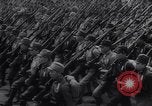
Orientation film for U.S. Occupational Forces in Japan. Militaristic Japan in past wars. Converting Japan into Peaceful Nation
Segment of orientation film for American troops occupying Japan after World War 2. First scene shows Japanese troops marching shouldering rifles with fixed bayonets. Viewed from more distance they are seen marching past the Japanese Imperial Palace on a hill in the background. Slate is superimposed over the scene reading: "Created to Rule the Whole Earth." Japanese soldiers rising from trenches to charge their enemy. Shells bursting all around them. Views of some huge explosions. Dead Chinese woman and child lying in rubble. Japanese soldier holding Rising Sun flag, charging past building. More dead women and children. Japanese troops advancing against wooden houses. Dead soldier lying on ground, with pistol held in his upraised hand. Japanese troops advancing past burning rural dwellings. Dead Chinese civilians in wreckage. Japanese troops holding Japanese flags celebrate a battlefield victory. Views of wounded Allied soldiers being transported on litters by American soldiers, interwoven with views of Japanese troops celebrating. Japanese civilians celebrating en masse. View of a human brain superimposed over scenes of celebrating Japanese soldiers and people. A slate superimposed at this point reading: "This is Japan's Last War." Views of Japanese workers busy in war production plants and factories, with Japanese war production workers building armament, war planes, and tanks; Japanese military officers walking in full dress uniforms ; Japanese warships; and Mitsubishi Ki-21 bombers in formation ("Type 97 Heavy Bombers") . All these views of war machinery are symbolically ended by intervening views of explosions. View of crashed Japanese warplane. Several American soldiers are seen among many Japanese people. Several American soldiers check identification of a Japanese man. U.S. soldiers standing guard in a roadway, as many Japanese stand in background. American soldier searching an unarmed Japanese soldier. Two American soldiers use a phrase book as they ask directions from a Japanese woman and her daughter. Japanese youth clapping hands and holding a homemade American flag. U.S. military officers accepting Chrysanthemum flowers from girls in traditional Japanese attire. A U.S. soldier reads a comic book to a Japanese boy. Other American GIs talk with a Japanese soldier. American troops in a chow line at a dining hall. U.S. soldiers with Japanese children at the Great Buddha of Kamakura at the Kotoku-in Temple in Kamakura, Kanagawa Prefecture, Japan. American soldier riding a bucking bronco in a Western Rodeo put on by U.S. forces. U.S. soldier and Japanese police sentries standing side by side.
Improvement of miners, condition of mines and factories and civilians of war affected countries of Europe, by Marshall Plan.
Film titled 'Me and Mr. Marshall' depicts developments of coal mines in Germany and aid to other European nations affected by World War II. German coal miners dig deep in a coal mine soon after the end of World War 2. Volunteers awarded at a ceremony. Volunteers board a train and proceed for work at coal mines. Volunteers eat food, give their shoe size, under go training on mine machinery. Miners on lift move underground. Miners at end of the day walk out tired and blackened by coal dust, from a mine. Miners take hot showers after work and get clean clothing hung high on ropes. Salary given to workers for a day's work. Headlines of German newspapers about Marshall Plan. General George C. Marshall speaks his plans at a meeting in Washington DC, America. Aerial views of ruined buildings and factories, wrecked harbor, refugees in tenements in Europe after World War II. Buildings, monuments and bridges in London and Eiffel Tower and other buildings and civilians on roads in Paris, and view of Kremlin in Moscow, Soviet Union. Map shows countries under Marshall recovery plan. View of meeting in progress of Conference for European Economic Cooperation in July 1947, in the Grand Dining Room of the French Foreign Office. Meetings of leaders of nations adopting Marshall plan. Ruins of industries of Germany. Ruins on the ground after war in London, with Big Ben in the far distance. Workers at a factory. Miners take a horse inside a coal mine. Empty coal cars at a German coal mine. Men push coal cars full with mined coal out from mine, on rails. Views of buyers in suits at a German trade show and conference, promoting German products and industries to potential buyers in other countries, a few years after the end of World War 2. U.S. Congress and President Harry Truman in Washington DC approve the Marshall Plan and provide monetary aid to other European countries. Scenes in Germany as it recovers economically after the war: Workers in a factory. Harbor, fruit and vegetable market; customers in a bakery; coal cars and machinery at a coal mine under normal operation under the plan.
CRITICALPAST.COM: About Us | Contact Us | FAQs - How to Order | License Agreement | My Account | My Lightboxes | Shopping Cart | Advanced Search | Featured Collections | Website Terms & Conditions | Privacy Policy ©2026 CriticalPast LLC.
License Agreement |
Terms & Conditions |
Privacy Policy
©2026 CriticalPast LLC.