


 Francais
 Deutsch
 Italiano

Refine Your Search
Greek-Civil-War stock footage and images
- Showing 13969 to 13974 of 27563 results more
 Hide
Detroit factory workers visit Camp Atterbury in WW2, and Army officials tour arms plants in Detroit.
Group of United Auto Workers visits Camp Atterbury during World War 2 to get a first hand perspective on what life is like for the soldiers who are receiving the military vehicles and weaponry they build as factory workers in Detroit. The auto workers exit a train car at the camp and run through steps similar to new recruits, including a basic medical check and receiving uniforms from a quartermaster. The auto workers try some of the same training drills as regular soldiers, including an obstacle course, bayonet drills, and crossing a ravine over water on a rope bridge while mock bombing takes place near them. The men clean dishes in a mess hall kitchen and make beds in a barracks. Scene changes to a Detroit factory where officers and soldiers from the Camp tour with the auto workers. They view B-24 liberator aircraft being built, tanks being built as treads are assembled onto vehicles, other vehicles being built. War production workers building and assembling war materiel. Welding and assembly line operations seen. Wide view of factory floor with many newly assembled military tanks and vehicles completed. Newly completed tanks are demonstrated on an open field as officials observe. A war production worker speaks and encourages fellow workers to work hard to support the soldiers.
Planning and execution of the Allied invasion of Normandy, France (WW2)
View of a port in England, filled with Allied ships and boats to carry war materiel for Allied forces preparing to invade Europe during World War II. A barrage balloon aloft overhead. Yards full of military rolling stock. Scene shifts to wide street view in London including Whitehall Government buildings around the Cenotaph War Memorial (Whitehall, London SW1A 2ET, United Kingdom) in London, England. Inside the British military headquarters the Allied High Command is gathered to plan the invasion of Europe. Supreme Allied Commander, General Dwight D. Eisenhower is pointing at a wall map, as senior Allied commanders, including British Marshal Bernard Montgomery, look on. Republic P-47 Thunderbolt fighter aircraft in D-Day paint stripes take off from an air base. Officers watch takeoffs from control tower porch. Views from Allied aircraft gun cameras show strafing from low altitudes destroying German ground targets, including railroads and airfields. A formation of Martin B-26 Marauder aircraft in flight overhead. Lines of communication such as road junctions being destroyed by bombing. Glimpse of copilot at controls in a bomber. Scene shifts to June 6, 1944 and the D-Day Allied invasion fleet underway across the English Channel. Allied warships bombarding the shores of Normandy, France. Landing Craft Tank (Rocket) firing salvos of rockets. Animated map shows the invasion forces striking the defenses of the German Atlantic Wall. View of British and American soldiers wading ashore from landing craft, and some falling to German gunfire at the shoreline beaches of Normandy. View of German defenders firing from inside a German fortifications. German soldiers firing machine guns from protected places overlooking the beaches of Normandy. Trapped American soldiers firing upwards toward the German positions in cliffs overlooking the beach. Later views of Allied troops in combat further inland. Animated map shows area of allied penetration after 19 days of bitter fighting. Allied Armor, trucks, and supplies moving inland from the beachhead. Barrage balloon above the improvised ports. Allied troops heading toward the port of Cherbourg and guns firing in that battle. American M8 Greyhound armored personnel carriers proceeding into the town of Cherbourg, Normandy, France. closeup of American soldiers firing small arms. Soldiers firing a howitzer point blank. The last of the German garrison troops surrender under a flag of truce, on June 27, 1944. Large group of German prisoners of war with hands clasped over their heads, being escorted under Allied guard from Cherbourg. Docks and facilities needing repair to make the port serviceable. U.S. Army engineers welding port facilities. Closeup of a locomotive operated by French railroad men, moving in the restored port.
General John J. Pershing and Marshal Joseph Joffre confer in France
The United States enter World War I. General John J. Pershing, Chief of American Expeditionary Forces confers with Marshal Joseph Joffre, Commander in Chief of the French Army during World War I. (World War I; World War 1; WWI; WW1)
Soldiers march and distribute political papers during postwar unrest in Berlin, Germany.
German post-war revolution in Berlin. German soldiers lined up at attention with eyes right. One of them carries the German War Ensign. They are given the command to be at ease, and they all relax. Honor guard of German soldiers at attention with the German War Ensign. They execute eyes right and eyes left maneuvers and then march out, four abreast. Soldiers parade in a street, under the German War Ensign flag, accompanied by officers on horseback. Civilian spectators walk along beside them.The parading soldiers pass through a narrow street where spectators hem them in from the sides. High ranking officers are driven in a car. Soldiers loaded onto a truck hand out political papers to civilians.
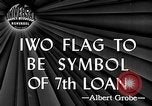
Famed Iwo Jima flag raisers raise flag above Capitol, and Henry Morgenthau, Secretary of Treasury speaks in Washington DC (WW2)
The Iwo Jima flag 7th War Loan drive in Washington DC during World War II. The 7th War Loan drive is underway. Famed Iwo Jima flag raising survivors and heroes, Rene Gagnon, John Bradley, and Ira Hayes stand together outside the U.S. Capitol. Guards stand at attention. Gagnon, Bradley and Hayes raise a flag of the Unites States above the U.S. Capitol to kick off the load drive. The military personnel salute the flag. The Secretary of the Treasury of the United States, Henry Morgenthau, Jr., speaks telling American people of the urgency of buying war bonds.
World hunger problem is discussed in a conference and ration lines for food all over the world.
Post-war starvation, food shortages and hunger problems in the world soon after the end of World War II: Interior of a conference room. U.S. President Harry S. Truman in discussion with U.S. ex- President Herbert Hoover. Seated to their left are ex-Vice President Henry A. Wallace and former Governor of New York, Herbert H Lehman. Emaciated and starving men, women and children seen in villages and cities. The people are probably in India. Food ration lines and queues of British people in England and German citizens in Germany due to post war shortages of food and supplies after end of World War 2. Farm equipment are used in farms harvesting grain. Ships in a harbor with grain being poured into a ship's hold.
CRITICALPAST.COM: About Us | Contact Us | FAQs - How to Order | License Agreement | My Account | My Lightboxes | Shopping Cart | Advanced Search | Featured Collections | Website Terms & Conditions | Privacy Policy ©2026 CriticalPast LLC.
License Agreement |
Terms & Conditions |
Privacy Policy
©2026 CriticalPast LLC.