


 Francais
 Deutsch
 Italiano

Refine Your Search
Greek-Civil-War stock footage and images
- Showing 14155 to 14160 of 27563 results more
 Hide

Gulf of Tonkin response: President Johnson announces U.S. action as United States soldiers and aircraft are rushed to Vietnam
United States planes and soldiers are rushed to Vietnam, responding to the Gulf of Tonkin crisis. U.S. Destroyer Maddox seen underway in the gulf of North Vietnam following reported skirmish with North Vietnamese torpedo boats (the "Maddox Incident.") Narrator indicates U.S. war planes from two carriers avenged the unwarranted Red communist assault with 64 sorties against North Vietnam. An airman boards a U.S. aircraft. Night view of the White House in Washington DC. President Lyndon Johnson addresses the American people in a midnight speech on August 4, 1964 describing U.S. actions in response to the Gulf of Tonkin incident. Scenes of South Vietnamese women and children evacuees looking exhausted and scared beside nearby American helicopters. The President's speech continues, including, "We Americans know, although others appear to forget, the risks of spreading conflict. We still seek no wider war." View of the United Nations building in New York and flags of various nations at the UN building. Ambassador Adlai Stevenson is seen making his report of the Gulf of Tonkin attacks to the UN Security Council and affirms U.S. position that it wants the people in Vietnam to be free of North Vietnamese intervention and agression. United States military advisors and U.S. Army soldiers board helicopters. A gunner aims at a target on the ground. Vietnamese troops accompany U.S. soldiers. South Vietnamese forces exit a helicopter and wade through water and rice paddies. U.S. soldiers advance in trucks with artillery. A Douglas TBD Devastator aircraft takes off armed with a torpedo. Another one lands at an airfield. A TBD plane, armed with a torpedo, taxis with wings folded. several TBD aircraft parked on a flight line. The President concludes his remarks referring to "firmness in the right" being indispensible for peace. (Vietnam War period).

United States Army troops undergo a training in defense against chemical warfare in the United States.
A United States Army training film about defense against chemical warfare during World War I. An organization within the field army for defense against chemical warfare. The hierarchy of officers within the organization. One of the soldiers shows chemical burn marks on his body and arm. An instructor takes a class in the open. (World War I; World War 1; WWI; WW1)
Soldiers affected by a poisonous gas are brought to Evacuation Hospital and advanced field hospital at Vesle Front, France.
A United States Army training film about defense against chemical warfare. U.S. soldiers affected by a poisonous gas in World War I are brought to Evacuation Hospital number 2 after an attack in 1918. United States troops put wounded soldiers on army trucks. Wounded soldiers at the advanced field hospital of the Fourth Division at Vesle Front, France in August 1918. (World War 1. World War I. WWI.)
United States soldiers create a smokescreen using Stokes Mortars during a training operation in the United States
A United States Army training film about chemical warfare service. United States soldiers in World War 1 fire Stokes Mortars after assembling them. Soldiers in arms-length line pass readied mortars forward and fire them in rapid succession. Explosions in the distance with smoke spreading and overcoming the area in smokescreen. (World War I; World War 1; WWI; WW1)
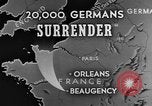
German General Erich Elster surrenders 20,000 troops and equipment to General RC Macon at Beaugency, France (WW2)
20,000 German soldiers surrender to Allied forces in France during World War II. German General Erich Elster surrenders himself and 20,000 troops to Major General Robert C Macon of the U.S. Ninth Army and to Major General OP Weyland, Commanding General of the XIX Tactical Air Command, on September 16. The formal surrender took place at the Beaugency Bridge on the Loire River. Long columns of Germans file into the city and lay down their arms. Numbers of items like trucks, civilian carts, horses, weapons and bicycle surrendered. View of surrendered rifles, pistols, machine guns, tucks and bicycles. 19360 Prisoners of War come down. View of Prisoners of War Camp and surrendered equipment.
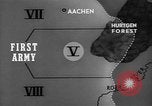
U.S. Army troops and engineers building roads, placing guns, transporting German POWs in Germany near Hurtgen Forest region.
Activities of American First Army from Aachen to Roer River in Germany. Animated map shows First Army entering into Hurtgen Forest and arrive Cologne plain going through the Roer River. 28th Division controls key roadways of Vossenack and Schmidt. Engineers build roads through the Hurtgen Forest. Large tree trunks are laid into place as foundation and then milled wooden planks are nailed atop to quickly create a usable road surface. Jeep passes over the newly built road. U.S. Army forces start a fire for protection against the cold. 28th Division troops with mortar and machine gun support advance (November, 1944) through a wooded area. Infantry columns move to the front. Smoke clouds rise. Ground forces move out from wooded area. German POW's file into an assembly area and are evacuated by truck. U.S. Army soldier hangs a sign around the neck of a Germany prisoner of war that says "200,000th prisoner of war captured by troops of U.S. First Army." Artillery and antitank guns are placed for defense. Soldiers work on telephone tower. Underground emplacements are built as snow falls. (World War II period).
CRITICALPAST.COM: About Us | Contact Us | FAQs - How to Order | License Agreement | My Account | My Lightboxes | Shopping Cart | Advanced Search | Featured Collections | Website Terms & Conditions | Privacy Policy ©2026 CriticalPast LLC.
License Agreement |
Terms & Conditions |
Privacy Policy
©2026 CriticalPast LLC.